
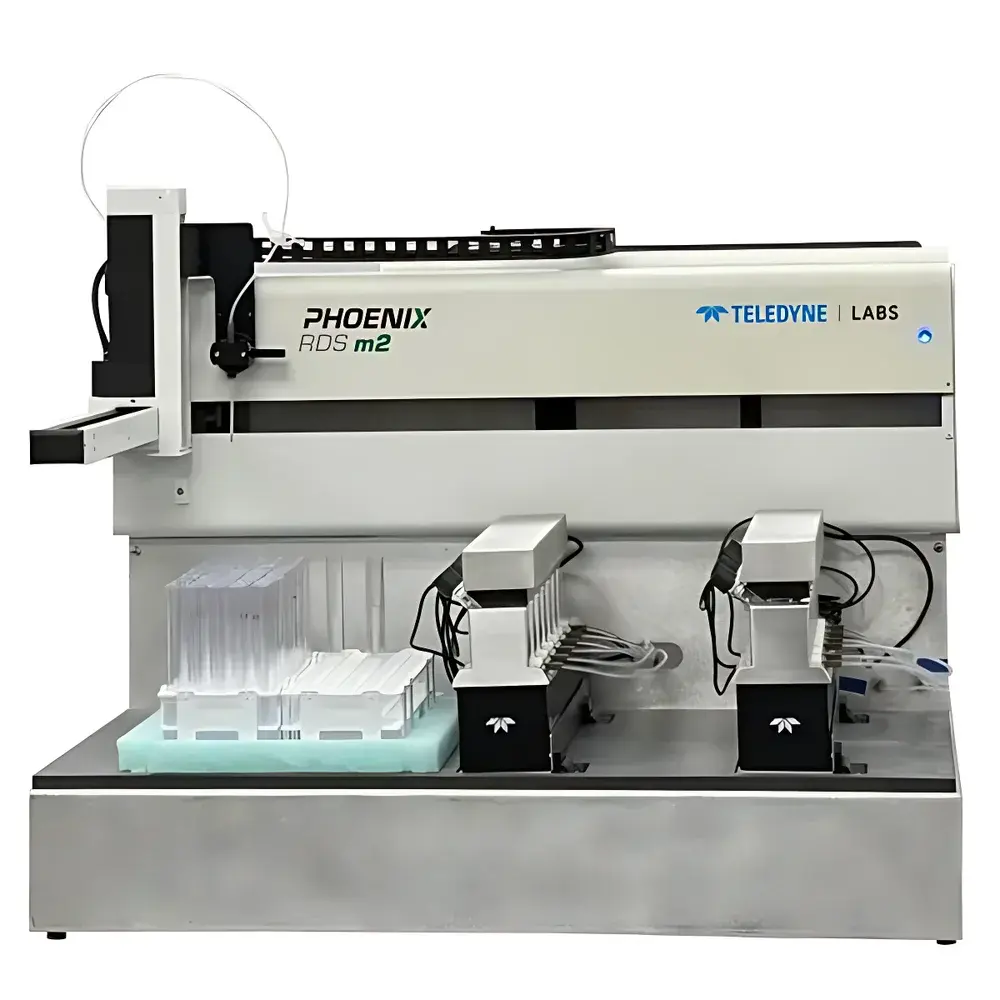
Phoenix RDS m2 Transdermal Diffusion Station
| Brand | Hanson |
|---|---|
| Origin | USA |
| Manufacturer Type | Authorized Distributor |
| Origin Category | Imported Instrument |
| Model | PHOENIX RDS m2 |
| Pricing | Upon Request |
Overview
The Phoenix RDS m2 Transdermal Diffusion Station is a fully automated, US-manufactured in vitro permeation testing (IVPT) system engineered for regulatory-compliant transdermal and topical drug product development. Based on the Franz diffusion cell principle—employing static or flow-through donor/receptor chamber configurations—the RDS m2 delivers high reproducibility in measuring compound flux across biological membranes (e.g., human epidermis, dermatomed skin, synthetic membranes) under physiologically relevant conditions. Its architecture supports both static sampling and continuous receptor medium replacement protocols, enabling precise kinetic profiling of permeation rates over extended durations (up to 72+ hours). Designed to meet the methodological rigor required by ICH Q5A(R2), USP , and FDA guidance for topical bioequivalence, the system integrates hardware-level temperature control, mechanical agitation precision, and software traceability into a single validated platform.
Key Features
- Independent, programmable magnetic stirring for each diffusion cell (0–600 rpm), ensuring uniform hydrodynamic conditions without vortex formation or membrane shear stress
- Full-volume or partial-volume receptor medium exchange capability—enabling both discrete time-point sampling and dynamic sink condition maintenance
- Integrated membrane surface temperature probe (±0.1 °C accuracy) with real-time logging, critical for correlating formulation application timing with thermal equilibration
- Bubble-free fluid path design with degassed reservoirs and precision peristaltic pumps, eliminating air entrapment that compromises diffusion boundary layer integrity
- Low-profile, adjustable diffusion cell holder with micro-adjustable clamping force—minimizing epidermal stretching or delamination during mounting and long-term incubation
- Optional receptor medium temperature monitoring (±0.2 °C) with independent PID-controlled heating/cooling jacket
- Automated membrane integrity verification via electrical resistance (TEER) logging pre- and post-study, supporting qualification of barrier function consistency
Sample Compatibility & Compliance
The RDS m2 accommodates standard 12-mm, 15-mm, and 25-mm Franz-type diffusion cells, as well as custom geometries compatible with ISO 10993-10 and OECD 439 guidelines. It supports native human skin, porcine ear/skin, reconstituted human epidermis (RhE), and synthetic silicone or cellulose acetate membranes. All hardware components contacting receptor medium are constructed from USP Class VI-certified materials (e.g., borosilicate glass, PTFE, 316L stainless steel), ensuring extractables/leachables compliance. The system is pre-validated for adherence to 21 CFR Part 11 requirements—including electronic signatures, audit trail generation (user actions, parameter changes, data exports), role-based access control, and immutable raw data storage—and aligns with GLP/GMP documentation workflows mandated by EMA CHMP and FDA CDER review divisions.
Software & Data Management
The embedded RDS Control Suite v4.2 provides intuitive, wizard-driven protocol setup, real-time visualization of temperature, stir speed, and sampling events, and automated calculation of key pharmacokinetic parameters: cumulative amount permeated (Q, µg/cm²), steady-state flux (Jss, µg/cm²/h), lag time (tlag, h), and permeability coefficient (Kp, cm/h). Raw sensor data (temperature, stir RPM, volume dispensed) are timestamped at 100 ms resolution and stored in encrypted SQLite databases compliant with ALCOA+ principles. Export options include CSV, PDF analytical reports (with metadata headers), and direct integration with LIMS via HL7 or ASTM E1384-compliant APIs. Audit trails record all user logins, method modifications, calibration entries, and data deletions—retained for ≥25 years per internal retention policy.
Applications
- Comparative in vitro release testing (IVRT) and in vitro permeation testing (IVPT) for generic transdermal patches, gels, creams, and sprays
- Formulation optimization studies evaluating enhancer effects, vehicle viscosity impact, and pH-dependent permeation kinetics
- Stability-indicating IVPT assays assessing degradation product penetration profiles under accelerated aging conditions
- Regulatory submission support for ANDAs, NDAs, and MAA dossiers requiring USP or Ph. Eur. 2.9.17-compliant datasets
- Academic and contract research organization (CRO) use in mechanistic dermal absorption modeling and QSAR correlation development
FAQ
Is the RDS m2 validated for 21 CFR Part 11 compliance?
Yes—the system includes full electronic signature capability, configurable audit trail depth, automatic session timeouts, and immutable raw data archiving with cryptographic hashing.
Can the RDS m2 perform both static and flow-through IVPT protocols?
Yes—hardware supports dual modes: static sampling with manual or automated aliquot withdrawal, and continuous receptor medium perfusion using integrated peristaltic pump modules.
What membrane integrity assessment methods does it support?
Baseline and endpoint TEER (transepithelial electrical resistance) measurements are supported via optional impedance module; alternative validation includes Lucifer Yellow exclusion and HRP permeability assays.
Does the software support multi-user environments with permission tiers?
Yes—administrator, analyst, and reviewer roles are enforced with granular permissions for method editing, run execution, data export, and audit trail review.
Are calibration certificates provided with the instrument?
Each RDS m2 ships with NIST-traceable calibration certificates for temperature sensors, stir speed encoders, and volumetric dispensing pumps—valid for 12 months from commissioning.




