
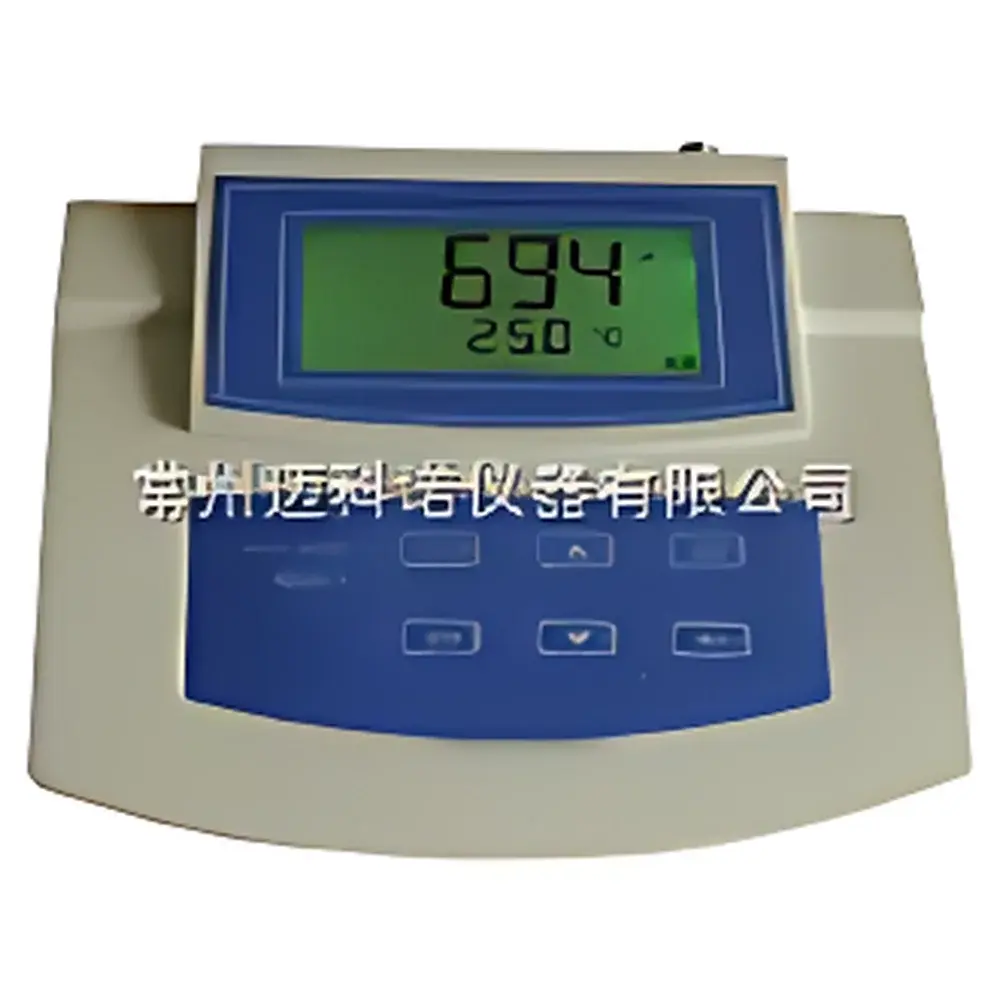
PHS-3C Benchtop pH Meter
| Origin | Jiangsu, China |
|---|---|
| Manufacturer Type | Authorized Distributor |
| Origin Category | Domestic (China) |
| Model | PHS-3C |
| Pricing | Available Upon Request |
| Accuracy Class | 0.01 |
| pH Range | 0.00–14.00 pH |
| mV Range | ±1400 mV |
| Resolution | 0.01 pH / 1 mV / 0.1 °C |
| Temperature Compensation | 0–60 °C |
| Basic Error (pH) | ±0.1 pH |
| Input Impedance | ≥3 × 10¹¹ Ω |
| Input Current | ≤1 × 10⁻¹¹ A |
| Repeatability (pH) | ≤0.05 pH |
| Stability | ±0.05 pH ±1 digit / 3 h |
| Dimensions (L×W×H) | 220 × 160 × 65 mm |
| Weight | 0.3 kg |
| Power Supply | DC 6 V |
| Operating Environment | 5–50 °C, RH ≤85%, No Strong Vibration or Magnetic Interference |
Overview
The PHS-3C Benchtop pH Meter is a precision electrochemical instrument engineered for reliable, high-reproducibility measurement of hydrogen ion activity in aqueous solutions. Based on the potentiometric principle—measuring the potential difference between a pH-sensitive glass electrode and a stable reference electrode—the PHS-3C delivers calibrated pH values traceable to NIST-standard buffer solutions. Its dual-display LCD with blue backlight simultaneously presents pH and temperature (°C) or millivolt (mV) readings, enabling real-time monitoring of both thermally compensated pH and raw electrode potential. Designed for routine laboratory use in academic, environmental, industrial, and quality control settings, the instrument complies with fundamental metrological requirements defined in ISO 7027-1:2023 (for pH measurement systems) and aligns with general performance expectations for Class 0.01 pH meters per IUPAC recommendations. It supports interchangeable electrode configurations—including combination pH electrodes, ORP (oxidation-reduction potential) electrodes, and select ion-selective electrodes (ISEs)—making it suitable for foundational electrochemical characterization beyond pH alone.
Key Features
- Dual-parameter digital display: Simultaneous readout of pH (0.00–14.00) and temperature (0.1 °C resolution) or mV (±1400 mV range, 1 mV resolution)
- Manual or automatic temperature compensation (0–60 °C), ensuring accurate pH calculation across common aqueous sample conditions
- High-input-impedance amplifier (≥3 × 10¹¹ Ω) minimizes loading effects and preserves signal integrity from high-impedance glass electrodes
- Low input current (≤1 × 10⁻¹¹ A) reduces polarization error and extends electrode service life
- Compact benchtop form factor (220 × 160 × 65 mm) with lightweight aluminum housing (0.3 kg) optimized for space-constrained labs
- DC 6 V power operation—compatible with standard battery packs or regulated DC adapters—eliminates AC line noise interference
- Stability specification of ±0.05 pH ±1 digit over 3 hours supports extended calibration verification intervals under GLP-compliant workflows
Sample Compatibility & Compliance
The PHS-3C is validated for use with standard aqueous electrolyte solutions, including buffer standards (e.g., pH 4.01, 7.00, 10.01 at 25 °C), process water, wastewater effluents, and mild chemical formulations. It is not intended for non-aqueous, highly viscous, or strongly oxidizing media without appropriate electrode selection and procedural validation. While the instrument itself does not carry CE, UKCA, or FDA 510(k) certification, its design adheres to baseline electrical safety and electromagnetic compatibility principles consistent with IEC 61010-1:2010 for laboratory equipment. Users performing regulated testing (e.g., EPA Method 9040C, ASTM D1293, or USP <791>) are responsible for establishing documented calibration procedures, electrode maintenance logs, and system suitability checks per their internal SOPs and applicable GxP requirements.
Software & Data Management
The PHS-3C operates as a standalone analog-digital hybrid instrument with no embedded microprocessor-based data logging or USB/Bluetooth connectivity. All measurements are displayed in real time and must be manually recorded or captured via external means (e.g., lab notebook, LIMS interface, or serial output with optional RS-232 adapter). For laboratories requiring audit-trail capability, integration into 21 CFR Part 11–compliant environments necessitates pairing the meter with validated third-party data acquisition software and electronic signature protocols. Calibration history, electrode performance metrics, and daily system checks should be maintained in accordance with ISO/IEC 17025:2017 clause 7.7 (Ensuring validity of results) and GLP Principle 5 (Record keeping).
Applications
- Academic teaching labs: Student experiments in general chemistry, analytical chemistry, and environmental science curricula
- Environmental monitoring: Field-deployable pH screening of surface water, groundwater, and treated effluent per EPA guidance
- Industrial QC: In-process verification of rinse water pH in electroplating, pharmaceutical cleaning validation, and food-grade sanitization cycles
- Research support: Preliminary characterization of reaction media, buffer preparation verification, and ORP monitoring in redox-controlled synthesis
- Calibration verification: Secondary standard checks using certified reference materials (CRMs) prior to high-precision titrations or sensor array deployment
FAQ
What electrode types are compatible with the PHS-3C?
The instrument accepts standard BNC-input pH electrodes, ORP electrodes, and monovalent ion-selective electrodes (e.g., Ag/AgCl, fluoride, nitrate) with matching reference junctions and impedance characteristics within the specified input range.
Does the PHS-3C support automatic calibration?
No—it requires manual two-point (or single-point) calibration using certified pH buffer solutions; auto-recognition of buffer values is not implemented.
Can temperature be measured independently of pH mode?
Yes—when configured in mV mode with a Pt100 or thermistor probe (via optional temperature input port), the unit displays ambient or sample temperature without pH calculation.
Is the PHS-3C suitable for ISO 17025-accredited testing?
It may be used within an accredited scope if supported by documented uncertainty budgets, regular metrological verification, and full traceability to national standards—but the instrument itself is not individually accredited.
What is the recommended recalibration frequency?
Per ISO 8655-7 and typical lab practice, recalibrate before each analytical batch, after electrode replacement, following prolonged storage, or when drift exceeds ±0.05 pH during system suitability checks.



