
PHYSIKE CryoM® Dry-Cryogenic Variable-Temperature Superconducting Magnet System
| Brand | PHYSIKE |
|---|---|
| Origin | Beijing, China |
| Manufacturer Type | Direct Manufacturer |
| Product Category | Domestic |
| Model | CryoM |
| Quotation | Upon Request |
| Temperature Range | 1.5 K – 400 K |
| Magnetic Field Range | 9 T / 12 T / 14 T / 16 T |
Overview
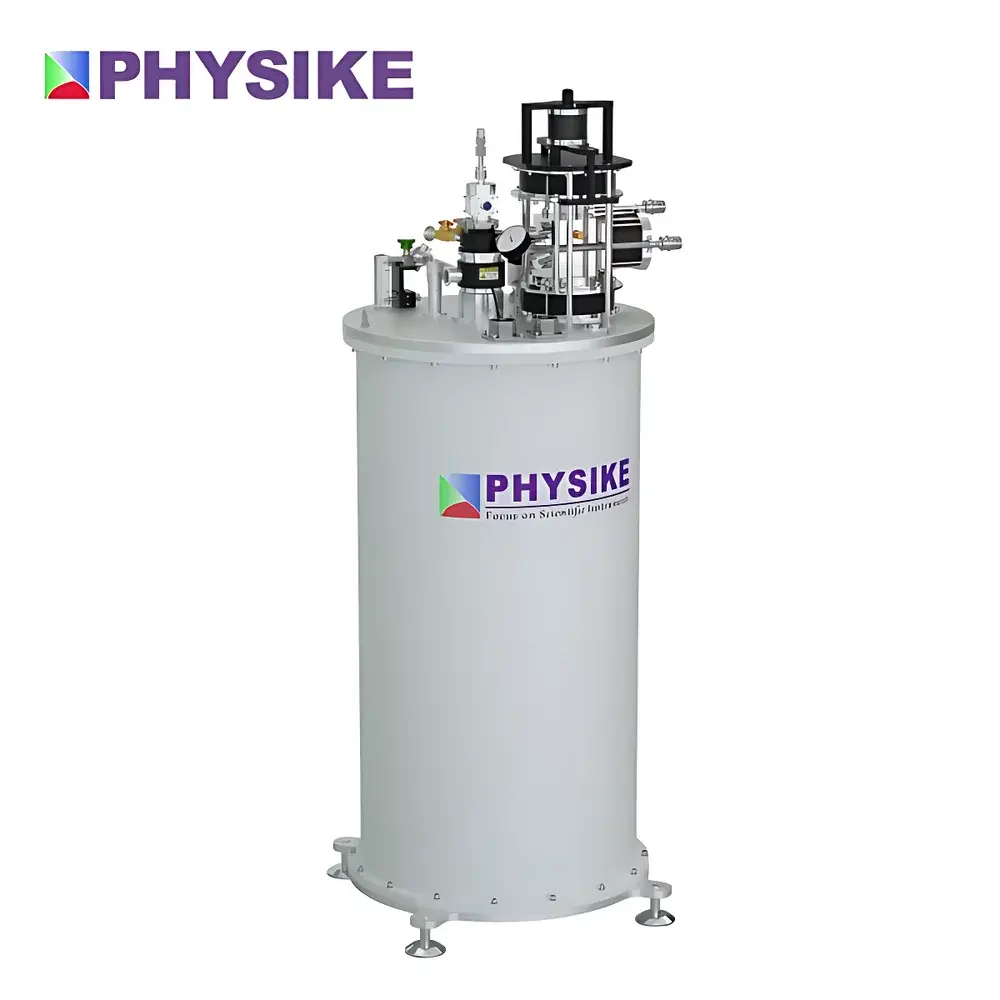
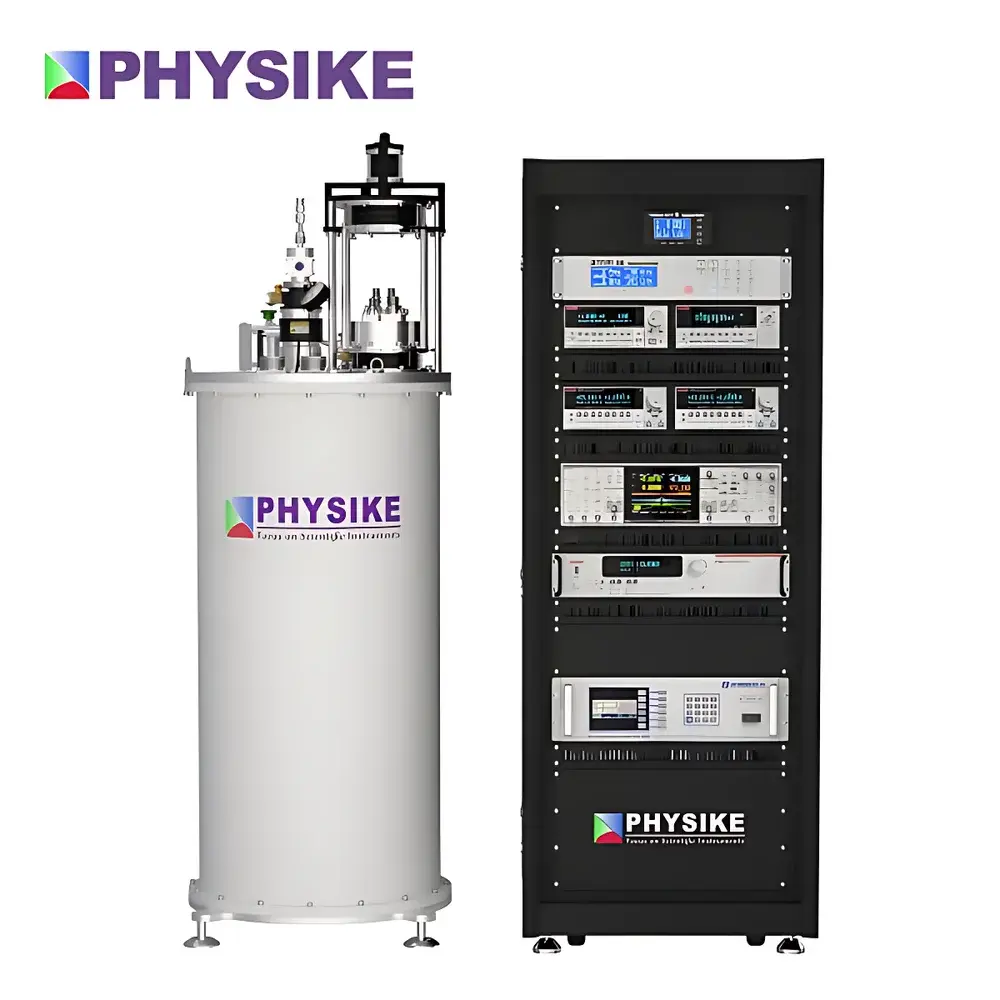
The PHYSIKE CryoM® Dry-Cryogenic Variable-Temperature Superconducting Magnet System is an integrated, helium-free platform engineered for high-precision physical property measurements under extreme cryogenic and high-magnetic-field conditions. Unlike traditional wet systems requiring continuous liquid helium refills, CryoM utilizes a single-stage 4 K pulse-tube or Gifford-McMahon (GM) cryocooler to simultaneously cool both the superconducting magnet and the variable-temperature insert (VTI), eliminating dependency on bulk cryogens while maintaining thermal stability and field homogeneity. The system operates on the principle of closed-cycle conduction cooling with static helium exchange gas environment, enabling stable temperature control from 1.5 K up to 400 K within a 50 mm warm bore. Its core architecture integrates a 9 T solenoid superconducting magnet (upgradable to 12 T, 14 T, or 16 T), a four-quadrant bipolar superconducting power supply, a four-channel high-accuracy temperature controller, and an eight-channel temperature monitor — all calibrated traceably to NIST-traceable standards across 1 K–325 K.
Key Features
- Dry operation: No liquid helium or liquid nitrogen required; continuous unattended operation > 6 months without external cryogen replenishment
- Ultra-low vibration design: Patented cold-head suspension and self-regulating pressure-balanced helium gas circuit reduce mechanical noise to < 100 nm RMS, critical for magneto-optical experiments (e.g., MOKE, Faraday rotation)
- Thermal performance: Base temperature ≤1.5 K (standard), optionally ≤1.3 K with He-3 insert; temperature stability ±10 mK over 24 h at fixed setpoint
- Modular VTI architecture: Standard sample rod includes 16-pin puck mount, multi-pin vacuum feedthroughs, low-magnetic-resistance calibrated Cernox™ sensors (1 K–325 K), and twisted-pair cryogenic wiring
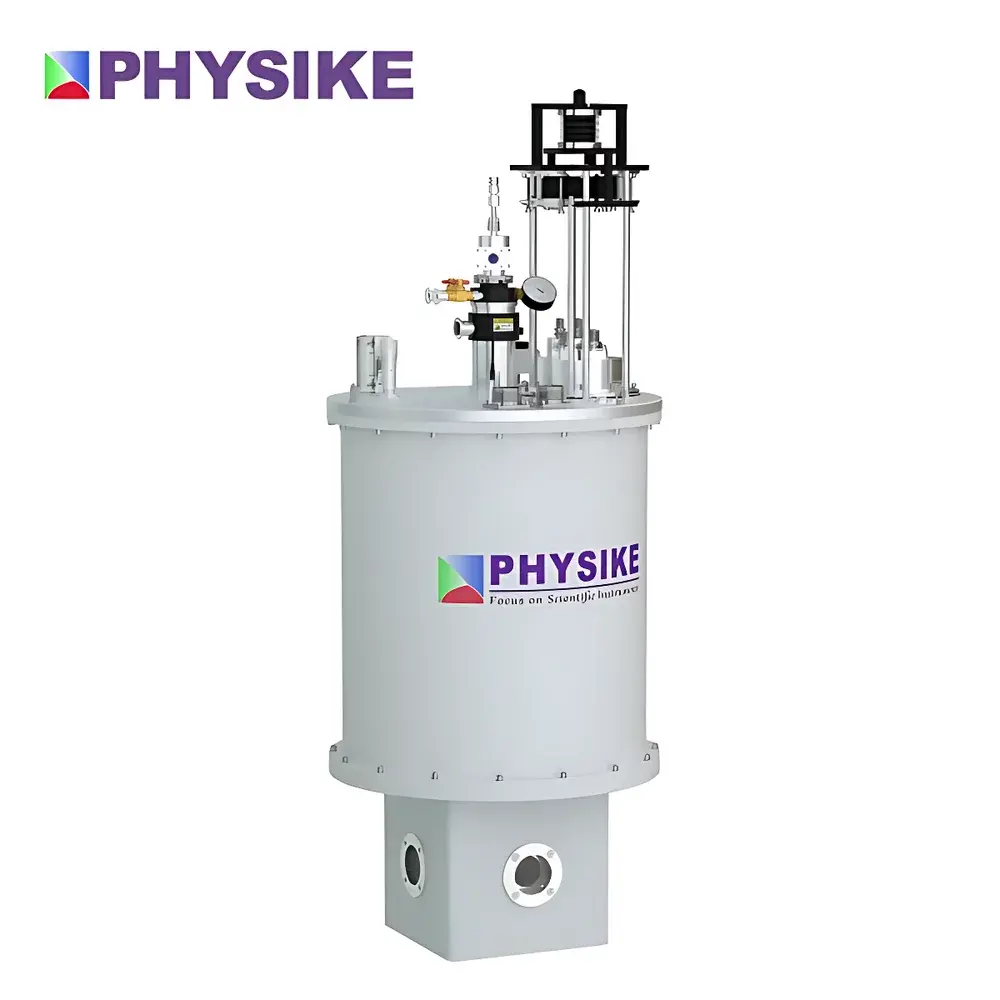
- Field flexibility: Configurable with solenoid (9/12/14/16 T), split-pair (7 T with horizontal optical window), vector (9 T/2 T/2 T), or high-homogeneity (ΔB/B < 1 ppm over 1 cm³) magnet options
- Compliance-ready infrastructure: Designed to support GLP/GMP-compliant data acquisition via audit-trail-capable software and hardware timestamping
Sample Compatibility & Compliance
CryoM accommodates diverse sample geometries through interchangeable sample rods — including electrical transport, thermal transport, magneto-optical, and AC susceptibility configurations. All vacuum feedthroughs comply with ISO-KF40 and CF63 flange standards. Electrical interfaces support SMA, BNC, triaxial, coaxial, and fiber-optic signal routing with magnetic shielding optimized for < 1 nV/√Hz input-referred noise. The system meets mechanical safety requirements per IEC 61000-6-2 (EMC immunity) and structural integrity guidelines outlined in ASTM F2658 (cryogenic equipment). Optional He-3 insert enables operation down to 60 h at base temperature and cooling power > 100 µW at 350 mK — fully compatible with USP and FDA 21 CFR Part 11–compliant instrument qualification protocols.
Software & Data Management
CryoM is controlled via PHYSIKE’s proprietary TKMS Control Suite — a Windows-based application supporting synchronized ramping of temperature and magnetic field with programmable dwell steps, real-time PID tuning, and multi-channel logging at up to 100 Hz sampling rate. Data export conforms to HDF5 and ASCII formats with embedded metadata (timestamp, setpoints, sensor IDs, calibration coefficients). The software includes built-in compliance modules for electronic signature, change control, and audit trail generation aligned with ALCOA+ principles. Remote monitoring and control are enabled via TLS-secured Ethernet interface; optional integration with LabVIEW™, Python (PyVISA), or MATLAB® toolboxes supports custom automation workflows.
Applications
- Quantum transport measurements: Hall effect, Shubnikov–de Haas oscillations, quantum Hall regime characterization under fields up to 16 T
- Superconductor physics: Critical current density (Jc) mapping, vortex dynamics, upper critical field (Hc2) determination
- Magnetic susceptibility: DC and AC (10 Hz–10 kHz) magnetization analysis with sensitivity < 1×10⁻⁸ emu and phase resolution ±0.5°
- Magneto-optical spectroscopy: MOKE, Faraday/Kerr rotation, polarized photoluminescence in static or swept-field modes
- Thermoelectric and thermal conductivity studies: Integrated heat capacity and thermal diffusivity modules with dual-slope relaxation calorimetry
- High-pressure quantum materials research: Compatible with diamond anvil cells (DACs) via custom top-loading VTIs and radial access ports
FAQ
What cooling technologies does CryoM support?
CryoM is available with either a Gifford-McMahon (GM) or pulse-tube cryocooler; both operate without liquid cryogens and feature valve-isolated cold heads to minimize vibration transmission.
Can CryoM be used for AC magnetic susceptibility measurements?
Yes — optional AC susceptibility probe supports excitation amplitudes from 0.01 Oe to 16 Oe, frequency range 10 Hz–10 kHz, and operates continuously from 1.5 K to 325 K in fields up to 16 T.
Is the system compatible with dilution refrigerator integration?
Yes — CryoM supports retrofit integration with commercial dilution refrigerators via custom flange adapters and thermally anchored sample stages; He-3 insert is also available as factory-installed option.
What is the typical temperature stability at 4.2 K?
With standard configuration and PID optimization, temperature fluctuation is ≤ ±5 mK over 1 hour at 4.2 K under zero-field conditions.
Does CryoM meet regulatory requirements for pharmaceutical or medical device R&D?
All control firmware and data acquisition modules are designed for IQ/OQ/PQ validation; full documentation packages, including URS, FDS, and test scripts, are provided upon request to support FDA 21 CFR Part 11 and EU Annex 11 compliance.



