
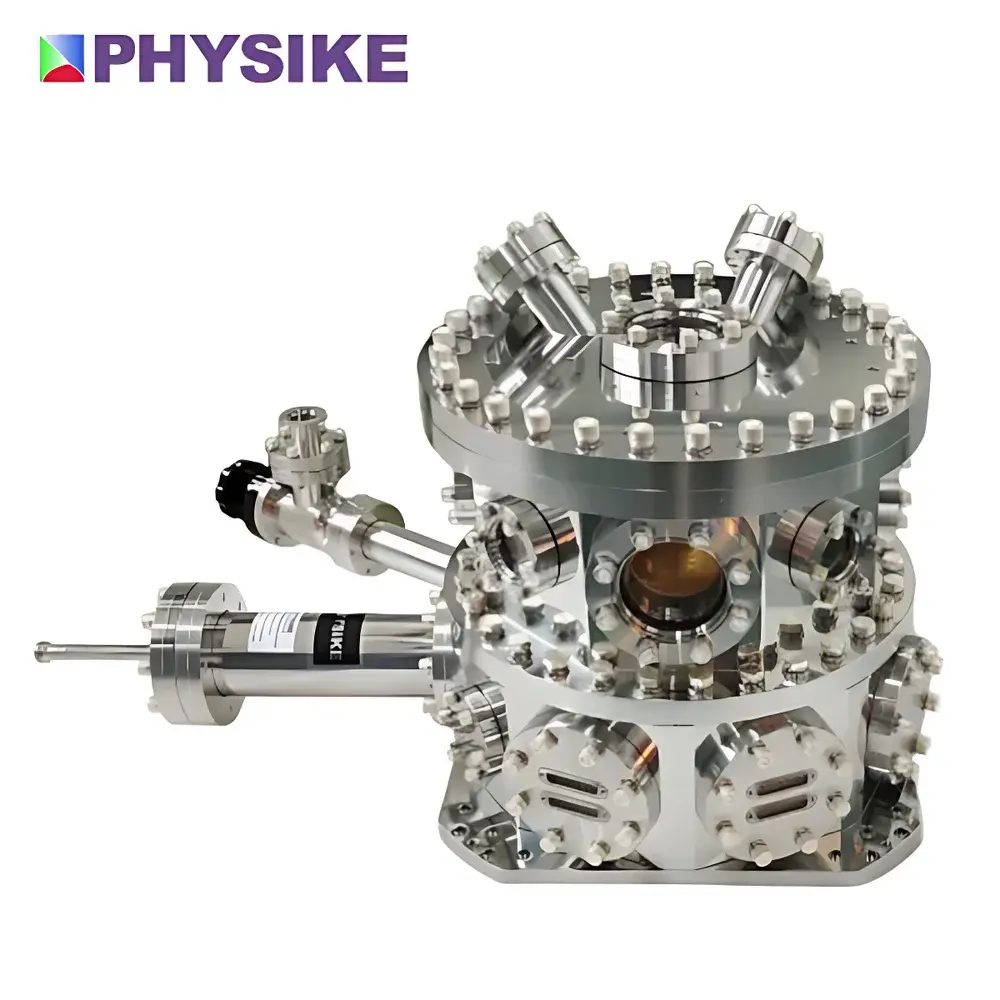
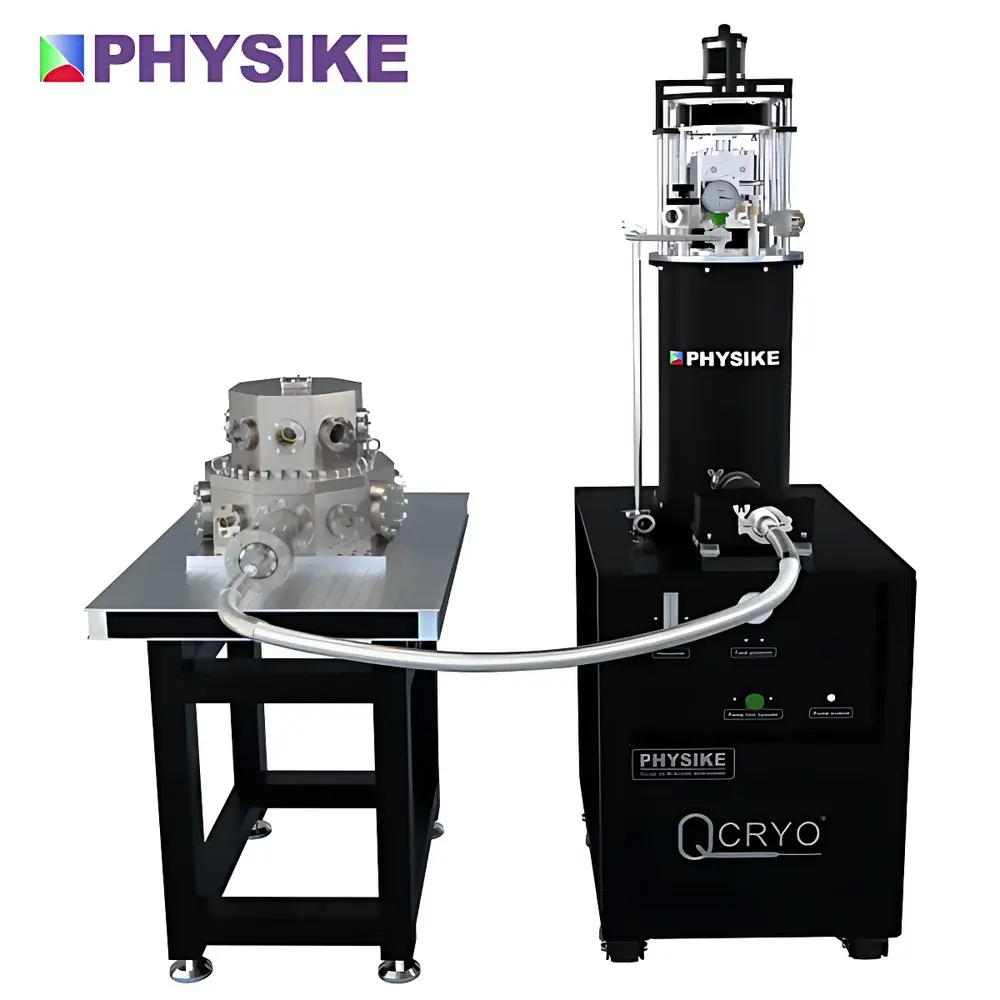
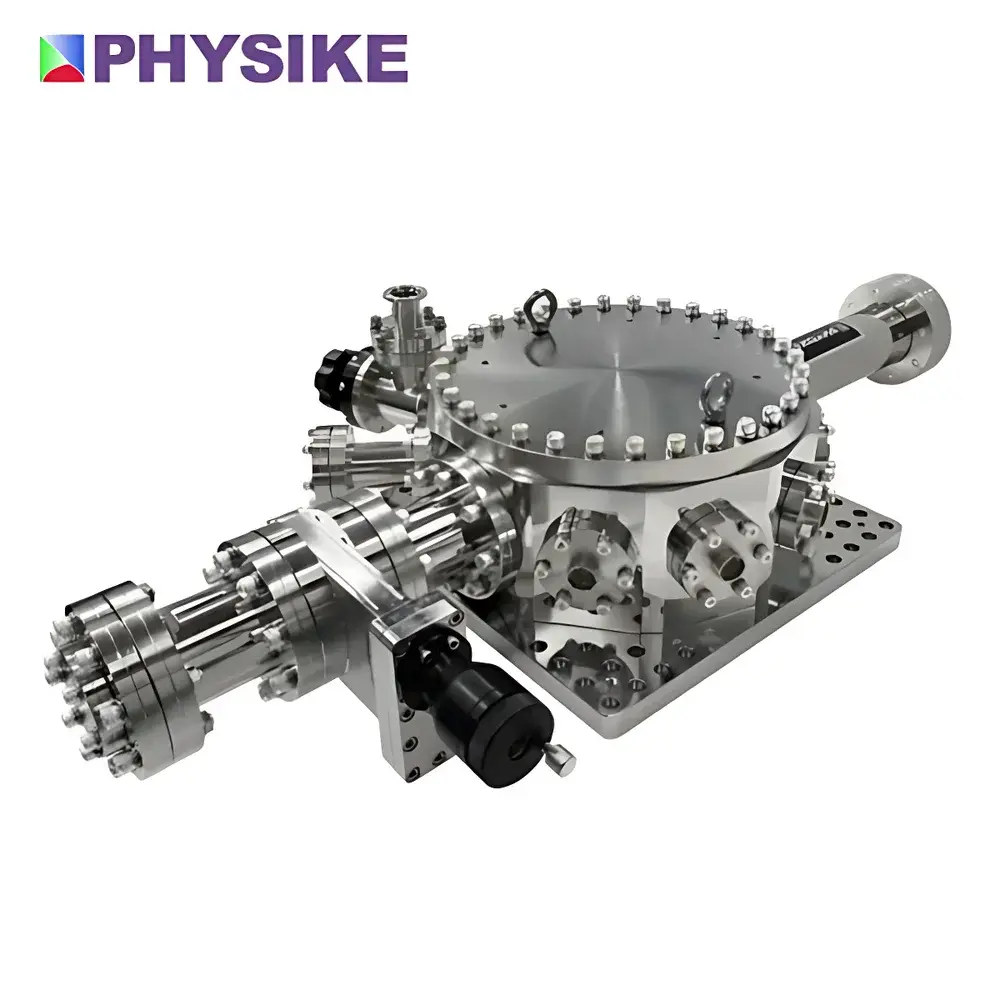
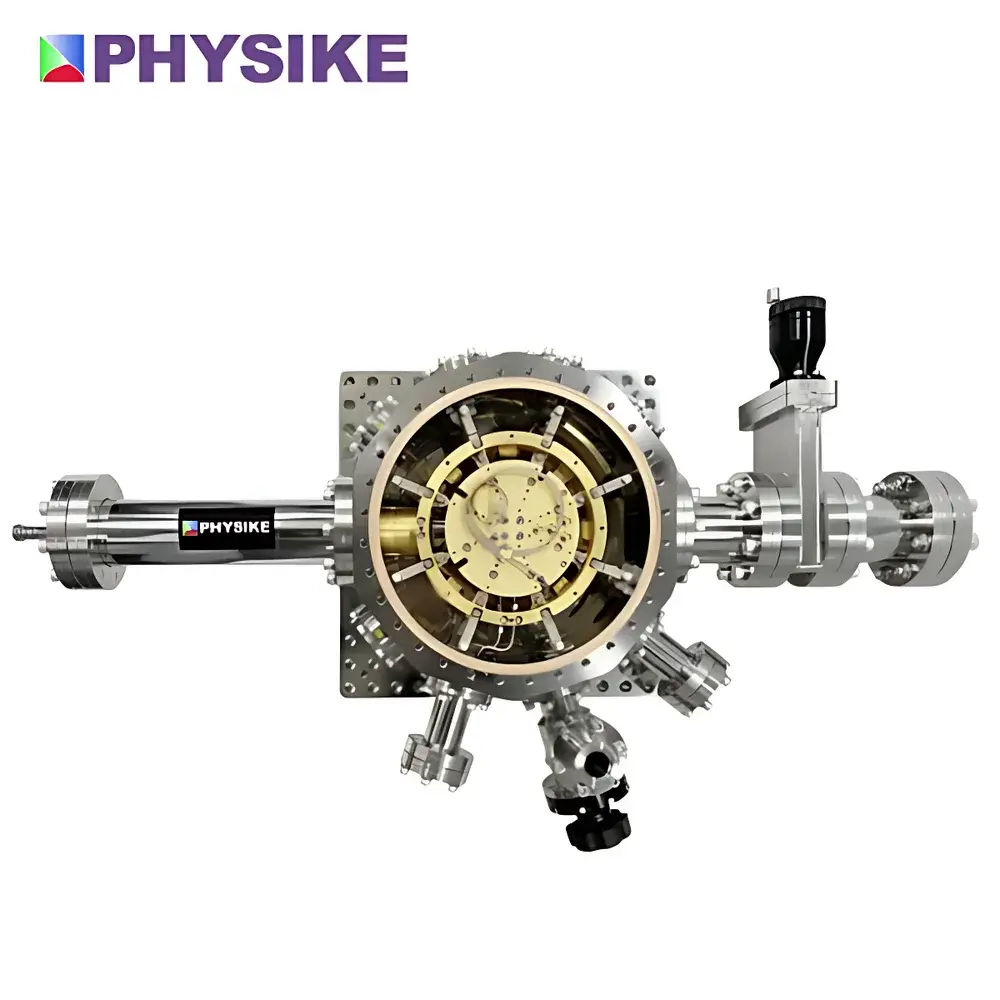
Physike Scryo-S-200 Ultra-High Vacuum Compatible Cryogenic Thermostat
| Brand | Physike |
|---|---|
| Origin | Beijing, China |
| Manufacturer Type | Direct Manufacturer |
| Product Category | Domestic |
| Model | Scryo-S-200 |
| Pricing | Available Upon Request |
| Vacuum Compatibility | UHV (≤1×10⁻¹⁰ mbar) |
| Bakeable Temperature | ≥150 °C |
| Cold Plate Diameter | 15 cm (standard), up to 25 cm (custom) |
| Base Temperature | <2.4 K (with Qcryo® helium recirculator) |
| Temperature Stability | ±2.5 mK over 10 min |
| Vibration Amplitude (FFT, 2.5 kHz) | X < 2 nm, Y < 2.5 nm, Z < 3 nm |
| Cooling Power | >650 mW at 4.2 K |
| Customization Options | Multi-layer radiation shields, side/roof viewports (up to 8 side + 3 top), UHV-compatible electrical feedthroughs (DC: up to 200 leads |
| RF | 4 coaxial lines), custom vacuum chamber integration |
Overview
The Physike Scryo-S-200 is an ultra-high vacuum (UHV)-compatible cryogenic thermostat engineered for applications demanding sub-kelvin thermal stability, nanometer-scale mechanical isolation, and stringent outgassing control. It operates on a closed-cycle helium refrigeration principle when integrated with the optional Qcryo® helium recirculation system—eliminating reliance on consumable liquid helium while maintaining continuous operation below 2.4 K. Its structural architecture features low-thermal-conductivity, high-strength composite supports; actively compensated thermal drift mechanisms; and a fully UHV-qualified material set—including OFHC copper cold plates, low-outgassing stainless steel vacuum jackets, electropolished aluminum radiation shields, and ceramic-insulated low-vibration wiring. All internal and external components are certified bakeable to ≥150 °C, enabling in-situ vacuum conditioning to achieve base pressures routinely below 1×10⁻¹⁰ mbar after bakeout—essential for surface science, quantum sensing, and trapped-ion experiments.
Key Features
- UHV-compliant construction with total pressure rise <1×10⁻¹¹ mbar·L/s after 150 °C bakeout (per ISO 10110-9 and ASTM E595 standards)
- Sub-nanometer vibration performance: RMS displacement <2 nm (X), <2.5 nm (Y), <3 nm (Z) measured via Polytec VGO-200 laser vibrometer (2.5 kHz bandwidth, background-subtracted)
- Thermal stability of ±2.5 mK over 10-minute intervals at operating temperatures <4 K, verified under load with calibrated RuO₂ sensors traceable to NIST
- Modular cold plate design: standard 15 cm diameter (expandable to 25 cm); configurable mounting interface for sample stages, optical mounts, or ion trap electrodes
- Integrated multi-layer radiation shielding (up to 4 layers) with polished Cu and Al surfaces to minimize radiative heat load at 4 K and 50 K stages
- UHV-compatible feedthrough suite: customizable DC (up to 200 twisted-pair leads), RF (4 SMA or K-type coaxial lines), and optical (fiber feedthroughs with AR-coated windows) interfaces
Sample Compatibility & Compliance
The Scryo-S-200 accommodates diverse experimental configurations—from compact scanning probe platforms to large-aperture ion trap assemblies—with full compatibility across major UHV infrastructure standards. Its vacuum envelope conforms to ISO-KF40/CF63/CF100 flange specifications and supports direct integration with user-provided upper chambers (e.g., multi-window CF150 top sections). All wetted materials meet ESA ECSS-Q-ST-70-02C outgassing requirements (<1×10⁻¹² g/cm²·s for H₂O, <5×10⁻¹³ g/cm²·s for total volatile condensable materials). The system is designed for GLP-compliant operation: temperature logs, vacuum history, and cooldown profiles are timestamped and exportable in CSV/JSON formats for audit trails per FDA 21 CFR Part 11 Annex 11 guidelines.
Software & Data Management
Operation is managed via Physike’s CryoControl™ v4.2 software suite, supporting real-time monitoring of 16+ channels—including dual-stage PT100/RuO₂ sensor arrays, turbo pump status, helium pressure differential, and cryocooler compressor parameters. The software implements PID+feedforward temperature regulation with adaptive tuning algorithms optimized for low-mass thermal loads. All data streams are time-synchronized to UTC via NTP and stored with SHA-256 checksum integrity verification. Remote access is secured via TLS 1.3–encrypted WebSocket API, enabling integration into LabVIEW, Python (PyVISA), or MATLAB environments for automated experiment sequencing and metadata tagging.
Applications
The Scryo-S-200 serves as a foundational platform for precision experiments where thermal, vibrational, and vacuum integrity are non-negotiable. Primary use cases include:
- Scanning tunneling microscopy (STM) and atomic force microscopy (AFM) requiring <3 nm RMS vibration floor at 4.2 K
- Trapped-ion quantum computing and simulation setups, including linear Paul traps and surface-electrode architectures with integrated microwave/RF delivery
- Cold atom and molecule beam experiments requiring long coherence times and minimal blackbody radiation-induced decoherence
- Optical lattice clocks and photonic cavity-based frequency standards operating inside thermally anchored UHV cavities
- Low-temperature transport and magnetotransport studies of 2D materials, topological insulators, and superconducting heterostructures
- High-energy physics detector calibration systems requiring stable sub-3 K reference environments
FAQ
Is the Scryo-S-200 compatible with existing UHV systems using ConFlat (CF) flanges?
Yes—standard configurations include CF63 and CF100 main vacuum ports; custom flange sets (CF150, ISO-KF40) are available upon request.
Can the system be operated without liquid helium indefinitely?
When paired with the Qcryo® helium recirculator, it achieves continuous operation below 2.4 K with zero liquid helium consumption and <0.5% helium loss per year.
What is the maximum allowable sample mass and thermal load at base temperature?
Standard configuration supports ≤500 g sample mass and ≤1.2 W parasitic heat load at 4.2 K; higher-capacity variants (Qcryo-S-200-HC) support up to 2.5 W.
Are calibration certificates provided for temperature sensors?
Each unit ships with NIST-traceable calibration reports for all embedded RuO₂ and platinum resistance thermometers, valid for 12 months from commissioning.
Does Physike offer installation, commissioning, and training services?
Yes—on-site UHV leak-checking, cooldown validation, vibration metrology verification, and operator certification are included in the Premium Support Package.



