
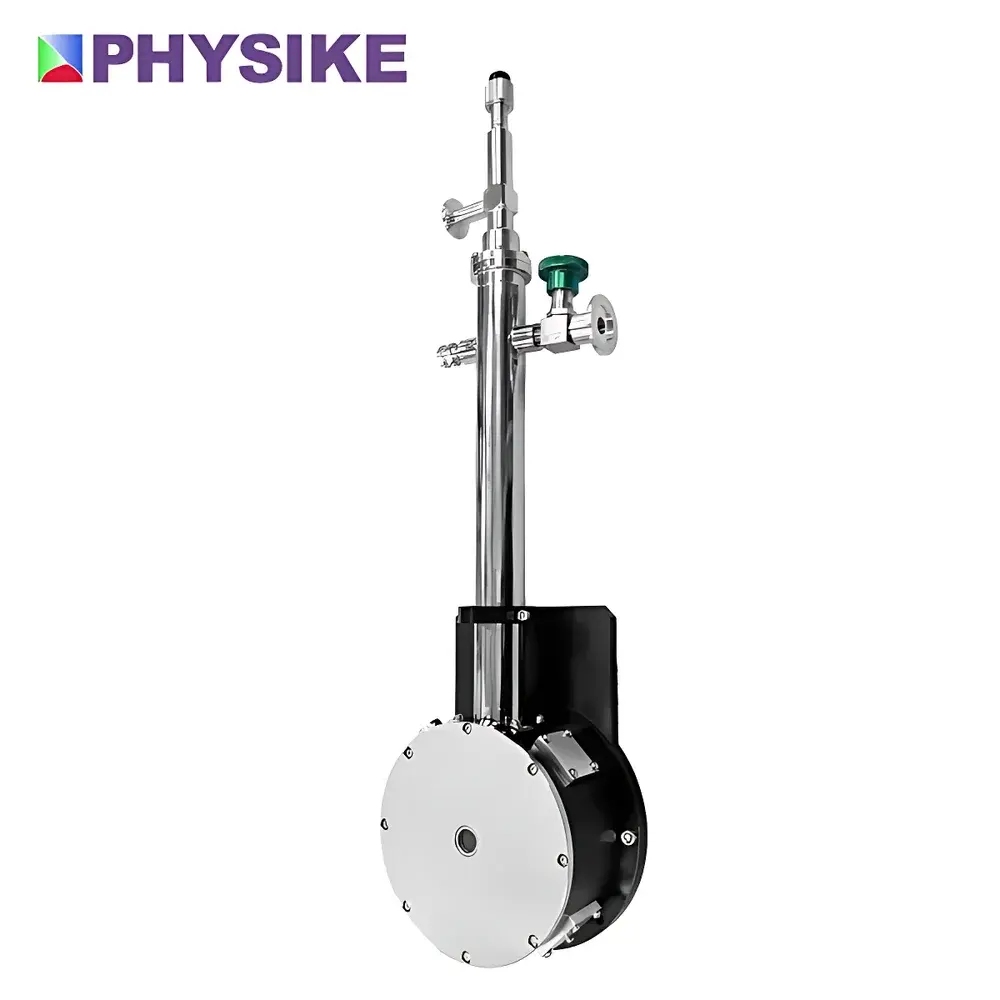
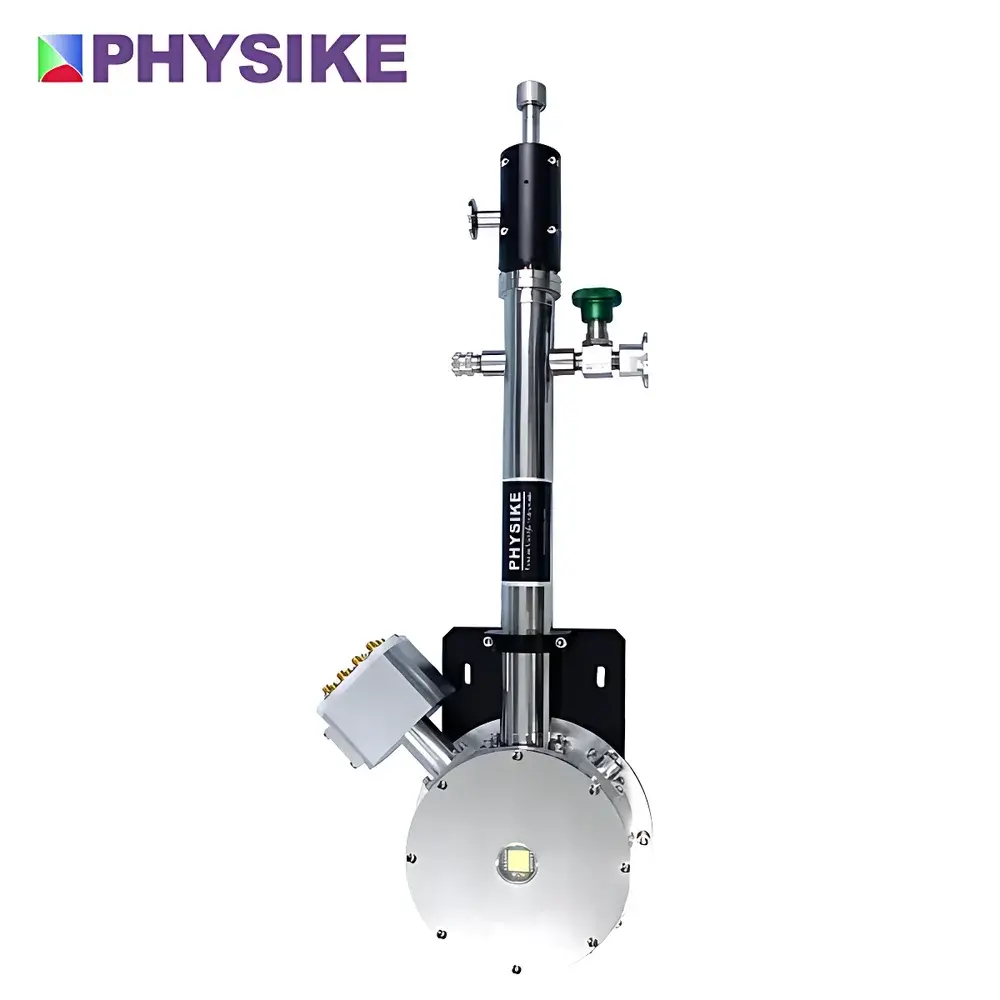
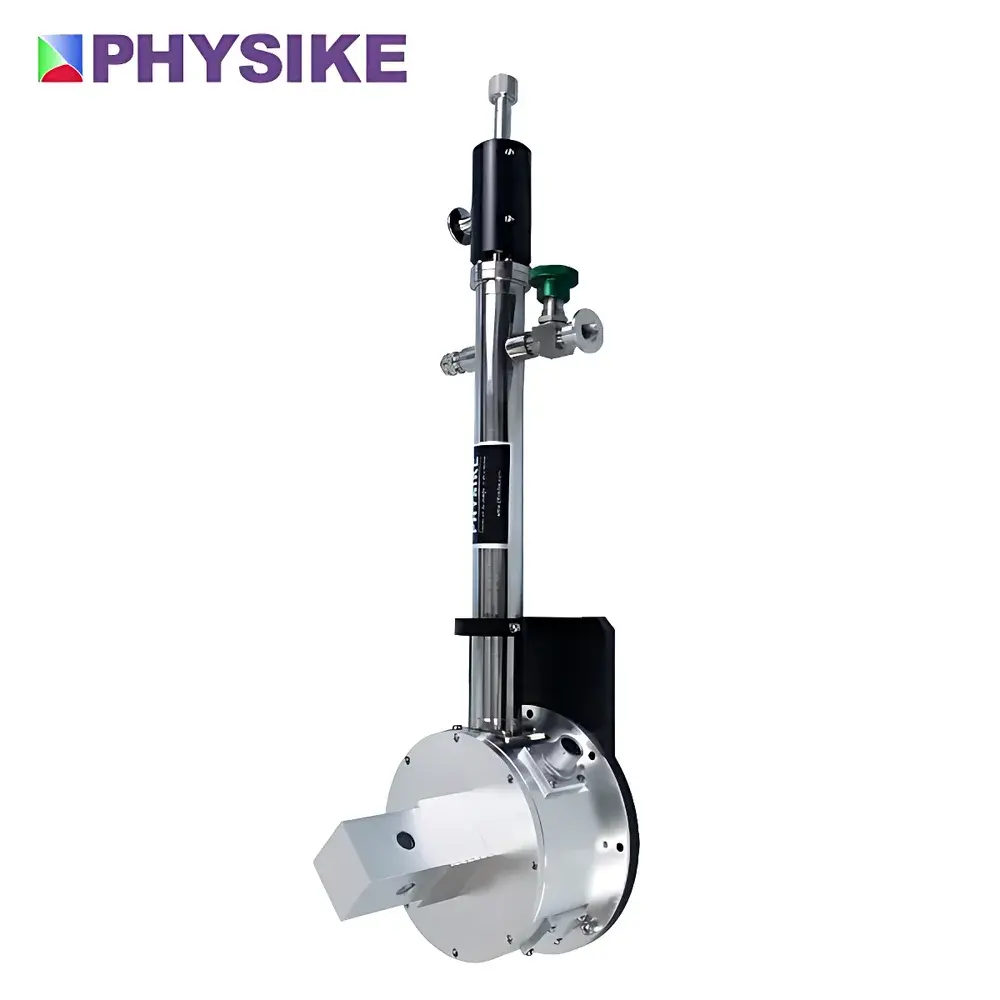
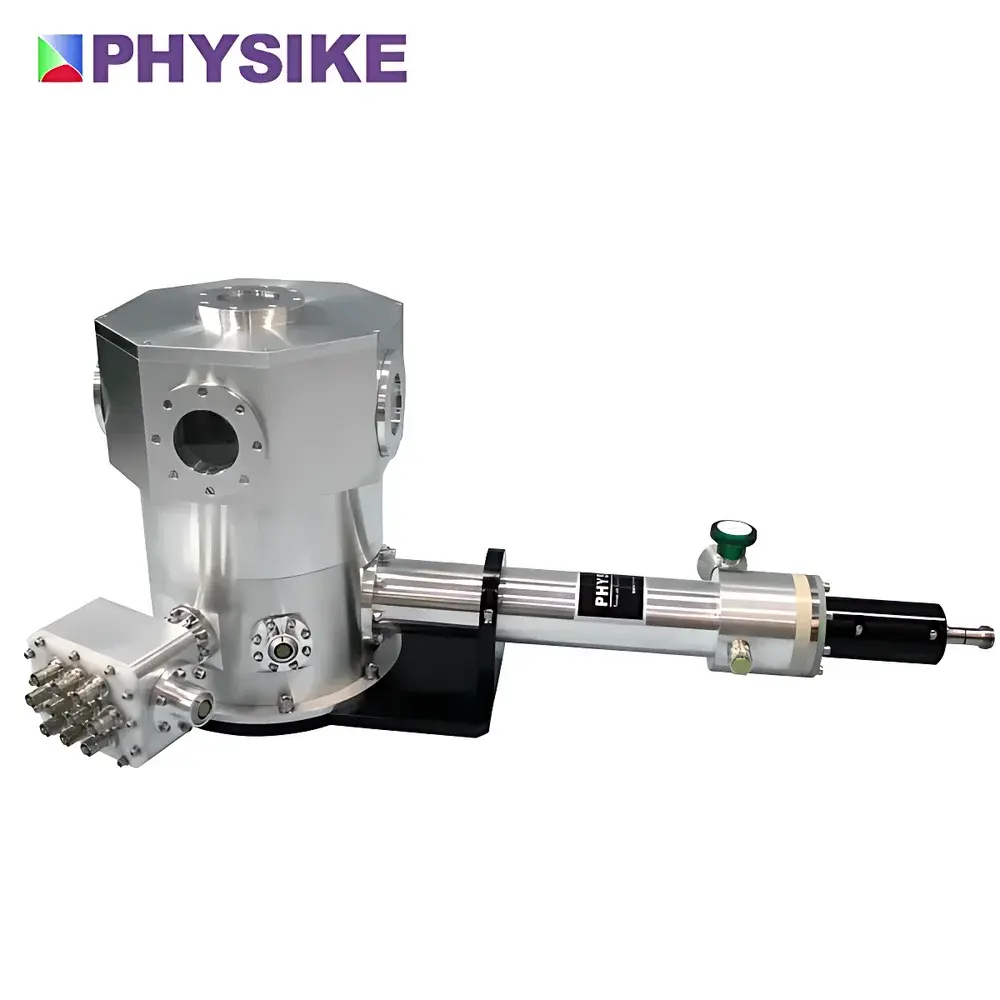
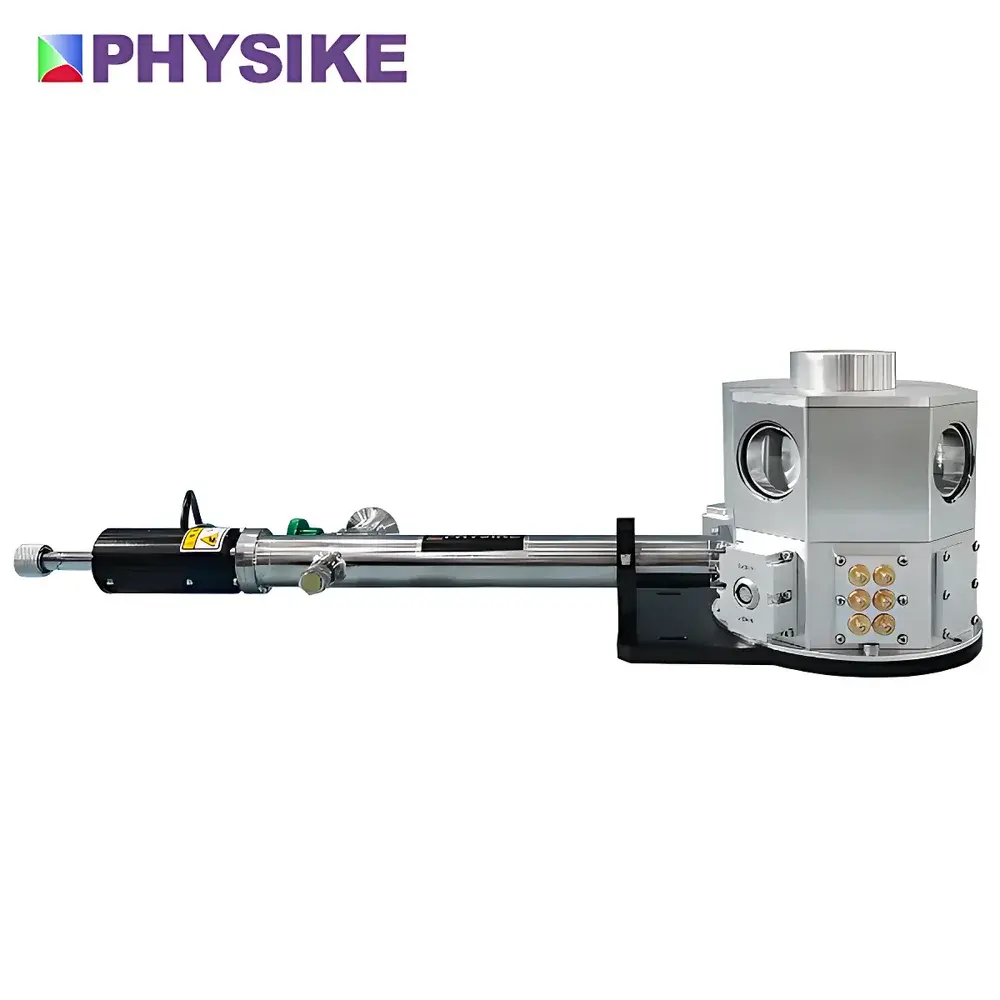
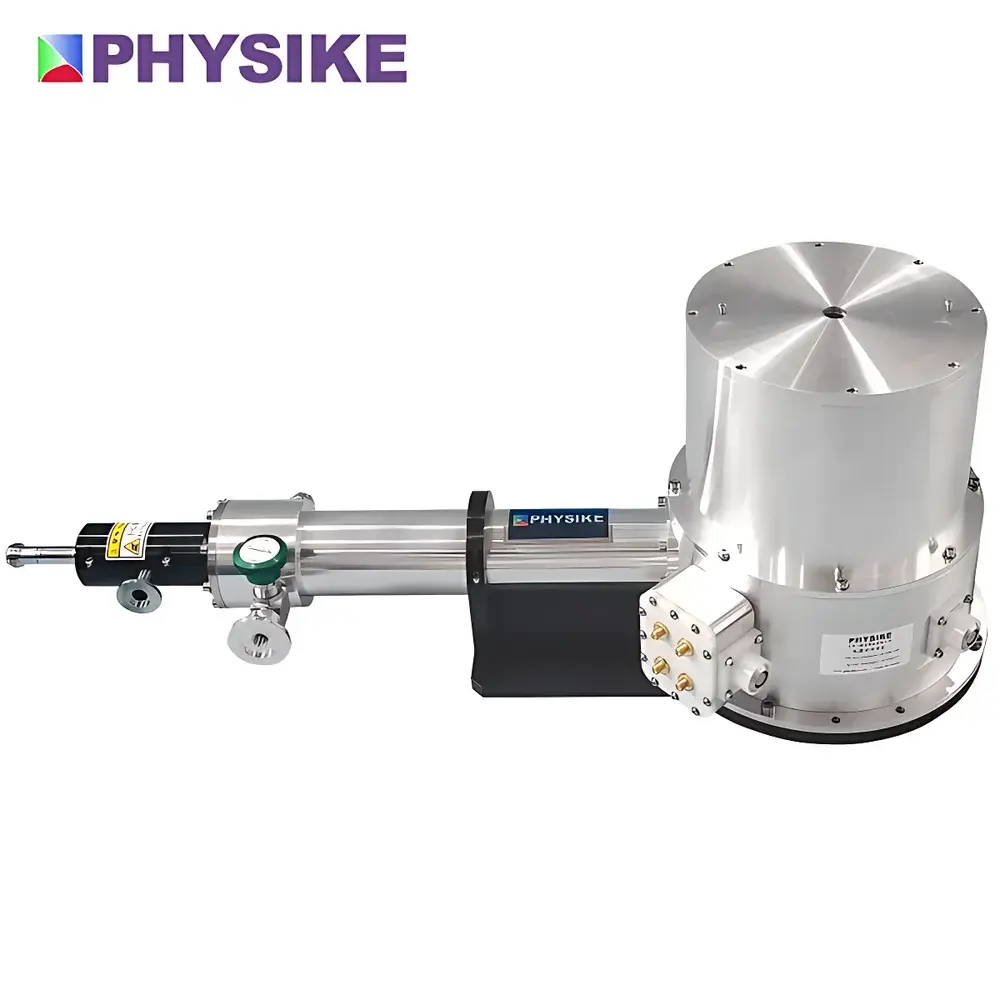
PHYSIKE Scryo-S-500 Microscope-Compatible Cryogenic Thermostat
| Brand | PHYSIKE |
|---|---|
| Origin | Beijing, China |
| Manufacturer Type | Direct Manufacturer |
| Model | Scryo-S-500 |
| Temperature Stability | < ±25 mK |
| Base Temperature | < 2.2 K |
| Vibration Level | < 5 nm (peak-to-peak) |
| Cooling Medium | Helium gas (closed-cycle option with Qcryo® system) |
| Operating Range | < 1.8 K – 420 K (pumped below 4.5 K) |
| Drift Rate | < 2 nm/min |
| Helium Consumption | < 0.55 L/hr @ 5 K (open-cycle) |
| Optical Windows | Standard fused silica |
| Vacuum Feedthroughs | SMA/2.92 mm/2.4 mm/1.85 mm microwave, BNC, Triax, fiber optic, multi-pin |
| Sample Holders | Puck, DIP, LCC, transmission, solar cell, thermal transport configurations |
| Optional Integration | Nanopositioning stages, DACs, superconducting magnets, vertical extension, stainless-steel vacuum chamber with indium-sealed flanges |
Overview
The PHYSIKE Scryo-S-500 is a high-performance, microscope-integrated cryogenic thermostat engineered for ultra-low-vibration, high-stability operation in advanced quantum and nanoscale characterization. It employs a continuous-flow open-cycle architecture with helium gas as the primary refrigerant, supported by a rigid, low-thermal-conductivity structural framework and active temperature drift compensation. The system achieves base temperatures below 2.2 K in open-cycle mode and down to <1.8 K under pumped conditions—enabling access to quantum ground states essential for single-emitter spectroscopy, quantum transport, and low-dimensional material physics. Its design prioritizes mechanical integrity and thermal decoupling: vibration amplitudes remain below 5 nm (peak-to-peak), with sub-2 nm/min thermal drift and long-term stability better than ±25 mK over 10-minute intervals. When upgraded with the optional Qcryo® closed-cycle helium recirculation system, the Scryo-S-500 transitions to a zero-boil-off, dry-operation platform while preserving its nanoscale mechanical stability—demonstrated by <4 nm (X/Y) peak-to-peak displacement and FFT spectral amplitude <0.6 nm across 0–1000 Hz.
Key Features
- Sub-2.2 K base temperature capability in both open-cycle (liquid helium) and closed-cycle (Qcryo®) configurations
- Nanometer-scale mechanical stability: <5 nm RMS vibration, <2 nm/min thermal drift, validated via time-domain displacement and FFT spectral analysis
- Optimized optical integration: coaxial inlet/outlet gas lines and short working distance compatible with commercial confocal microscopes, Raman spectrometers (e.g., Horiba, Renishaw), FTIR, and Brillouin scattering platforms
- High-efficiency helium management: integrated high-surface-area vaporizer and superinsulated transfer lines reduce liquid helium consumption to <0.55 L/hr at 5 K
- Modular vacuum interface: standardized CF-63/CF-100 flanges support customizable feedthrough arrays—including up to 12 SMA (2.92 mm), BNC, triax, or fiber-optic ports
- Expandable sample environment: configurable internal volume for integration of nanopositioning stages (XYZ, rotation, tilt), diamond anvil cells (DACs), in-vacuum objectives, and low-magnetic-field-compatible components
Sample Compatibility & Compliance
The Scryo-S-500 accommodates diverse sample geometries and experimental modalities—including puck-, DIP-, and LCC-mounted devices; transmission and reflection samples; photovoltaic stacks; and high-pressure DAC assemblies with BeCu or diamond anvils. Its vacuum chamber complies with ISO-UHV standards (base pressure <1×10⁻⁷ mbar) and supports indium-gasketed CF flanges for leak-tight sealing. Optional beryllium, sapphire, Mylar, and quartz windows enable broadband optical access from X-ray (Be window) through THz frequencies. For regulated environments, the system’s temperature control architecture supports audit-ready logging (timestamped setpoints, actual readings, PID parameters) compliant with GLP and 21 CFR Part 11 when paired with validated data acquisition software. All electrical feedthroughs meet IEC 61000-4 immunity requirements for low-noise cryogenic measurement.
Software & Data Management
Temperature regulation is managed via a dual-channel PID controller with programmable ramp rates (0.01–10 K/min), hold steps, and multi-segment profiles. Real-time monitoring includes digital readouts of cold-stage temperature, helium flow rate, pressure differentials, and heater power—accessible via Ethernet-connected front panel or remote API (TCP/IP). Data logging records all sensor inputs at user-defined intervals (10 ms–10 s resolution) into timestamped CSV files. Optional integration with LabVIEW™, Python (PyVISA), or MATLAB™ enables synchronized triggering with spectrometers, lock-in amplifiers, or AFM controllers. For closed-cycle operation, Qcryo® system diagnostics—including compressor status, cold-head temperature, and helium circuit pressure—are embedded into the same interface, ensuring full operational traceability.
Applications
The Scryo-S-500 serves as a foundational platform for experiments requiring simultaneous cryogenic cooling, nanoscale positioning, and optical access. Key use cases include: single quantum dot and single-molecule photoluminescence (PL/EL) spectroscopy; micro-Raman and Brillouin scattering under high magnetic fields (up to 9 T with room-temperature-bore superconducting magnets); low-temperature transport in 2D materials (graphene, TMDCs) and topological insulators; high-pressure quantum phase studies using BeCu DACs with in situ pressure tuning; micro-focused X-ray diffraction and absorption spectroscopy (with Be windows); cryogenic ion trapping and quantum logic gate characterization; thermal conductivity mapping in nanostructured thermoelectrics; and low-noise microwave reflectometry of superconducting qubits. Its modular architecture has been validated in peer-reviewed setups involving Horiba LabRAM HR Evolution, Renishaw inVia Reflex, and custom-built near-field optical systems.
FAQ
What is the minimum base temperature achievable in open-cycle mode?
The Scryo-S-500 reaches <2.2 K with liquid helium and mechanical pumping; stable operation below 4.5 K requires vacuum pumping of the helium gas phase.
Can the system operate without liquid helium?
Yes—when equipped with the Qcryo® closed-cycle helium recirculation system, it achieves <2.2 K with zero liquid helium consumption and retains <4 nm vibration performance.
Is the Scryo-S-500 compatible with superconducting magnets?
Yes—optional vertical extension modules allow direct integration with room-temperature-bore superconducting magnets (up to 9 T) or electromagnets, maintaining field homogeneity and minimizing eddy-current heating.
What optical transmission ranges are supported?
Standard fused silica windows cover 185–2500 nm; optional Be (X-ray), Mylar (THz), CaF₂ (deep UV), and KBr (far-IR) windows extend coverage from 0.01 nm to 1 mm wavelength.
How is electrical noise minimized at cryogenic temperatures?
Shielded triax and semi-rigid microwave cables (1.85 mm) are routed through magnetically shielded feedthroughs; low-thermal-EMF twisted-pair wiring is standard for DC/low-frequency measurements.
Are custom vacuum feedthrough configurations available?
Yes—PHYSIKE provides engineering support for bespoke feedthrough layouts, including mixed-signal arrays (RF + fiber + HV), hermetic ceramic seals, and differential thermal expansion compensation.
Related Products



