
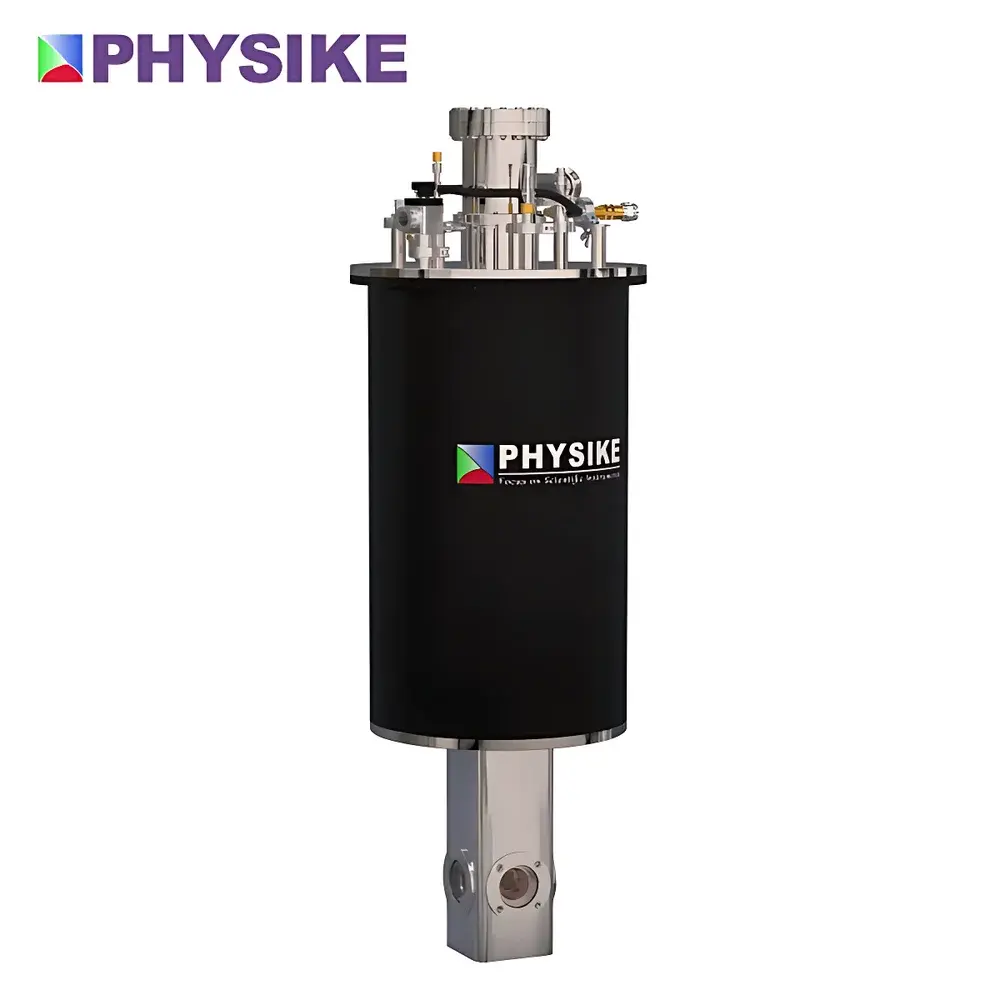
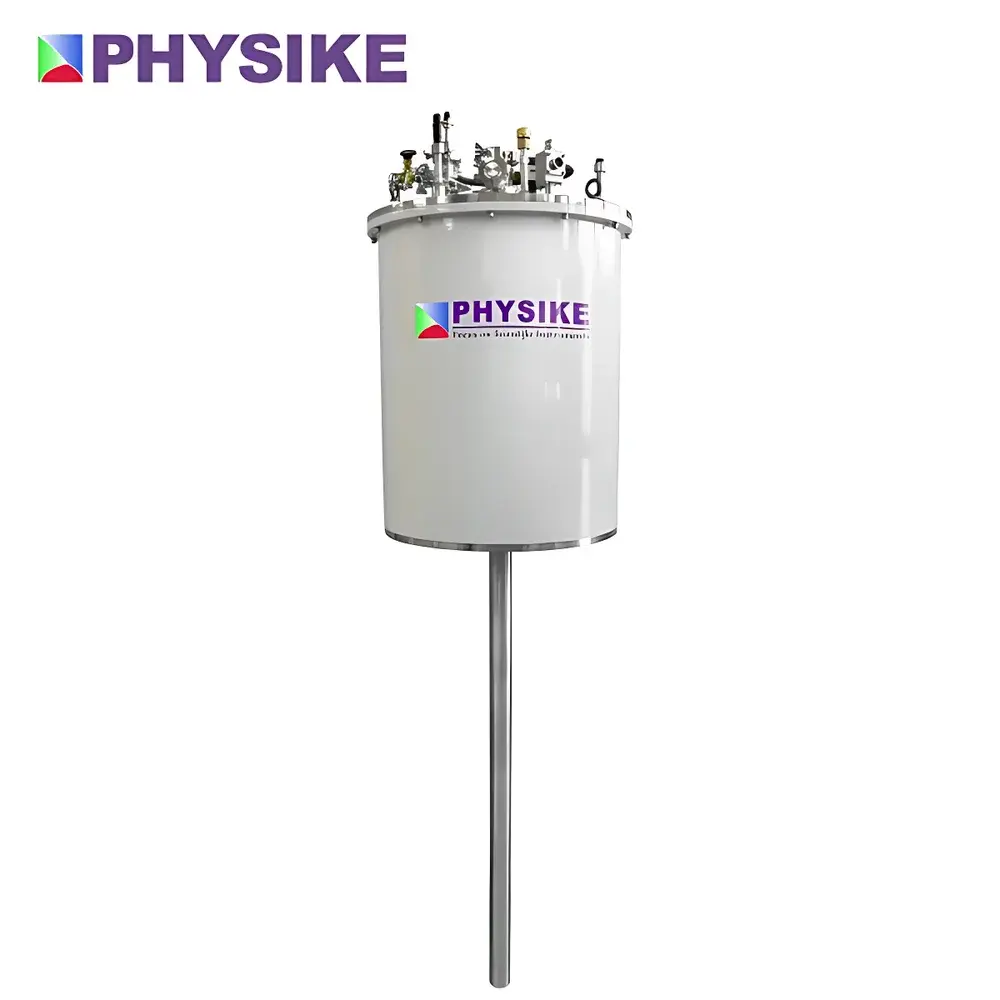
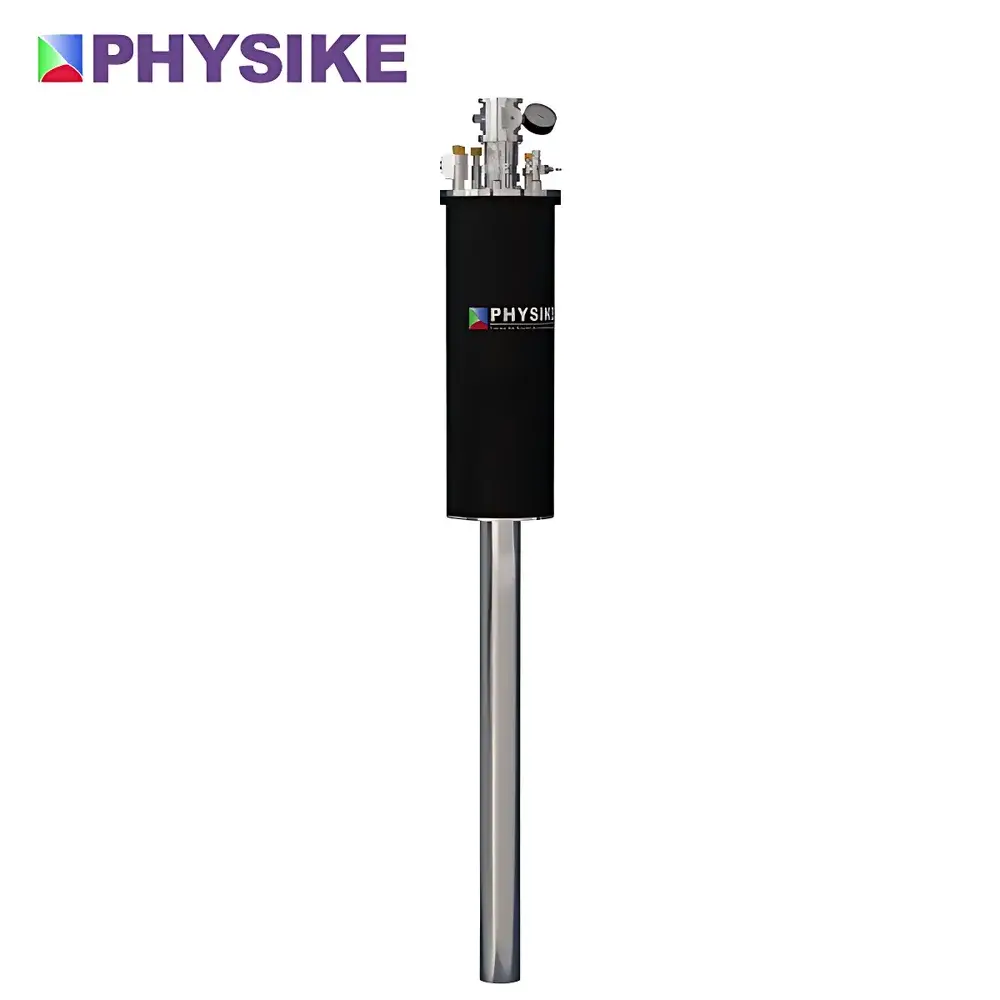
PHYSIKE Scryo-SDV Cryogenic Dewar Thermostat
| Brand | PHYSIKE |
|---|---|
| Origin | Beijing, China |
| Manufacturer Type | Direct Manufacturer |
| Country of Origin | China |
| Model | Scryo-SDV |
| Pricing | Available Upon Request |
| Cooling Medium | Dual Liquid Helium & Liquid Nitrogen Reservoirs |
| Temperature Range | 1.5 K to 300 K |
| Static Liquid Helium Consumption Rate | < 0.1 L/h |
| Tail Length | > 1 m |
| Tail Outer Diameter | 47.8 mm |
| Sample Tube Inner Diameter | 31.5 mm |
| Design | Top-Loading, Plug-in Sample Rod Configuration |
| Thermal Architecture | Ultra-Low Heat Leak with LN₂ Radiation Shield & Superinsulated Sample Tube |
| Optional Configurations | Linear Actuator Sample Rod, Single/Double-Axis Rotating Sample Rod, Puck Holder, In-situ Pressure-Tuning Sample Rod, AC Susceptibility Measurement Kit, Static Helium Gas Environment |
| Vacuum Feedthrough Options | Multi-pin, BNC, SMA, Fiber Optic, Twisted Pair, Coaxial/Triaxial, Semi-Rigid RF Cable, Optical Fiber |
| Optical Window Compatibility | Gamma, X-ray, UV–Vis–IR–THz Transmission |
| Magnet Integration | Compatible with Electromagnets, Superconducting Magnets, Hybrid High-Field Magnets (e.g., 35 T Water-Cooled) |
| Application-Specific Adaptations | NMR Magnet Coupling, DAC (Diamond Anvil Cell), Hydrostatic Pressure Cells, AFM/STM Vibration-Sensitive Mounting |
Overview
The PHYSIKE Scryo-SDV Cryogenic Dewar Thermostat is an engineered solution for high-stability, long-duration low-temperature experiments requiring precise thermal control from 1.5 K to 300 K. Based on a dual-reservoir cryostat architecture, it integrates independent liquid helium (LHe) and liquid nitrogen (LN₂) storage vessels within a single vacuum-jacketed dewar. Its core thermal design employs a passive LN₂ radiation shield surrounding the LHe reservoir and variable-temperature insert (VTI), significantly suppressing parasitic heat load from ambient sources. The sample tube is constructed with superinsulation—multilayer reflective foil and low-conductivity spacers—to maintain exceptionally low static helium boil-off (< 0.1 L/h) even during extended operation at intermediate temperatures (e.g., 10–50 K), where conventional cryostats typically exhibit accelerated consumption. The top-loading, plug-in sample rod interface enables rapid sample exchange without breaking vacuum or warming the entire system—a critical advantage for high-throughput characterization in condensed matter physics, quantum materials research, and precision spectroscopy.
Key Features
- Ultra-low static liquid helium consumption rate (< 0.1 L/h), validated under continuous operation at base temperature
- Dual-cryogen reservoir configuration with thermally decoupled LN₂ shield minimizing radiative and conductive heat leak to the LHe stage and VTI
- Top-access, modular sample rod system supporting quick mechanical insertion/removal while preserving cryogenic stability
- Extended tail section (> 1 m length, 47.8 mm OD) optimized for integration with high-field magnets—including water-cooled resistive (e.g., 35 T), superconducting, and hybrid systems
- Large internal bore (31.5 mm ID sample tube) accommodating complex probe assemblies, multi-channel wiring, and optical paths
- Vibration-damping static helium gas environment option for atomic force microscopy (AFM), scanning tunneling microscopy (STM), and near-field optical experiments
- Customizable vacuum feedthroughs including multi-pin electrical connectors, BNC/SMA RF interfaces, coaxial/triaxial lines, semi-rigid microwave cables, and fused silica or sapphire optical fibers
Sample Compatibility & Compliance
The Scryo-SDV supports a broad spectrum of experimental configurations across physical science disciplines. Its large-bore sample space and flexible mounting options accommodate diamond anvil cells (DAC), hydrostatic pressure cells, custom magnetoresistance probes, ESR/EPR resonators, and THz waveguides. Optical access is enabled via interchangeable windows fabricated from materials selected per spectral band: beryllium or Kapton for X-ray transmission; CaF₂, MgF₂, or sapphire for UV–Vis; KBr, CsI, or polyethylene for IR–THz; and quartz or fused silica for broadband visible applications. All configurations comply with standard laboratory vacuum practices (≤10⁻⁶ mbar operating pressure) and are compatible with GLP-aligned experimental workflows. While not certified to specific ISO or ASTM standards by default, the system’s thermal reproducibility, pressure integrity, and electromagnetic compatibility support validation under ISO/IEC 17025-accredited testing protocols when integrated into user-defined measurement chains.
Software & Data Management
The Scryo-SDV operates as a hardware platform requiring external temperature controllers (e.g., Lakeshore 336, BlueFors TMC-200) and data acquisition systems. It does not include embedded firmware or proprietary software but provides standardized analog and digital I/O interfaces (0–10 V, RS-232, IEEE-488/GPIB) for seamless integration with LabVIEW, Python-based control frameworks (PyVISA, QCoDeS), or commercial DAQ platforms. All temperature sensors (Cernox®, RuO₂, diode) and heater outputs are routed through calibrated, shielded connections to ensure traceable thermal metrology. Audit trails for temperature setpoints, ramp rates, and hold durations can be generated externally, supporting 21 CFR Part 11 compliance when paired with validated software environments and electronic lab notebooks (ELNs).
Applications
- Quantum transport measurements (Hall effect, magnetoresistance, Josephson junctions) under high magnetic fields up to 35 T
- Vibrating sample magnetometry (VSM) and AC magnetic susceptibility studies on single crystals, thin films, and nanostructured materials
- Spectroscopic techniques including Fourier-transform infrared (FTIR), terahertz time-domain spectroscopy (THz-TDS), Raman scattering, and magneto-optical Kerr effect (MOKE)
- Nuclear magnetic resonance (NMR) and electron paramagnetic resonance (EPR) experiments requiring field homogeneity and thermal stability
- Mössbauer spectroscopy, neutron scattering sample environments, and synchrotron X-ray diffraction under cryogenic conditions
- High-pressure studies using diamond anvil cells (DAC) and hydrostatic media, coupled with in situ electrical or optical probes
- Low-noise quantum device characterization (SQUIDs, transition-edge sensors, superconducting qubits) in vibration-isolated helium-gas mode
FAQ
What is the base temperature achievable with the Scryo-SDV?
The system achieves a base temperature of 1.5 K using high-purity liquid helium under standard vacuum and shielding conditions.
Can the Scryo-SDV be used with superconducting magnets requiring horizontal access?
Yes—the extended tail geometry and modular flange design allow adaptation to horizontal-bore superconducting magnets, including split-pair and wide-bore configurations.
Is the static helium consumption rate affected by liquid nitrogen level depletion?
No—the LN₂ shield is engineered to maintain effective thermal isolation even at low fill levels, ensuring stable LHe consumption across operational cycles.
Are optical windows included as standard equipment?
Optical windows are optional and selected based on spectral requirements; standard offerings include fused silica (UV–Vis), KBr (IR), and polyethylene (THz), with custom substrates available upon request.
Does the system support automated temperature ramps and multi-step thermal protocols?
Yes—when connected to compatible third-party temperature controllers, the Scryo-SDV fully supports programmable ramping, dwell steps, and closed-loop PID regulation with user-defined thermal profiles.



