
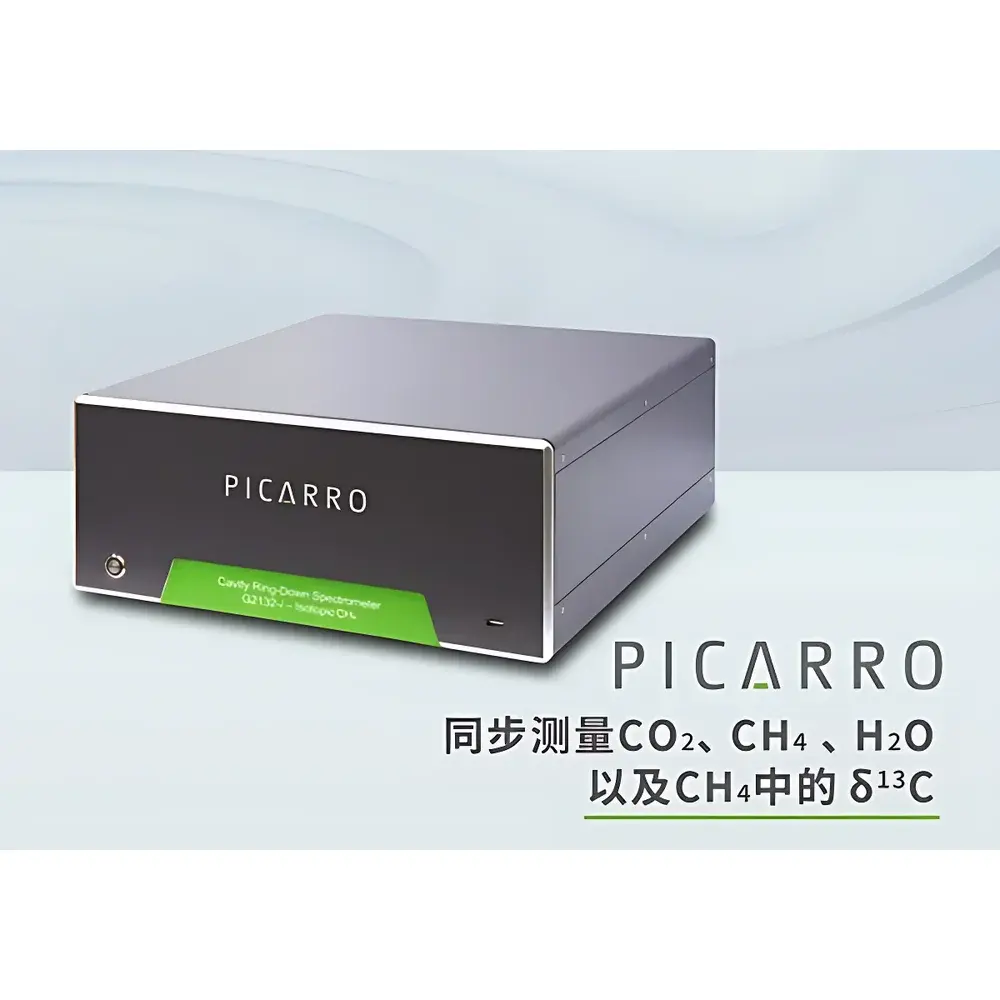
Picarro G2132-i Isotope Ratio Analyzer for δ¹³C in Methane (CH₄)
| Brand | Picarro |
|---|---|
| Origin | USA |
| Model | G2132-i |
| Measurement Principle | Cavity Ring-Down Spectroscopy (CRDS) |
| δ¹³C Precision (1σ, 1-hour average) | < 0.4‰ at [CH₄] > 10 ppm |
| δ¹³C Drift (24 h, 1-hr avg) | < 1.5‰ at [CH₄] = 10 ppm |
| CH₄ Concentration Precision (30 s, 1σ) | 1 ppb + 0.05% of ¹³CH₄ reading |
| CH₄ Dynamic Range | 1.8–1500 ppm (operational) |
| CO₂ Range | 100–4000 ppm |
| H₂O Range | 0–5% RH |
| Sample Temp. | –10 to 45 °C |
| Sample Pressure | 300–1000 Torr (40–133 kPa) |
| Flow Rate | ≤25 sccm (at 760 Torr) |
| Temperature Stability | ±0.005 °C |
| Pressure Stability | ±0.0002 atm |
| Environmental Operating Range | 10–35 °C, <99% RH (non-condensing) |
| Data Interfaces | RS-232, Ethernet, USB, analog (0–10 V) |
| Dimensions (Analyzer) | 43.2 × 17.8 × 44.6 cm |
| Weight | 27.4 kg (incl. external pump) |
Overview
The Picarro G2132-i Isotope Ratio Analyzer is a high-performance, field-deployable cavity ring-down spectroscopy (CRDS)-based instrument engineered for continuous, real-time, and highly precise measurement of the carbon isotope ratio (δ¹³C) in methane (CH₄). Unlike traditional isotope ratio mass spectrometers (IRMS), which require offline sample preparation, cryogenic trapping, and combustion to CO₂ prior to analysis, the G2132-i performs direct, in situ δ¹³C quantification in ambient or extracted CH₄ gas streams—eliminating sample pre-treatment, drying, and calibration drift associated with conversion-based methods. Its optical architecture leverages ultra-stable, temperature- and pressure-controlled high-finesse optical cavities to resolve isotopic absorption features near 1650.9 nm with sub-part-per-trillion sensitivity. This enables robust discrimination between ¹²CH₄ and ¹³CH₄ without chemical interference from common atmospheric constituents—provided spectral interferences (e.g., from ethane, ethylene, ammonia, or sulfur compounds) are assessed and mitigated per application-specific validation protocols.
Key Features
- Direct, calibration-free δ¹³C measurement in CH₄—no sample drying, pre-concentration, or combustion required
- CRDS-based optical detection ensures long-term stability and minimal drift: <1.5‰ δ¹³C drift over 24 hours (at 10 ppm CH₄)
- High temporal resolution: ~2-second measurement cycle (including concurrent CO₂ and H₂O monitoring)
- Exceptional precision: <0.4‰ (1σ, 1-hour average) for δ¹³C at CH₄ concentrations ≥10 ppm
- Integrated ChemDetect™ algorithm for real-time identification of spectral contaminants (e.g., hydrocarbons, NH₃)
- Passive thermal and pressure stabilization: ±0.005 °C cavity temperature control and ±0.0002 atm pressure regulation
- Wide operational flexibility: supports sample temperatures from –10 to 45 °C and pressures from 300 to 1000 Torr
- Low-maintenance design: no consumables, no vacuum pumps internal to analyzer, minimal routine service intervals
Sample Compatibility & Compliance
The G2132-i is validated for use with ambient air, soil flux chambers, biogas streams, natural gas headspace, and eddy-covariance systems. It complies with environmental monitoring best practices defined by the Integrated Carbon Observation System (ICOS), the Global Atmospheric Watch (GAW), and EPA Method TO-15 (for VOC-influenced trace gas characterization). While not an IRMS, its CRDS-derived δ¹³C values demonstrate strong linear correlation with certified reference materials (e.g., USGS40, IAEA-CH-7) when calibrated using two-point linear referencing against primary standards traceable to VPDB. The system meets MIL-STD-810F for shock and vibration resilience, supporting mobile laboratory and remote field deployments. Users must validate method performance under site-specific conditions—particularly where elevated H₂O (>2.4%), CO₂ (>4000 ppm), or interfering organics are present—as specified in ISO 17025-compliant analytical procedures.
Software & Data Management
Picarro’s proprietary Analyze software provides full instrument control, real-time data visualization, automated baseline correction, and configurable averaging windows (5-min, 15-min, hourly). Raw spectral fits, cavity ring-down time constants, and diagnostic flags (e.g., laser power, mirror reflectivity decay) are logged at user-defined intervals. Data export supports CSV, NetCDF, and ASCII formats compatible with MATLAB, Python (Pandas/NumPy), and commercial statistical platforms. Audit trails—including operator ID, parameter changes, calibration events, and firmware updates—are maintained in accordance with GLP and FDA 21 CFR Part 11 requirements when configured with user authentication and electronic signature modules. Remote monitoring via Ethernet or cellular gateway enables unattended operation across distributed networks.
Applications
- Atmospheric science: Source apportionment of anthropogenic vs. biogenic CH₄ emissions (e.g., distinguishing landfill, ruminant, wetland, and fossil fuel signatures)
- Carbon cycle research: Quantifying CH₄ oxidation rates in soils and sediments via isotopic fractionation modeling
- Oil & gas operations: Leak detection and fugitive emission verification in upstream infrastructure using isotopic fingerprinting
- Waste management: Monitoring anaerobic digester efficiency and landfill gas composition dynamics
- Climate policy support: Providing isotopically resolved CH₄ data for national greenhouse gas inventories (UNFCCC reporting)
- Ecological studies: Partitioning CH₄ production pathways (acetoclastic vs. hydrogenotrophic methanogenesis) in peatlands and rice paddies
FAQ
Does the G2132-i require external calibration gases for routine operation?
No—its CRDS platform uses intrinsic wavelength referencing and cavity-length stabilization to maintain accuracy without daily span gas injections. However, periodic verification (e.g., weekly) against certified δ¹³C-CH₄ standards is recommended for regulatory or publication-grade data.
Can the instrument measure δ¹³C in CH₄ at sub-ppm concentrations?
The G2132-i is optimized for [CH₄] ≥1.8 ppm. Below this threshold, precision degrades significantly; for sub-ppm applications, pre-concentration modules (e.g., Picarro’s G2201-i with cryo-trap) are advised.
How does the system handle water vapor interference?
The analyzer incorporates proprietary H₂O correction algorithms and measures H₂O simultaneously at high resolution (0–5% RH, 100 ppm precision). Residual spectral cross-talk is minimized through multi-spectral fitting and validated below ±0.06‰/°C temperature dependence.
Is the G2132-i suitable for integration into automated flux measurement systems?
Yes—its 2-second measurement cycle, analog voltage output, and Ethernet-triggered data acquisition make it fully compatible with eddy covariance, chamber-based, and drone-mounted deployment architectures.
What maintenance is required beyond routine cleaning of inlet filters?
Annual mirror reflectivity verification and cavity alignment check are recommended. No consumables (e.g., filaments, detectors, or ion sources) require replacement—unlike IRMS systems—resulting in >95% operational uptime over multi-year field campaigns.




