
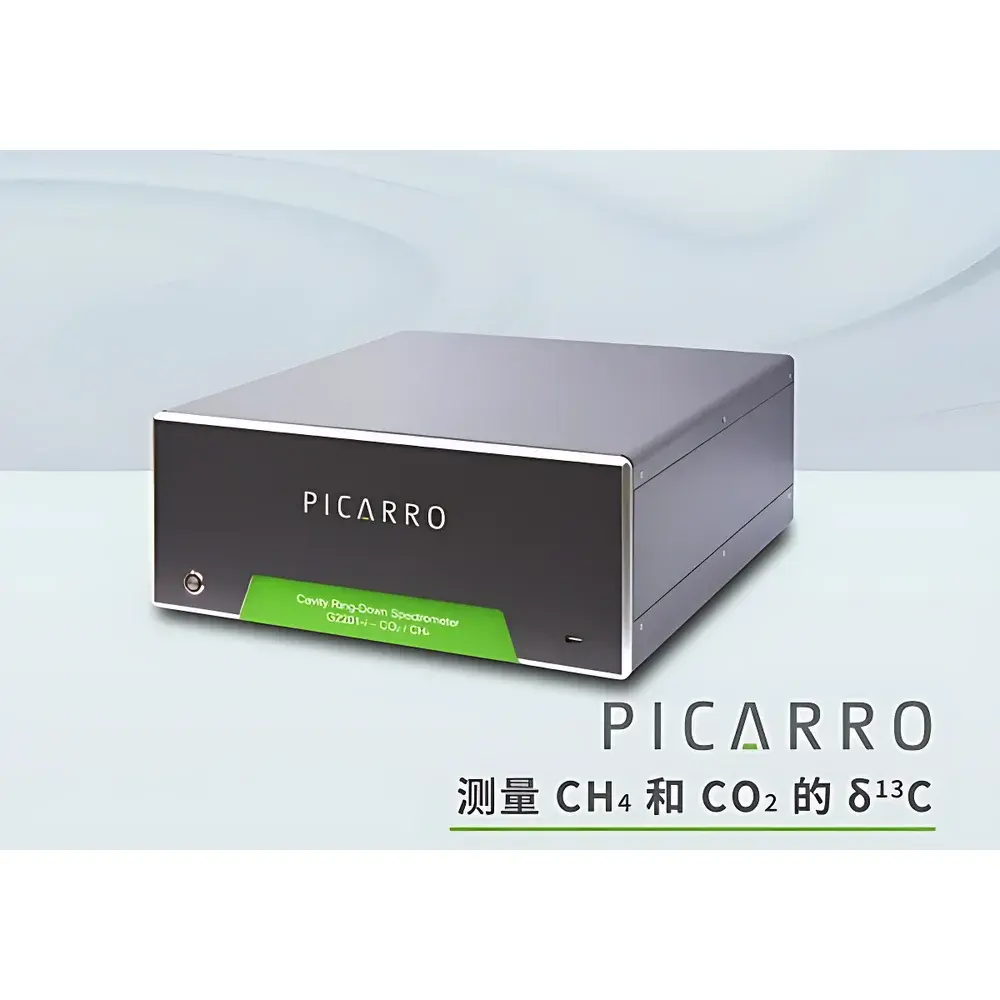
Picarro G2201-i Cavity Ring-Down Spectroscopy (CRDS) Isotope Ratio Analyzer for δ¹³C in CO₂ and CH₄
| Brand | Picarro |
|---|---|
| Origin | USA |
| Model | G2201-i |
| Instrument Type | Stable Gas Isotope Ratio Analyzer |
| Measurement Precision | δ¹³C-CO₂ < 0.12‰ (1σ, 1 hr), δ¹³C-CO₂/δ¹³C-CH₄ dual-species mode < 0.16‰ (1σ, 1 hr) |
| Measured Species | CO₂, CH₄, H₂O |
| Operating Principle | Cavity Ring-Down Spectroscopy (CRDS) |
| Temperature Stability | ±0.005 °C (cavity) |
| Pressure Stability | ±0.0002 atm (cavity) |
| Sample Flow Rate | < 50 sccm (typ. 25 sccm at 760 Torr) |
| Dimensions | 43.2 × 17.8 × 44.6 cm (W×H×D) |
| Weight | 25.4 kg (incl. external pump) |
Overview
The Picarro G2201-i is a field-deployable, high-precision cavity ring-down spectroscopy (CRDS) isotope ratio analyzer engineered for simultaneous, real-time measurement of δ¹³C in carbon dioxide (CO₂) and methane (CH₄) — two critical greenhouse gases central to biogeochemical cycling, emissions attribution, and climate feedback studies. Unlike traditional isotope ratio mass spectrometry (IRMS), which requires cryogenic trapping, vacuum systems, and consumable filaments, the G2201-i employs wavelength-scanned CRDS technology to quantify isotopic ratios via direct absorption spectroscopy within an ultra-stable optical cavity. This enables trace-level detection without sample pre-concentration or chemical conversion, delivering laboratory-grade precision in portable form factor. Its dual-molecule capability eliminates the need for parallel instruments or sequential switching, allowing researchers to resolve co-located isotopic signatures from shared carbon sources — such as wetland emissions, ruminant respiration, fossil fuel combustion, or microbial methanogenesis — with temporal synchronization at sub-minute intervals.
Key Features
- Simultaneous δ¹³C measurement in CO₂ and CH₄ using a single optical cavity and integrated laser system
- Three operational modes: CO₂-only, CH₄-only, and interleaved CO₂/CH₄ dual-species mode (measurement cycle ≈ 3–5 seconds per species)
- Exceptional long-term stability: δ¹³C drift < 0.6‰ over 24 hours (1-hour averaging) for CO₂; < 1.15‰ for CH₄ under high-dynamic-range conditions
- Thermally and barometrically stabilized measurement cavity (±0.005 °C temperature control; ±0.0002 atm pressure control)
- Ruggedized design compliant with MIL-STD-810F for shock and vibration resistance — validated for field deployment in remote or mobile platforms
- No consumables required: operates without carrier gases, filaments, or cryogens; minimal calibration frequency compared to IRMS or tunable diode laser (TDL) systems
- Integrated H₂O concentration measurement (0–5% RH) with cross-interference correction algorithms for isotopic accuracy
Sample Compatibility & Compliance
The G2201-i accepts ambient or controlled gas streams across a broad operational envelope: sample temperature from −10 °C to +45 °C, pressure from 300–1000 Torr (40–133 kPa), and flow rate < 50 sccm. It is compatible with standard Swagelok® 1/4″ inlet fittings and supports both open-path and closed-loop configurations. While optimized for dry-to-moderately-humid samples (< 99% RH, non-condensing), its onboard water vapor quantification allows real-time correction of isotopic fractionation effects. Interferences from NH₃, C₂H₆, C₂H₄, SO₂, or other organosulfur compounds are documented; users must verify sample matrix compatibility prior to deployment. The instrument meets environmental operating specifications per IEC 61000-6-2 (immunity) and IEC 61000-6-3 (emissions), and supports audit-ready data logging aligned with GLP/GMP principles — including time-stamped raw absorbance spectra, cavity ring-down times, and diagnostic flags.
Software & Data Management
Picarro’s proprietary Analyzers Control Software (ACS) provides intuitive configuration, real-time visualization, and automated calibration workflows. All measurements are timestamped with GPS-synchronized UTC, and raw spectral data (ring-down decay curves, fitted line intensities, baseline offsets) are stored in HDF5 format for traceability. Export options include CSV, NetCDF, and XML, enabling integration with third-party platforms such as LabVIEW, MATLAB, or Python-based analysis pipelines. The system supports remote monitoring via Ethernet or RS-232, and optional secure authentication protocols satisfy requirements for regulated environments under FDA 21 CFR Part 11 — including electronic signatures, audit trails, and role-based access control when deployed with Picarro’s enterprise server suite.
Applications
- Atmospheric flux studies: eddy covariance towers, aircraft campaigns, and drone-based surveys requiring synchronized δ¹³C-CO₂ and δ¹³C-CH₄ to partition biospheric vs. anthropogenic sources
- Soil and sediment biogeochemistry: in situ monitoring of methanogenic pathways (acetoclastic vs. hydrogenotrophic) and carbon turnover rates
- Carbon capture and storage (CCS) verification: isotopic fingerprinting of injected CO₂ plumes and potential leakage detection
- Waste management and landfill monitoring: source apportionment of fugitive CH₄ emissions using δ¹³C-CH₄/δ¹³C-CO₂ covariation
- Ecological tracer studies: tracking carbon assimilation pathways in C3/C4 plants, mycorrhizal networks, or aquatic food webs
- Calibration reference generation: supporting inter-laboratory comparison exercises and secondary standard development under ISO 17025-accredited protocols
FAQ
What measurement principle does the G2201-i use?
It employs cavity ring-down spectroscopy (CRDS), a highly sensitive absorption technique that measures the decay rate of laser light trapped in a high-finesse optical cavity to determine isotopic ratios with ppm-level precision.
Can the instrument measure δ¹³C in both CO₂ and CH₄ at the same time?
Yes — in CO₂/CH₄ interleaved mode, it alternates measurements every few seconds, providing temporally aligned isotopic data without hardware duplication.
Does the G2201-i require external calibration gases during routine operation?
Calibration frequency is significantly reduced versus IRMS or conventional laser systems; however, periodic validation using certified reference materials (e.g., NIST SRM 1610, USGS24, IAEA-CH-7) is recommended for long-term traceability.
Is the system suitable for unattended operation in remote locations?
Yes — its low power consumption (< 260 W total), wide ambient temperature tolerance (10–35 °C operational), and robust mechanical design support continuous field deployment with solar or battery backup integration.
How does water vapor affect isotopic accuracy, and how is it corrected?
H₂O is measured concurrently and used to apply empirically derived spectral interference corrections; performance remains within specification up to 2.4% H₂O (v/v) without external drying.
Related Products




