
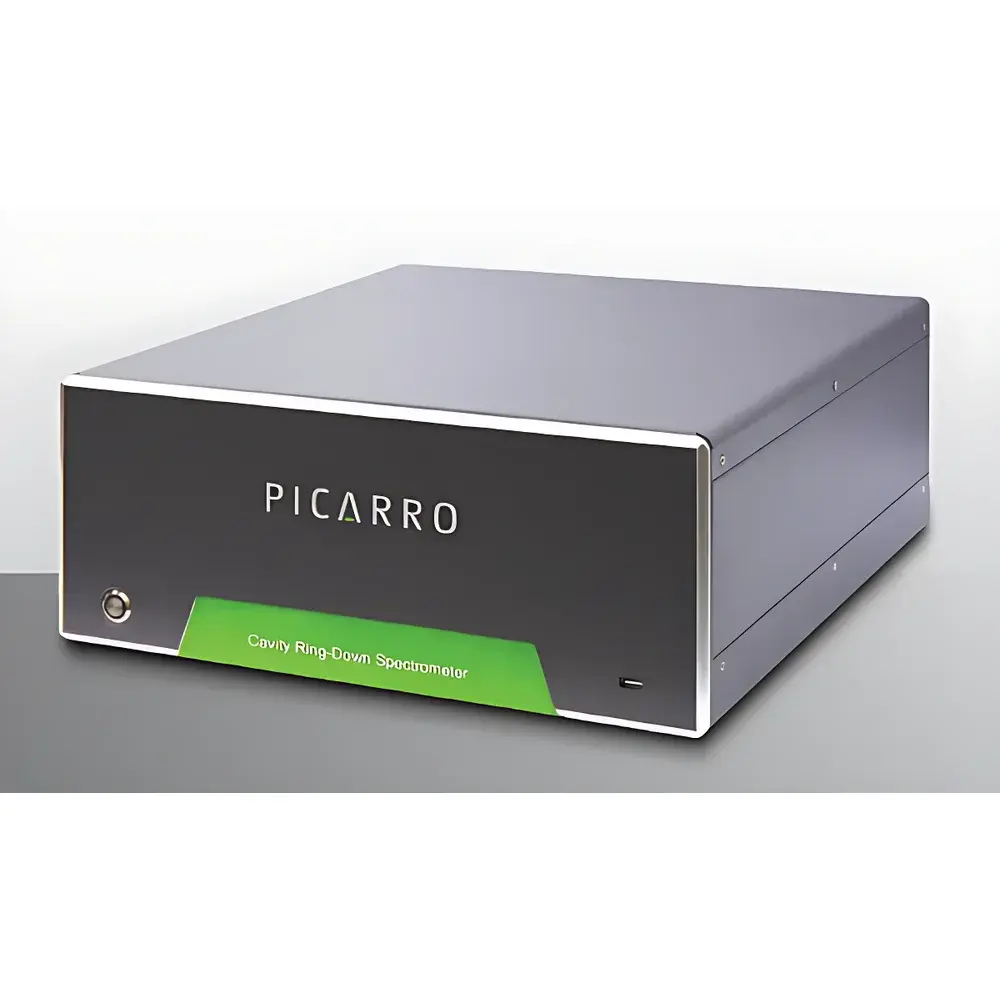
Picarro G2203 High-Precision Cavity Ring-Down Spectroscopy (CRDS) Analyzer for Methane (CH₄) and Acetylene (C₂H₂)
| Brand | Picarro |
|---|---|
| Origin | USA |
| Model | G2203 |
| Detection Principle | Cavity Ring-Down Spectroscopy (CRDS) |
| Target Gases | Methane (CH₄) and Acetylene (C₂H₂) |
| Measurement Sensitivity | Sub-ppb |
| Response Time | <2 seconds |
| CH₄ Precision (2-s) | 3 ppb |
| C₂H₂ Precision (2-s) | <0.6 ppb |
| CH₄ Drift (8-h, STP) | <4 ppb |
| C₂H₂ Drift (8-h, STP) | <1.5 ppb |
| Environmental Stability | Engineered for minimal thermal drift across −10 °C to +45 °C operating range |
Overview
The Picarro G2203 is a field-deployable, high-precision gas concentration analyzer engineered for simultaneous, continuous, and real-time quantification of methane (CH₄) and acetylene (C₂H₂) at sub-parts-per-trillion (ppt) to parts-per-trillion (ppt) sensitivity levels. It employs proprietary Cavity Ring-Down Spectroscopy (CRDS), a laser-based absorption technique that achieves exceptional detection limits through ultra-long effective pathlengths (>20 km optical path within a compact 35 cm cavity) and precise temporal measurement of photon decay rates. Unlike conventional NDIR or TDLAS systems, CRDS delivers inherent immunity to laser intensity fluctuations and optical misalignment—critical for long-term unattended operation in remote environmental monitoring sites. The G2203 is specifically optimized for trace-gas applications where CH₄ source attribution and emission rate quantification are required, leveraging C₂H₂ as a stable, non-reactive tracer co-emitted with CH₄ from anthropogenic sources such as landfills, natural gas infrastructure, and biogas facilities.
Key Features
- Simultaneous dual-species detection: Real-time, independent concentration time series for CH₄ and C₂H₂ at 2 Hz sampling frequency
- Sub-ppb precision: 3 ppb (2σ, 2-second average) for CH₄ and <0.6 ppb for C₂H₂ under standard temperature and pressure (STP)
- Ultra-low instrumental drift: <4 ppb (CH₄) and <1.5 ppb (C₂H₂) over 8 hours at STP—enabling extended calibration intervals and reduced maintenance overhead
- Thermally robust optical architecture: Actively temperature-stabilized cavity and laser subsystems ensure consistent performance across ambient temperatures from −10 °C to +45 °C
- Integrated sample handling: Built-in mass flow controller, particulate filter, and moisture-resistant inlet path compatible with ambient air, stack gas, and soil gas sampling configurations
- Modular communications interface: Ethernet (TCP/IP), RS-232, and digital I/O ports support seamless integration into SCADA, data loggers, and centralized telemetry networks
Sample Compatibility & Compliance
The G2203 is validated for direct analysis of ambient air, landfill gas, natural gas vent streams, and biogas without pre-concentration or chemical scrubbing. Its CRDS methodology conforms to the physical measurement principles referenced in EPA Method OTM-33 (Optical Remote Sensing for Quantitative Emission Rate Determination) when deployed in conjunction with spatial mapping protocols. While not a certified reference method per se, its performance characteristics meet or exceed the metrological requirements outlined in ISO 14064-3 for GHG quantification verification and ASTM D6522–22 for ambient hydrocarbon measurement. Data integrity complies with GLP/GMP-aligned audit trail requirements via timestamped metadata, firmware-level checksum validation, and user-access logging—facilitating compliance with regulatory reporting frameworks including the U.S. EPA Greenhouse Gas Reporting Program (GHGRP) and EU MRV (Monitoring, Reporting, Verification).
Software & Data Management
Picarro’s Analyze software provides full instrument control, spectral diagnostics, and real-time visualization via Windows-based desktop application or web browser interface. All measurements are stored locally in standardized HDF5 format with embedded calibration coefficients, pressure/temperature sensor readings, and cavity health metrics. Remote access is enabled via secure RDP or SSH tunneling; scheduled data export (CSV/NetCDF) can be configured for automated FTP/SFTP upload to cloud repositories or enterprise LIMS platforms. Firmware supports configurable alarm thresholds, event-triggered data capture, and time-synchronized logging with GPS-derived timestamps—essential for mobile surveys and fence-line monitoring deployments.
Applications
- Quantitative fugitive emission monitoring at landfills, LNG terminals, compressor stations, and well pads using C₂H₂ as a conservative tracer
- Mobile ground-based surveys (e.g., vehicle-mounted or backpack configurations) aligned with EPA OTM-33 and CALPUFF dispersion modeling inputs
- Long-term background station monitoring for atmospheric CH₄ trend analysis and regional source apportionment
- Calibration transfer and validation of open-path sensors (OP-FTIR, DOAS) and drone-based payloads
- Research-grade studies on microbial CH₄ oxidation kinetics where C₂H₂ serves as a selective inhibitor of methanotrophic activity
FAQ
What is the recommended calibration frequency for the G2203 in continuous monitoring mode?
Typical field deployments utilize zero-air and two-point span calibration every 7–14 days, depending on ambient particulate loading and regulatory requirements. Automated zero/span sequences can be scheduled via software.
Can the G2203 operate unattended for extended periods in remote locations?
Yes—designed for >6-month unattended operation with optional external power management (12–24 V DC), environmental enclosure, and cellular telemetry modules.
Is the G2203 compliant with FDA 21 CFR Part 11 for regulated pharmaceutical or biogas facility use?
While not pre-certified, its audit trail functionality, electronic signature support, and role-based access control meet foundational Part 11 requirements; site-specific validation documentation is supported by Picarro’s IQ/OQ protocols.
How does the G2203 handle water vapor interference in humid samples?
The CRDS cavity operates under controlled pressure and temperature; spectral fitting algorithms include H₂O line broadening corrections, and optional Nafion dryers or chilled mirrors may be integrated upstream for extreme humidity conditions (>95% RH).
What are the minimum sample flow rate and pressure requirements?
Optimal performance is achieved at 0.5–1.0 SLPM and 700–1050 hPa absolute pressure; internal pressure regulation maintains cavity stability across variable inlet conditions.
Related Products







