
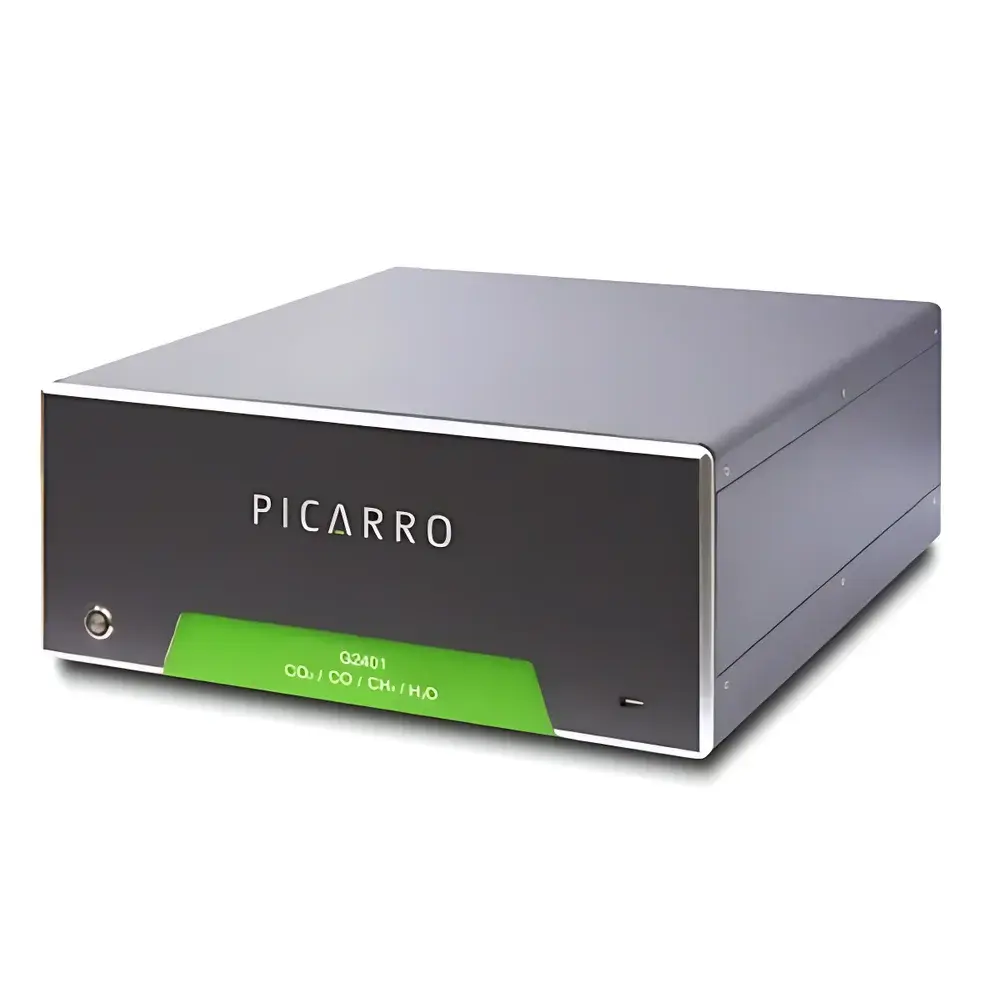
Picarro G2401 High-Precision Multicomponent Greenhouse Gas Analyzer
| Brand | Picarro |
|---|---|
| Origin | USA |
| Model | G2401 |
| Principle | Cavity Ring-Down Spectroscopy (CRDS) |
| Form Factor | Benchtop/Field-Deployable |
| Response Time | < 5 s |
| Repeatability | CO₂, CH₄, CO, H₂O |
| Measurement Range | CO₂ (0–1000 ppm), CH₄ (0–20 ppm), CO (0–5 ppm), H₂O (0–7 %v/v) |
| Accuracy (1σ, 5 s) | CO₂ < 50 ppb, CH₄ < 1 ppb, CO < 15 ppb, H₂O < 30 ppm |
| Drift (24 h, peak-to-peak) | CO₂ 100 ppb, CH₄ 1 ppb, CO 10 ppb, H₂O ±5% of reading |
| Temperature Control Stability | ±0.005 °C |
| Pressure Control Stability | ±0.0002 atm |
| Operating Temp | +10 to +35 °C |
| Storage Temp | −10 to +50 °C |
| Power | 100–240 VAC, 47–63 Hz |
| Weight | 27.4 kg (incl. external pump) |
| Dimensions (Analyzer) | 43.2 × 17.9 × 44.5 cm |
Overview
The Picarro G2401 is a high-precision, field-deployable multicomponent gas analyzer engineered for continuous, simultaneous quantification of carbon dioxide (CO₂), methane (CH₄), carbon monoxide (CO), and water vapor (H₂O) in ambient air. It employs proprietary Cavity Ring-Down Spectroscopy (CRDS), a laser-based absorption technique that achieves effective optical path lengths exceeding 20 km within a compact, thermally and pressure-stabilized optical cavity. This enables part-per-trillion (ppt)-level detection limits and sub-ppb precision without requiring frequent calibration or reference gases. The instrument delivers dry-mole-fraction measurements for CO₂, CH₄, and CO using Picarro’s embedded water-vapor correction algorithm—eliminating the need for external drying or dilution systems. Designed for unattended operation over extended periods, the G2401 exhibits negligible long-term drift (< 1 ppb/month for CH₄; < 500 ppb/month for CO₂), making it suitable for compliance-grade atmospheric monitoring networks including the World Meteorological Organization (WMO) Global Atmosphere Watch (GAW) and the Integrated Carbon Observation System (ICOS).
Key Features
- Simultaneous, real-time measurement of CO₂, CH₄, CO, and H₂O at < 5-second intervals with no cross-interference
- CRDS-based optical architecture with active thermal control (±0.005 °C) and pressure regulation (±0.0002 atm) for ultra-stable baseline performance
- Dry-mole-fraction reporting enabled by on-board water-vapor spectral correction—no external dryers or permeation dryers required
- Proven environmental robustness: validated across −10 °C to +50 °C storage and +10 °C to +35 °C operational ranges; passed MIL-STD-810F shock and vibration testing
- Low power consumption: < 260 W at startup, ~110 W in steady-state operation; compatible with solar/battery hybrid deployments via optional DC conversion
- Integrated data acquisition system with 160 GB internal SSD, Ethernet, RS-232, USB, and 0–10 V analog output interfaces
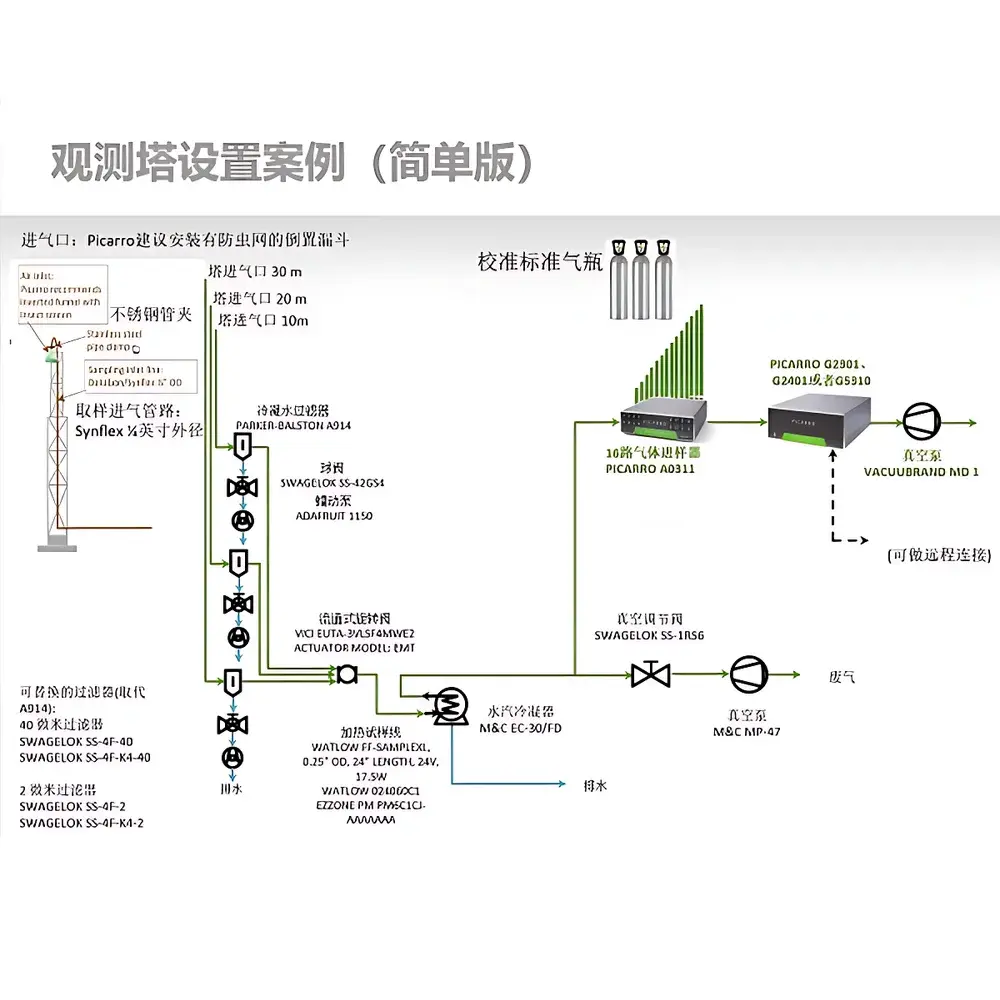
- Modular expandability via Picarro A0311 16-port distribution manifold for multipoint sampling in eddy covariance towers, soil flux chambers, or urban monitoring grids
Sample Compatibility & Compliance
The G2401 accepts untreated ambient air samples across a wide dynamic range: sample pressure 300–1000 Torr (40–133 kPa), humidity up to 99% RH (non-condensing at ≤40 °C), and temperature from −10 °C to +45 °C. Its CRDS cell tolerates particulate-laden streams without filter degradation, provided inlet particulate filtration (e.g., 2 µm stainless-steel sinter) is installed upstream. The analyzer meets WMO GAW Tier 1 data quality objectives for CO₂ (< 50 ppb uncertainty, 2σ, 1-hour average), CH₄ (< 1 ppb), and CO (< 2 ppb). It also satisfies ICOS atmospheric station specifications for repeatability (< 0.5 ppb CH₄, < 50 ppb CO₂ over 10 minutes, 1σ) and long-term stability. All firmware and data handling routines comply with GLP principles; audit trails, user access logs, and electronic signatures are configurable per FDA 21 CFR Part 11 requirements when paired with Picarro’s compliant software suite.
Software & Data Management
Picarro’s proprietary Analyzers Software Suite (v3.x) provides intuitive instrument control, real-time spectral visualization, automated diagnostics, and customizable reporting templates. Raw absorbance spectra, cavity ring-down times, and derived mole fractions are timestamped and stored with metadata (temperature, pressure, flow rate, laser current). Data export supports CSV, NetCDF, and ASCII formats compatible with FluxNet, ICOS Central Data Archive, and NOAA GML ingestion pipelines. Remote monitoring and configuration are supported via secure HTTPS or SSH. Optional Picarro Data Logger (PDL) firmware enables autonomous logging during network outages, with automatic resynchronization upon reconnection. All software modules undergo annual NIST-traceable verification and version-controlled release management aligned with ISO/IEC 17025 documentation standards.
Applications
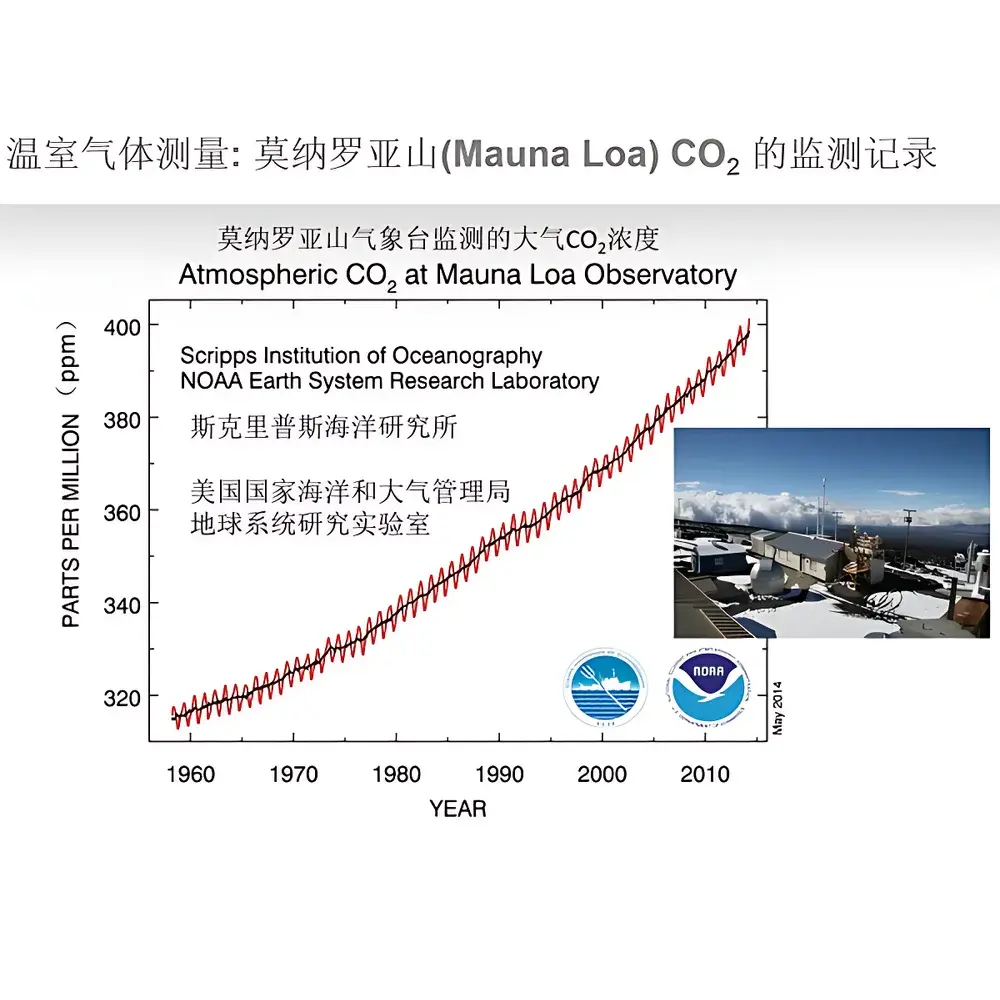
- Atmospheric greenhouse gas monitoring at WMO/GAW and ICOS stations
- Eddy covariance flux measurements over forests, wetlands, and agricultural sites
- Urban air quality networks tracking CO–CO₂–CH₄ co-emission patterns
- Soil-atmosphere exchange studies using automated chamber systems
- Calibration transfer and intercomparison campaigns between mobile labs and fixed observatories
- Verification of satellite-derived XCO₂ and XCH₄ products (e.g., OCO-2, TROPOMI)
- Industrial fugitive emission detection via differential column measurements
FAQ
Does the G2401 require daily calibration with certified gas standards?
No. The CRDS architecture provides intrinsic stability; routine calibration is recommended only every 3–6 months using traceable multi-point standards to verify linearity and zero offset.
Can the G2401 operate unattended for >30 days in remote field locations?
Yes. With proper power conditioning (e.g., regulated AC or DC input), inlet filtration, and environmental enclosure, the G2401 has demonstrated >120-day continuous uptime in Arctic, alpine, and tropical deployments.
How does the instrument handle variable water vapor concentrations?
It applies first-principles spectroscopic correction in real time using high-resolution H₂O absorption features measured concurrently—enabling accurate dry-mole-fraction reporting without physical drying.
Is the G2401 compliant with EPA Method TO-15 or ISO 13861 for ambient VOC analysis?
No. The G2401 is optimized for permanent gases (CO₂, CH₄, CO, H₂O); it is not designed for volatile organic compound (VOC) speciation or quantification.
What maintenance is required beyond routine inlet filter replacement?
Annual inspection of optical cavity cleanliness, laser diode health check, and pressure sensor recalibration—typically performed by Picarro-certified field service engineers.







