
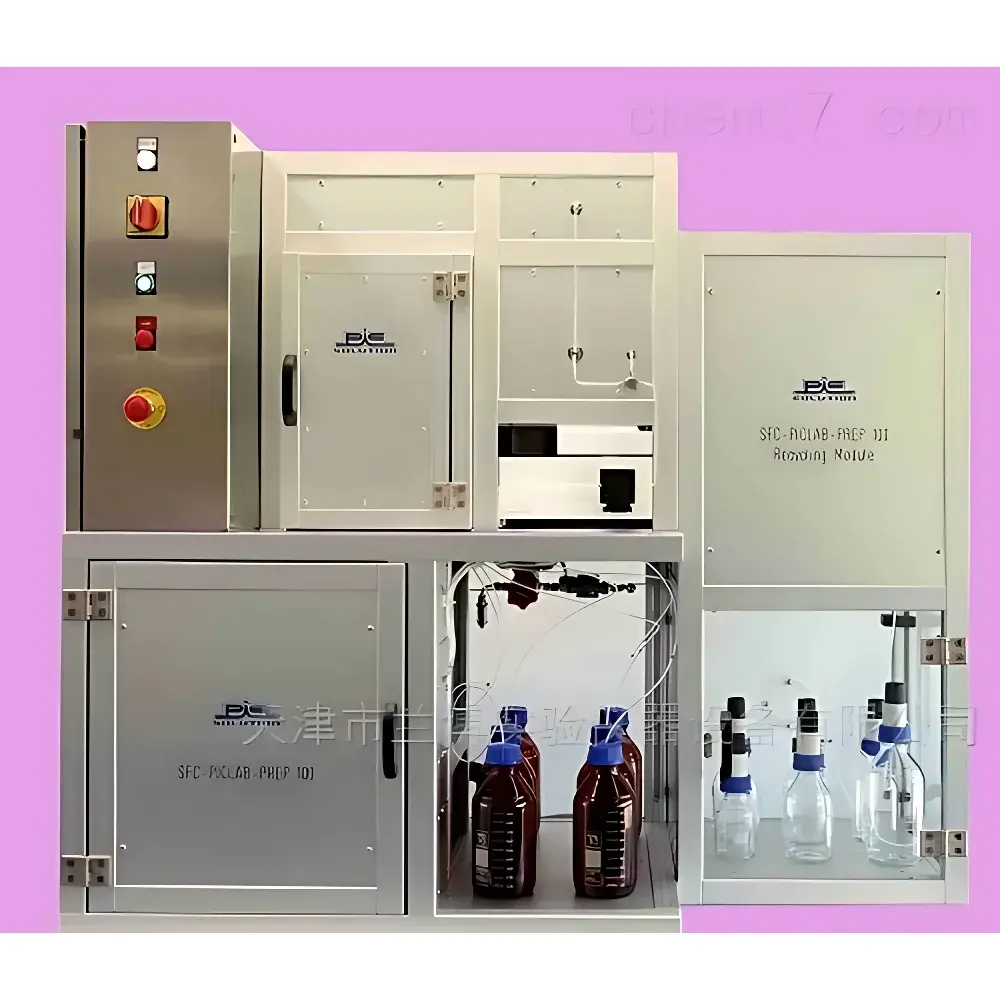
PICLab Supercritical Fluid Chromatograph (SFC) System by LABA
| Brand | LABA (Tianjin Lanbo) |
|---|---|
| Origin | France |
| Model Series | PICLab 100 / 150 / 200 / 600 / 1000 |
| Instrument Type | Preparative SFC System |
| Detector Options | DAD, UV-Vis, Mass Spectrometer (MS) |
| Maximum Operating Pressure | 350 bar |
| CO₂ Flow Rate Range | 10–1000 mL/min |
| Application Modes | Analytical, Semi-Preparative (up to 100 g), and Preparative (gram-to-kilogram scale) |
| CO₂ Recycling Capability | Standard on PICLab 150 and above |
| Compliance | Designed for GLP-compliant laboratories |
Overview
The PICLab Supercritical Fluid Chromatograph (SFC) is a modular, high-pressure chromatographic platform engineered for both method development and scalable purification of chiral and thermally labile compounds. Unlike conventional liquid chromatography (LC), PICLab leverages supercritical carbon dioxide (scCO₂) as the primary mobile phase—operating above its critical point (31.1 °C, 73.8 bar)—to achieve superior solvating power, low viscosity, and high diffusivity. This enables rapid mass transfer, sharp peak resolution, and significantly reduced analysis and purification cycle times—often completing chiral separations in under five minutes. The system’s architecture integrates precise back-pressure regulation, temperature-controlled columns, and programmable modifier delivery to maintain thermodynamic stability of the supercritical fluid throughout gradient elution. As scCO₂ is non-toxic, non-flammable, and fully recoverable via integrated recycling loops, the PICLab platform aligns with green chemistry principles while lowering solvent consumption, waste disposal costs, and occupational safety risks compared to traditional HPLC or flash chromatography.
Key Features
- Modular design supporting analytical, semi-preparative (≤100 g per run), and preparative (1 g–1 kg per batch) workflows on a single platform—no hardware reconfiguration required.
- High-pressure capability up to 350 bar, enabling optimization of density-dependent selectivity across diverse compound classes including APIs, natural products, and synthetic intermediates.
- Wide CO₂ flow control range (10–1000 mL/min) with dual-piston pump technology ensuring pulse-free delivery and long-term flow stability (RSD < 0.2% over 24 h).
- Integrated CO₂ recirculation loop (standard on PICLab 150 and higher models) reduces CO₂ consumption by >85% and eliminates venting during fraction collection.
- Automated modifier blending system for precise, real-time adjustment of ethanol, methanol, or isopropanol concentration (0–40% v/v) to fine-tune elution strength without manual intervention.
- Intuitive touchscreen interface coupled with PC-based control software featuring sequence-driven operation, method archiving, and full parameter logging compliant with ALCOA+ data integrity standards.
Sample Compatibility & Compliance
The PICLab SFC demonstrates broad applicability for enantiomeric separations—particularly for chiral pharmaceuticals, agrochemicals, and fragrances—using immobilized polysaccharide-based columns (e.g., Chiralpak IA/IB/IC, Chiralcel OD/OJ). It accommodates samples ranging from microgram-scale analytical injections to multi-gram crude mixtures requiring baseline resolution and high recovery (>95%) with purity exceeding 99% (by GC/HPLC assay). All PICLab configurations comply with ISO/IEC 17025 requirements for testing laboratories and support validation protocols aligned with ICH Q2(R2) and USP <621>. When deployed with 21 CFR Part 11–enabled software, the system provides electronic signatures, user access controls, and immutable audit trails suitable for FDA-regulated environments operating under GMP/GLP frameworks.
Software & Data Management
The proprietary PICLab Control Suite offers unified management of method development, automated fraction collection, and post-run data evaluation. It includes built-in tools for retention time prediction, peak tracking across gradients, and dynamic adjustment of collection windows based on UV/DAD spectral thresholds. Raw data files are stored in vendor-neutral .cdf format, compatible with third-party chemometric packages (e.g., Simca, Unscrambler). All system events—including pressure transients, temperature deviations, and valve actuation—are timestamped and logged with metadata traceability. Software validation documentation (IQ/OQ/PQ protocols) is available upon request for regulated users.
Applications
- Chiral resolution of racemic drug candidates during early-stage development and clinical supply synthesis.
- Purification of sensitive biomolecules (e.g., peptides, oligonucleotides) where thermal degradation limits reversed-phase HPLC utility.
- Isolation of natural product analogues from plant extracts with minimal co-elution and high recovery yield.
- Green alternative to normal-phase silica chromatography for lipid and sterol separation—eliminating chlorinated solvents.
- Method scouting and transfer between analytical and preparative scales using identical column chemistries and mobile phase conditions.
FAQ
Can the same column be used for both analytical and preparative runs?
Yes—PICLab supports seamless method translation using identical stationary phases across all models, provided flow rate and injection volume are scaled proportionally.
Is CO₂ recycling mandatory for operation?
No—systems can operate in open-loop mode—but recycling is enabled by default on PICLab 150+ to ensure economic and environmental sustainability.
What detector interfaces are supported for hyphenated analysis?
Standard configurations include UV-Vis and diode-array detectors; optional MS coupling (ESI/APCI) is available with dedicated SFC-MS transfer line and pressure-decoupling interface.
How is system performance verified after installation?
Each unit ships with a certified test report including pressure calibration, flow accuracy verification at multiple setpoints, and gradient dwell volume measurement per ASTM D7212.
Does the software support remote monitoring and troubleshooting?
Yes—the Control Suite includes secure HTTPS-based remote access with role-based permissions, enabling off-site diagnostics and method review without compromising network security.





