
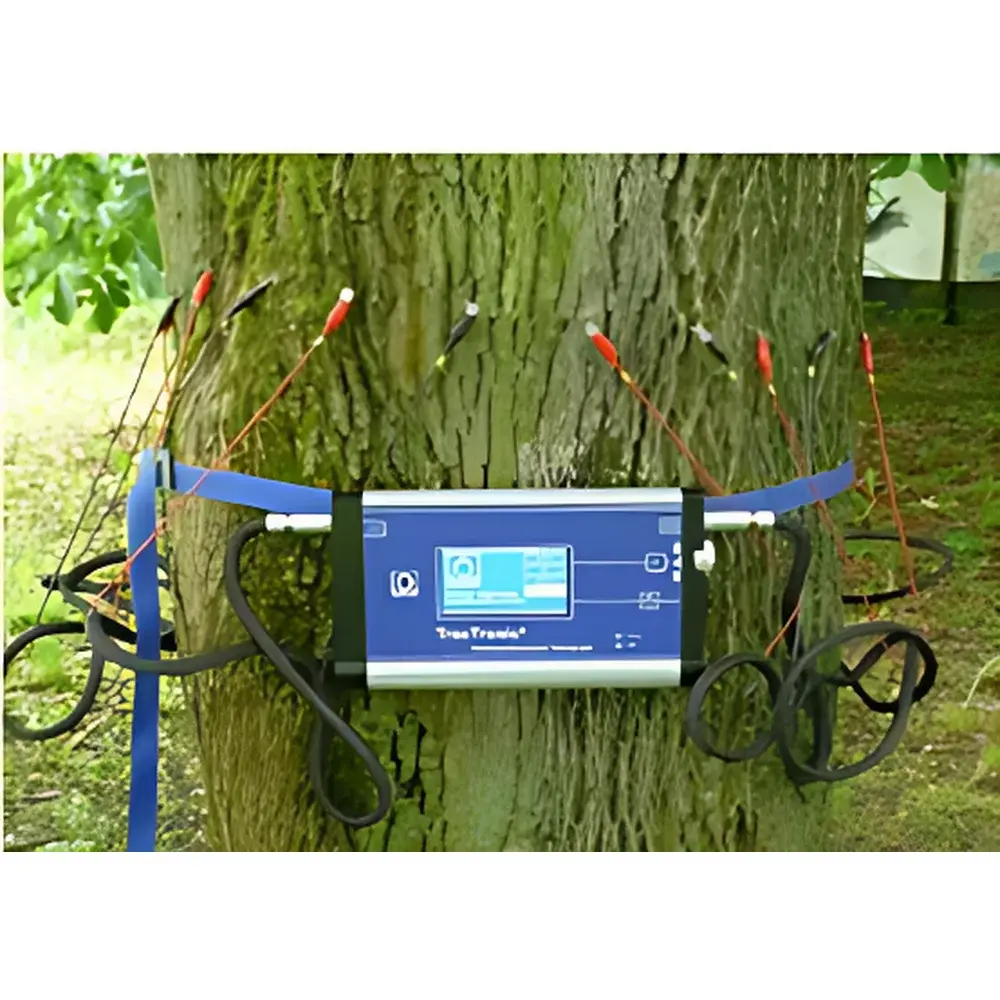
PiCUS TreeTronic 3 Electrical Resistance Tomography (ERT) Scanner
| Brand | Argus |
|---|---|
| Origin | Germany |
| Model | PiCUS TreeTronic 3 |
| Measurement Principle | Electrical Resistance Tomography |
| Max Electrode Count | 24 |
| Minimum Electrodes Required | 10 |
| Max Output Current | 20 mA |
| Max Output Voltage | 80 V |
| Measurement Modes | Two-point & Three-point |
| Electrode Cable Length | 3.5 m |
| Tree Diameter Range | 3–250 cm (extendable) |
| Onboard Storage | >100 scans |
| Display | Color LCD (real-time ERT visualization) |
| Data Transfer | USB 2.0 / Bluetooth |
| Integrated GPS & Bluetooth | Yes |
| Battery Life | >4 h continuous operation |
| Charging Time | ≤2 h |
| Weight | 8.9 kg |
| Dimensions | 55 × 42 × 13 cm |
| Optional Electronic Dendrometer | Range 160 mm–2150 cm, Stainless Steel Construction, LED Display, Bluetooth Sync |
Overview
The PiCUS TreeTronic 3 is a field-deployable, battery-powered Electrical Resistance Tomography (ERT) scanner engineered for non-invasive assessment of internal tree structure and physiological status. Based on the principle of injecting low-frequency alternating current (up to 20 mA at 80 V) between pairs or triplets of surface-mounted electrodes, the system measures voltage potentials across the trunk cross-section to reconstruct two-dimensional resistivity distributions. Since electrical resistivity in woody tissue correlates strongly with moisture content, cell integrity, lignin distribution, and presence of decay-associated electrolytes (e.g., organic acids from fungal metabolism), ERT enables quantitative differentiation between healthy sapwood, reaction wood, decayed zones, and cavities. Unlike destructive coring or visual inspection, the PiCUS TreeTronic 3 delivers spatially resolved diagnostics without mechanical damage—making it suitable for longitudinal monitoring of urban trees, heritage specimens, orchard stock, and forest inventory applications.
Key Features
- Compact, integrated control unit with embedded color LCD display—enables real-time ERT image generation and interpretation without external computing devices.
- Dual-cable electrode configuration with spring-loaded alligator clips for rapid, repeatable sensor placement on irregular bark surfaces.
- Support for up to 24 stainless-steel electrodes; minimum operational count is 10—increased electrode density improves spatial resolution and inversion stability.
- Onboard storage capacity exceeds 100 full-resolution ERT scans, each timestamped and georeferenced via integrated GPS module.
- Lightweight design (8.9 kg) and ergonomic form factor (55 × 42 × 13 cm) optimized for single-operator field deployment across diverse terrain.
- Dual communication interfaces: USB 2.0 for bulk data export and Bluetooth 4.0 for wireless synchronization with mobile tablets or laptops running PiCUS software.
- Rechargeable lithium-ion battery provides >4 hours of continuous scanning; full recharge completes in under 2 hours.
- Two validated measurement protocols: two-point (dipole-dipole) and three-point (Wenner-type) configurations—selected based on target resolution, trunk geometry, and bark conductivity variability.
Sample Compatibility & Compliance
The PiCUS TreeTronic 3 is validated for use on living, standing trees with diameters ranging from 3 cm (young saplings) to 250 cm (mature hardwoods); larger specimens may be assessed using optional extension cables. It accommodates broadleaf and coniferous species—including but not limited to Fagus sylvatica, Quercus robur, Acer platanoides, and Picea abies. Species-specific baseline resistivity profiles are essential for diagnostic interpretation; reference libraries are maintained per ISO 17941:2017 (“Wood — Non-destructive testing — Guidelines for electrical resistance tomography of standing trees”). The device complies with IEC 61000-6-3 (EMC emission limits) and IEC 61000-6-2 (immunity to electrostatic discharge and RF fields). Its operational safety profile meets EN 61010-1 for portable field instrumentation.
Software & Data Management
Data acquisition and visualization are managed through the proprietary PiCUS Analysis Suite (v5.2+), compatible with Windows 10/11 and macOS 12+. The software supports inversion modeling using finite-element-based algorithms (e.g., Gauss-Newton optimization), generates calibrated resistivity maps (Ω·m), and exports results in GeoTIFF, CSV, and DICOM formats for integration into GIS platforms or long-term monitoring databases. Audit trails record operator ID, GPS coordinates, timestamp, electrode configuration, and raw voltage/current matrices—ensuring traceability aligned with GLP principles. Optional FDA 21 CFR Part 11-compliant modules provide electronic signatures, role-based access control, and immutable log files for regulatory reporting.
Applications
- Early detection of internal decay caused by white-rot or brown-rot fungi—identified by localized low-resistivity zones (<50 kΩ·m) corresponding to elevated moisture and ion concentration.
- Differentiation of stress-induced reaction wood (e.g., tension wood in angiosperms) from normal xylem via characteristic radial resistivity gradients.
- Quantitative mapping of sap flow dynamics during drought response or irrigation trials—correlating temporal resistivity shifts with volumetric water content changes.
- Integration with Sonic Tomography (SoT): Concurrent SoT/ERT analysis enables multi-modal classification of defects—e.g., high sonic velocity + low resistivity indicates early-stage wet rot; low sonic velocity + low resistivity suggests advanced enzymatic degradation.
- Urban forestry risk assessment: Prioritization of hazardous trees based on decay volume estimation (>30% cross-sectional loss) and structural continuity metrics derived from ERT-derived resistivity thresholds.
FAQ
How does ERT distinguish decay from natural heartwood?
Decay zones exhibit significantly lower resistivity than inert heartwood due to increased electrolyte mobility from microbial activity—not merely reduced moisture. Heartwood typically shows uniform, moderately high resistivity (>200 kΩ·m), while decay displays heterogeneous, sharply bounded low-resistivity regions (<80 kΩ·m).
Can the PiCUS TreeTronic 3 be used on palm or bamboo?
No—its inversion algorithms assume radial symmetry and homogeneous cylindrical geometry typical of dicot and gymnosperm trunks. Monocots (e.g., palms, bamboo) lack secondary xylem organization required for reliable ERT reconstruction.
Is calibration required before each scan?
No field calibration is needed; however, electrode contact impedance must remain below 5 kΩ (verified via built-in self-test). Bark moisture, lichen coverage, or deep furrows may necessitate light abrasion or conductive gel application to ensure stable current injection.
What is the spatial resolution limit of the system?
Resolution is depth- and electrode-density-dependent: near-surface features (~0–5 cm depth) resolve down to ~3–5 cm; central regions degrade to ~10–15 cm. Resolution improves with ≥16 electrodes and three-point acquisition.
Does the system meet standards for municipal tree inventories?
Yes—it satisfies DIN 18920 (Germany), BS 5837:2012 (UK), and ISA Best Management Practices for Tree Risk Assessment when deployed by certified arborists following PiCUS-certified training protocols.




