
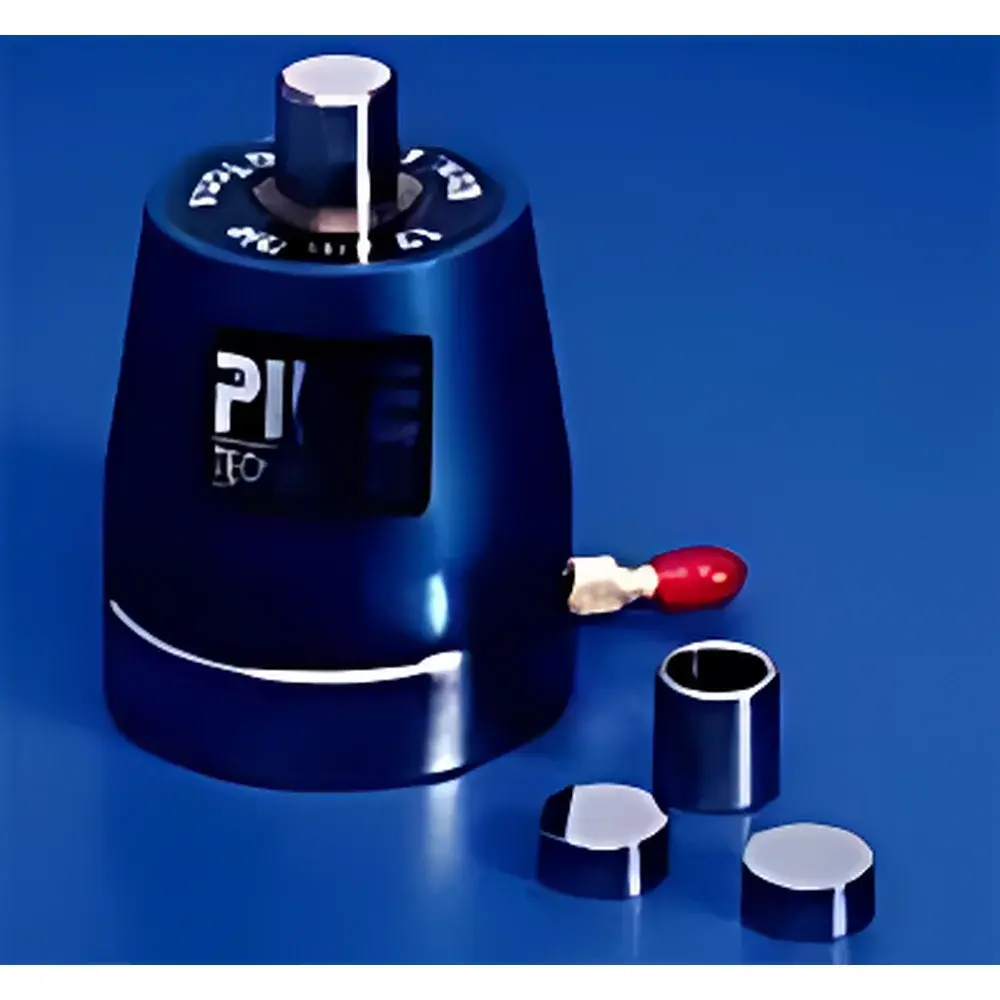
PIKE 160-1900 13 mm Vacuum Pellet Die for FTIR Sample Preparation
| Brand | PIKE |
|---|---|
| Origin | USA |
| Model | 160-1900 |
| Type | Laboratory-Scale IR Sample Preparation Accessory |
| Material | Hardened Stainless Steel |
| Sample Diameter | 13 mm |
| Vacuum Interface | Standard Negative-Pressure Port |
| Includes | Stainless Steel Base with Vacuum Port, 13 mm Die Cavity, Two Polished Pressure Anvils, Precision-Machined Plunger, Two O-Rings (for Plunger Seal and Base Mounting) |
| Surface Finish | Mirror-Polished Contact Surfaces |
| Compliance | Designed for ASTM E1252 and USP <1119> FTIR Sample Preparation Protocols |
Overview
The PIKE 160-1900 13 mm Vacuum Pellet Die is a precision-engineered sample preparation tool designed specifically for transmission-mode Fourier Transform Infrared (FTIR) spectroscopy. It operates on the principle of hydraulic compression under controlled vacuum conditions to produce homogeneous, optically transparent potassium bromide (KBr) pellets containing trace quantities of analyte—enabling quantitative and qualitative molecular identification across the mid-infrared spectral range (typically 4000–400 cm⁻¹). Unlike ambient-pressure die sets, this vacuum-capable configuration actively removes adsorbed moisture and entrapped air from hygroscopic KBr-analyte mixtures prior to and during compaction, thereby minimizing spectral artifacts such as spurious H₂O absorption bands near 3400 cm⁻¹ and 1640 cm⁻¹. The die’s mechanical architecture conforms to established physical requirements for reproducible pellet thickness (typically 0.5–1.5 mm), uniform density distribution, and minimal scattering loss—critical parameters affecting baseline stability, signal-to-noise ratio, and peak shape fidelity in quantitative FTIR analysis.
Key Features
- Hardened stainless steel construction (AISI 420 or equivalent) ensures long-term dimensional stability and resistance to corrosion from halide salts and organic solvents.
- Mirror-polished anvil and cavity surfaces minimize surface adhesion and facilitate clean pellet ejection without residue transfer.
- Integrated vacuum port (standard 1/4″ NPT or Swagelok-compatible) enables connection to laboratory vacuum systems (≤10 mbar recommended) for in-situ degassing prior to compression.
- Interchangeable 13 mm die cavity accommodates standard FTIR sample holders (e.g., 2″ × 3″ card mounts) and aligns with ISO 1833-1 and ASTM E1252 specimen dimension guidelines.
- Dual O-ring sealing system isolates the compression chamber: one seals the plunger-to-base interface; the other secures the base mounting to the hydraulic press platen—preventing vacuum leakage and ensuring consistent pressure transmission.
- Includes two matched, heat-treated anvils and a hardened plunger—each individually calibrated for parallelism within ±0.5 µm to guarantee uniform stress distribution across the pellet cross-section.
Sample Compatibility & Compliance
The 160-1900 die supports a broad spectrum of solid-phase samples compatible with KBr matrix dilution, including pharmaceutical actives, polymers, catalysts, inorganic oxides, and forensic trace evidence. It is routinely employed in regulated environments where method validation is required: its geometry and operational protocol are referenced in ASTM E1252 (“Standard Practice for General Techniques for Qualitative Infrared Analysis”), USP <1119> (“Infrared Absorption Spectrophotometry”), and ICH Q5E (comparability of protein higher-order structure). When used with documented pressure calibration (e.g., 8–15 tons for 13 mm pellets), it supports GLP-compliant documentation of compaction force, dwell time, and vacuum duration—key metadata for audit trails under FDA 21 CFR Part 11.
Software & Data Management
While the 160-1900 die itself is a passive mechanical component, its use integrates seamlessly into digital laboratory workflows. Modern FTIR spectrometers (e.g., Thermo Nicolet iS50, Bruker Tensor II, PerkinElmer Frontier) log acquisition parameters—including pellet batch ID, compression pressure (if instrument-linked load cell is used), and vacuum hold time—directly into proprietary data files (.spa, .opusr, .spc). When paired with LIMS or ELN platforms (e.g., LabVantage, Benchling), operators can attach die-specific metadata (e.g., serial-numbered anvil set, last calibration date, maintenance log) to each spectral record, satisfying traceability requirements for ISO/IEC 17025 accreditation.
Applications
- Pharmaceutical solid-state characterization: polymorph screening, hydrate/solvate identification, and blend uniformity assessment.
- Quality control of raw materials per USP monographs requiring FTIR identity testing.
- Forensic drug analysis under SWGDRUG guidelines for spectral library matching.
- Polymer additive quantification (e.g., plasticizers, flame retardants) via internal standard calibration.
- Environmental microplastic identification in filtered particulate matter using reflectance-corrected transmittance spectra.
FAQ
What vacuum level is recommended for optimal KBr pellet formation?
A final chamber pressure of ≤10 mbar for ≥60 seconds prior to compression is empirically validated to reduce residual moisture without inducing excessive KBr deliquescence.
Can this die be used with hydraulic presses outside the PIKE line?
Yes—the 160-1900 is mechanically agnostic and fits standard 4-inch-diameter press platens; users must verify platen parallelism and maximum rated load (minimum 15 tons recommended).
How often should the O-rings be replaced?
Under routine use (≤50 pellets/week), replace both O-rings every 6 months or after any visible compression set, nicks, or loss of vacuum integrity during leak testing.
Is cleaning required between samples?
Yes—wipe all contact surfaces with spectroscopic-grade methanol followed by dry nitrogen purge; avoid ultrasonic cleaning to preserve mirror finish and dimensional tolerances.
Does PIKE provide calibration certification for this die?
No—calibration applies to force measurement (hydraulic press) and vacuum gauge (external system); PIKE supplies dimensional inspection reports per lot, traceable to NIST standards.




