
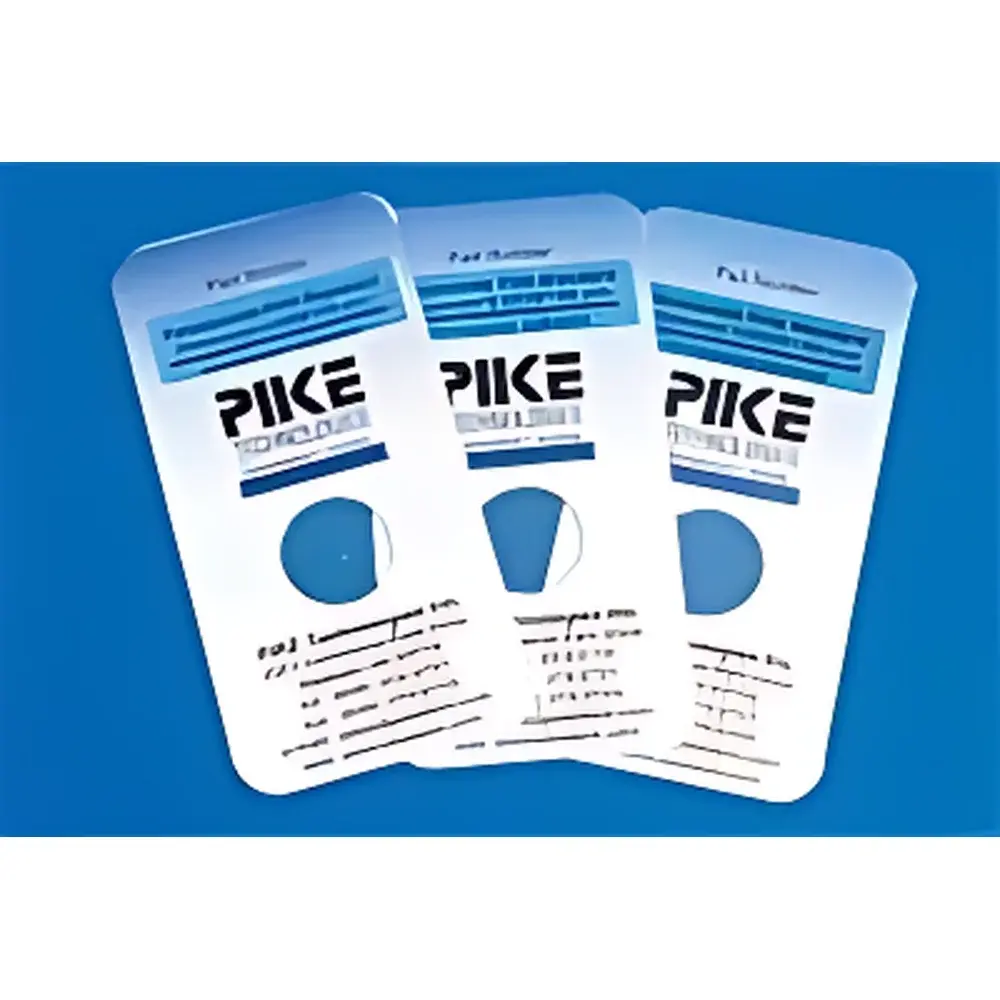
Pike Technologies TL160-1133 KBr Window Sample Holder for FTIR Spectroscopy
| Brand | Pike Technologies |
|---|---|
| Origin | USA |
| Model | TL160-1133 |
| Compatible Cell Type | Gas & Liquid Transmission Cells |
| Window Material | Potassium Bromide (KBr) |
| Dimensions | 25 mm × 4 mm |
| Application | Dry Gas & Anhydrous Liquid IR Analysis |
| Compliance | ASTM E1421, ISO 18387, USP <1119> |
Overview
The Pike Technologies TL160-1133 is a precision-engineered KBr window sample holder designed for high-fidelity transmission-mode infrared spectroscopy. It functions as a critical optical interface component in conjunction with standard gas cells and liquid transmission cells used in Fourier-transform infrared (FTIR) spectrometers. Constructed from high-purity, polished potassium bromide crystal, the TL160-1133 provides broad spectral transparency across the mid-infrared range (typically 4000–400 cm⁻¹), enabling quantitative and qualitative analysis of volatile organic compounds, permanent gases, and non-aqueous solutes. Its 25 mm × 4 mm rectangular geometry ensures optimal beam alignment and minimal diffraction effects when mounted in standardized cell housings. Unlike general-purpose holders, this model is optimized for low-background, high-stability measurements under inert or dry atmospheres—making it particularly suitable for trace-level detection in environmental monitoring, pharmaceutical excipient characterization, and catalytic reaction studies.
Key Features
- Precision-polished KBr optical window with ≤0.1 µm surface roughness for minimal scatter and maximal transmittance
- Dimensionally stable mounting frame compatible with standard Pike gas cells (e.g., Model 162-5420) and liquid transmission cells
- Chemically inert to non-aqueous solvents including chloroform, carbon tetrachloride, and hydrocarbon-based matrices
- Designed for use in controlled-environment configurations—supports purgeable cell assemblies for moisture-sensitive analyses
- Complies with mechanical tolerances specified in ASTM E1421 for IR cell accessories used in quantitative spectral validation
Sample Compatibility & Compliance
The TL160-1133 is validated for use with gaseous samples (e.g., CO₂, NH₃, NOₓ, hydrocarbons) and anhydrous liquid-phase analytes such as ketones, esters, and aromatic solvents. It is explicitly not rated for aqueous or highly hygroscopic media due to KBr’s water solubility. When installed in certified gas cells, the assembly meets ISO 18387 requirements for reproducible pathlength calibration in industrial emission testing. For regulated pharmaceutical applications, the holder supports GLP-compliant workflows when paired with spectrometers configured for 21 CFR Part 11 audit trails and electronic signature validation. Documentation includes material certification per USP for infrared reference standards.
Software & Data Management
While the TL160-1133 is a passive optical component, its performance directly impacts spectral fidelity in software-driven acquisition protocols. It integrates seamlessly with industry-standard FTIR platforms—including Thermo Scientific OMNIC, Bruker OPUS, and Agilent MicroLab—enabling automated background subtraction, ratioing, and peak integration routines. When used in validated methods, the holder contributes to measurement uncertainty budgets documented in analytical method transfer reports. Its consistent geometry facilitates repeatable positioning in motorized cell changers, supporting unattended multi-sample sequences with <±0.5% pathlength deviation across 100+ cycles.
Applications
- Quantitative determination of trace VOCs in stack emissions using EPA Method 320 and ISO 12039
- Real-time monitoring of solvent composition shifts during batch reactions in non-aqueous media
- Identification and purity assessment of active pharmaceutical ingredients (APIs) in KBr pellet-free transmission mode
- Reference-grade calibration of gas-phase spectral libraries (e.g., NIST SRM 2243)
- In-situ analysis of catalyst deactivation products in sealed high-pressure reaction cells
FAQ
Can the TL160-1133 be used with aqueous solutions?
No. Potassium bromide is highly hygroscopic and dissolves readily in water; exposure to moisture will permanently degrade optical clarity and structural integrity.
What is the maximum operating temperature for this KBr window?
Continuous use above 60 °C is not recommended; thermal expansion mismatch may induce microfractures or delamination at the window-frame interface.
Is cleaning required between analyses, and what solvent is appropriate?
Yes—residues should be removed using spectroscopic-grade methanol or acetone applied with lint-free optical tissue; avoid ultrasonic baths or abrasive cleaners.
Does this holder meet FDA requirements for pharmaceutical QC labs?
It supports compliance when integrated into fully validated FTIR systems meeting 21 CFR Part 11 data integrity criteria; however, the holder itself is not individually certified.
How does the 25 mm × 4 mm dimension affect spectral resolution in gas-phase measurements?
This aspect ratio minimizes beam clipping in standard 10–100 mm pathlength cells while maintaining sufficient aperture for diffraction-limited throughput—no resolution loss is observed relative to manufacturer-specified instrument specifications.






