
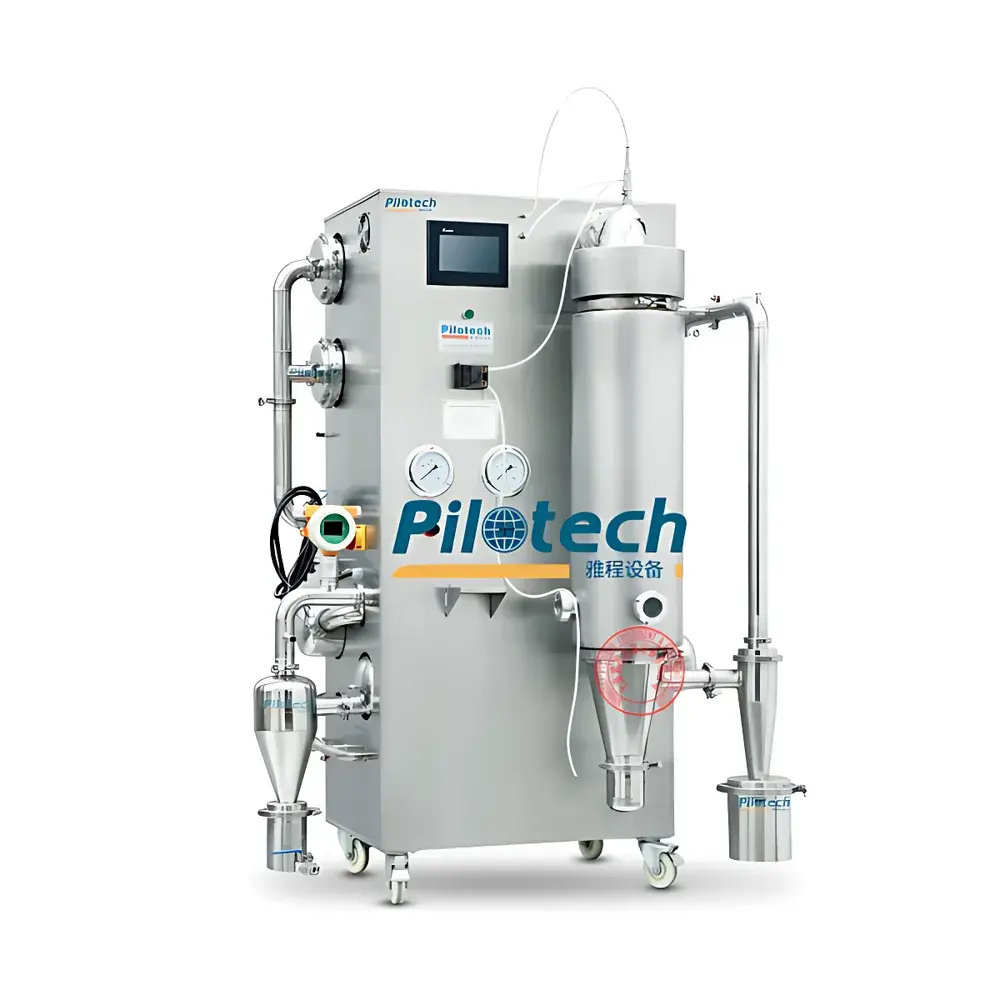
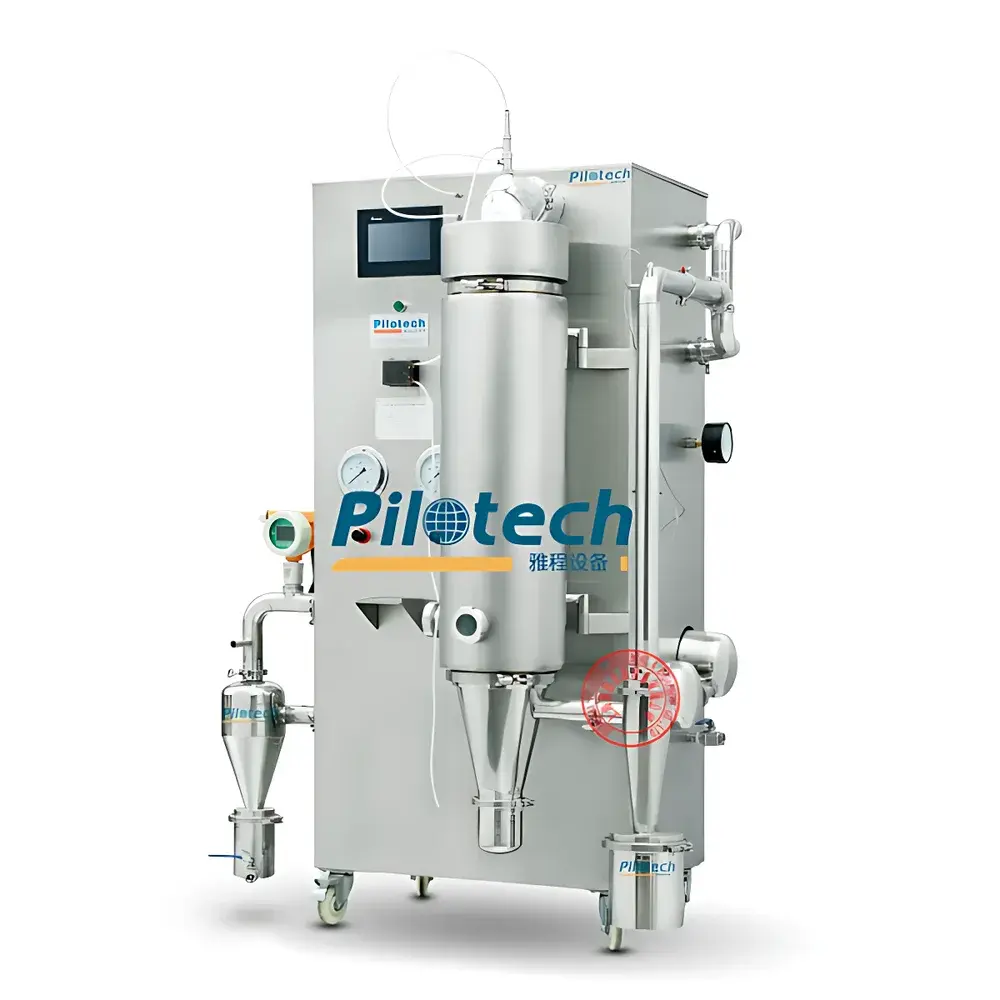
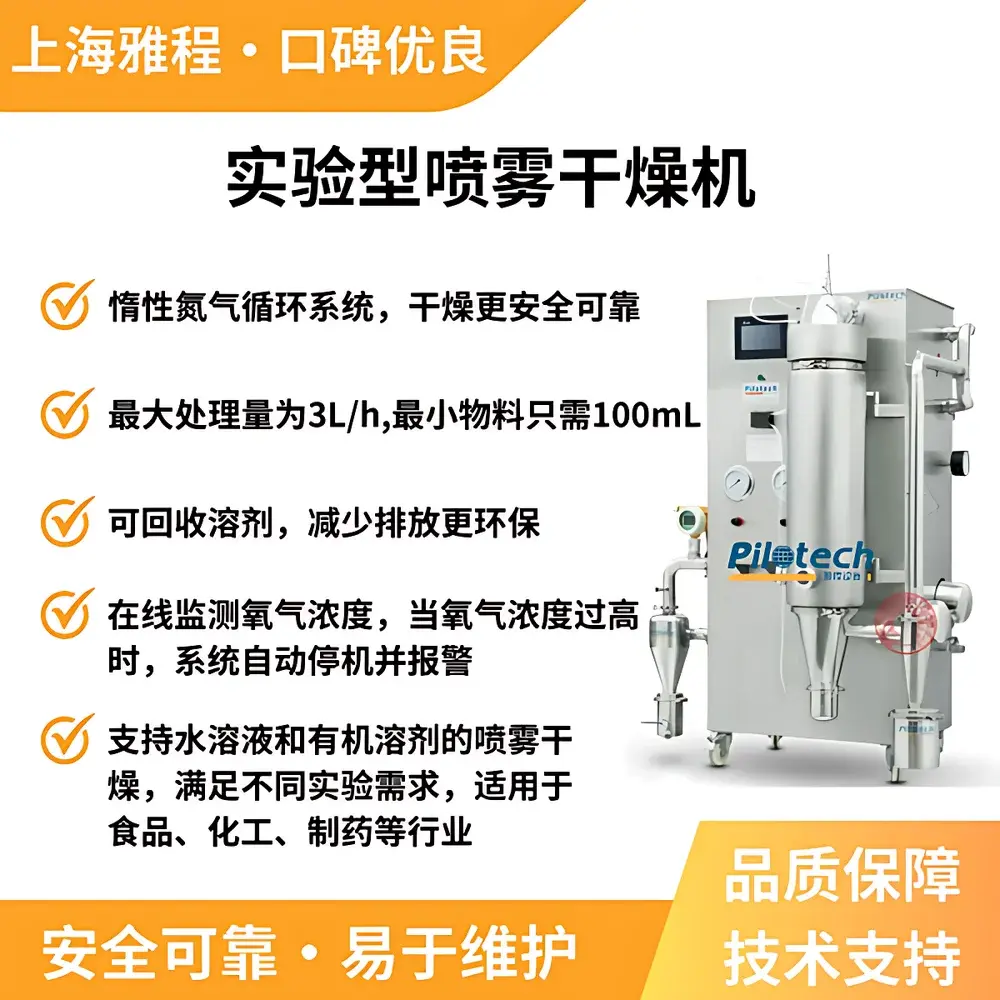
Pilotech YC-018A Closed-Loop Inert-Gas Spray Dryer for Organic Solvent-Based Samples
| Brand | Pilotech |
|---|---|
| Origin | Shanghai, China |
| Manufacturer Type | Direct Manufacturer |
| Product Origin | Domestic (China) |
| Model | YC-018A |
| Max Feed Rate | 3000 mL/h |
| Temperature Range | Ambient to 200 °C |
| Particle Size Range | 1–80 µm |
| Operating Atmosphere | Nitrogen-Closed Loop |
| Oxygen Monitoring | Real-time O₂ sensor with auto-shutdown at ≥2.5% O₂ |
| Nozzle Diameter | Standard 1.5 mm (optional: 0.5/0.8/1.0/2.0 mm) |
| Control Interface | 7-inch color touchscreen with PLC-based PID temperature control (±2 °C accuracy) |
| Solvent Recovery | Integrated condenser + heat exchanger system |
| Minimum Sample Volume | 100 mL |
Overview
The Pilotech YC-018A is a benchtop closed-loop spray dryer engineered specifically for the safe, reproducible, and scalable drying of heat-sensitive, oxidation-prone, or flammable organic solvent-based solutions. Unlike conventional open-air spray dryers, the YC-018A operates under a fully sealed nitrogen atmosphere—eliminating oxygen exposure and mitigating explosion risks associated with volatile solvents such as acetone, ethanol, dichloromethane, or ethyl acetate. Its core process employs rotary atomization via a concentric nozzle, coupled with precise thermal management using preheated nitrogen gas (up to 200 °C), enabling rapid solvent evaporation while preserving labile molecular structures. The dried powder is separated via cyclonic force and collected in an inert-gas-purged vessel, while saturated nitrogen vapor passes through a refrigerated heat exchanger and condenser to recover >95% of the solvent—ensuring compliance with VOC emission regulations and reducing operational costs. Designed for method development and small-batch production (100 mL minimum, up to 3000 mL/h throughput), it bridges the gap between analytical-scale lyophilization and pilot-scale production.
Key Features
- Inert-gas closed-loop architecture with real-time oxygen concentration monitoring (0–21% range); automatic emergency shutdown triggered at ≥2.5% O₂—meeting IEC 60079-10-1 zone classification requirements for hazardous area operation.
- Concentric dual-channel nozzle design ensures axial symmetry during atomization—preventing wall impingement, improving powder yield consistency, and enabling adjustable vertical positioning for optimized droplet–gas contact time.
- PLC-integrated control system with 7-inch color touchscreen interface; supports dynamic parameter adjustment during operation—including feed rate (peristaltic pump speed), inlet temperature, nitrogen flow rate, and anti-clogging needle frequency.
- Robust thermal management: PID-controlled heating with ±2 °C stability across the full 40–200 °C inlet temperature range; post-run cooling protocol automatically sustains fan operation until chamber temperature falls below 60 °C, preventing thermal degradation of internal components.
- Corrosion-resistant blower assembly constructed from stainless steel and fluoropolymer-coated alloys—designed to withstand prolonged exposure to aggressive organic vapors without performance drift or maintenance downtime.
- Modular solvent recovery train: integrated plate-type heat exchanger followed by a Peltier-cooled condenser capable of sub-0 °C dewpoint operation—enabling efficient recovery of low-boiling solvents (e.g., diethyl ether, pentane) when paired with optional cryogenic circulation units.
Sample Compatibility & Compliance
The YC-018A accommodates a broad spectrum of sample matrices including aqueous emulsions, polymer solutions (e.g., PLGA, cellulose acetate), pharmaceutical suspensions (nanocrystals, liposomes), natural product extracts (alkaloids, terpenes), and agrochemical formulations. Its low-temperature drying capability (as low as 40 °C inlet for low-boiling solvents) makes it suitable for thermolabile biologics—such as enzymes, peptides, monoclonal antibody fragments, and live probiotic cultures—where conventional hot-air drying would induce denaturation or aggregation. From a regulatory standpoint, the system supports GLP-compliant documentation workflows through timestamped audit logs of all critical parameters (temperature, O₂%, feed rate, pressure). While not pre-certified to FDA 21 CFR Part 11, its data integrity framework—including user-access controls, electronic signatures, and non-erasable event history—facilitates validation under ISO 13485, ICH Q5C, and USP guidelines for sterile powder manufacturing.
Software & Data Management
The embedded HMI runs on a deterministic real-time OS, recording all operational variables at 1-second intervals into encrypted binary files (.dat) compatible with MATLAB, Python (pandas), and commercial LIMS platforms. Raw data exports include synchronized timestamps, alarm events (e.g., O₂ breach, overtemperature), and setpoint deviations—enabling statistical process control (SPC) charting per ASTM E2587. Optional Ethernet/IP connectivity allows remote monitoring via secure VPN, while USB export supports offline analysis without network dependency. All firmware updates are signed and verified prior to installation to prevent unauthorized modification—aligning with cybersecurity best practices outlined in ISA/IEC 62443-3-3.
Applications
- Pharmaceutical R&D: Production of amorphous solid dispersions for enhanced bioavailability; microencapsulation of APIs with enteric polymers; stabilization of mRNA-LNPs under non-aqueous conditions.
- Food & Nutraceuticals: Encapsulation of omega-3 oils, anthocyanins, or probiotics using ethanol or limonene as carrier solvents—preserving oxidative stability and sensory profile.
- Materials Science: Synthesis of metal-organic framework (MOF) nanoparticles, quantum dot inks, or battery cathode precursors where solvent purity and atmospheric control dictate crystallinity and phase purity.
- Agrochemical Development: Formulation of encapsulated pesticides with controlled release kinetics—avoiding thermal decomposition during drying and minimizing operator exposure to toxic volatiles.
FAQ
Can the YC-018A handle chlorinated solvents such as chloroform or DCM?
Yes—provided the optional corrosion-resistant condenser coil and nitrogen purge lines are specified. System compatibility must be verified case-by-case based on vapor pressure, dewpoint, and material compatibility charts.
Is GMP documentation support available for qualification (IQ/OQ/PQ)?
Yes—Pilotech provides URS templates, FAT/SAT protocols, calibration certificates for all sensors (RTD, O₂, flowmeter), and traceable component schematics upon request.
What is the typical solvent recovery efficiency for ethanol at 60 °C inlet temperature?
Under standard configuration with ambient cooling, recovery exceeds 92%; with optional -20 °C recirculating chiller, efficiency reaches ≥97% as confirmed by gravimetric and GC-FID validation.
Does the system comply with ATEX or equivalent explosion protection directives?
The base unit meets IP54 enclosure rating and incorporates intrinsically safe O₂ sensing. Full ATEX Zone 1 certification requires site-specific hazardous area assessment and optional Ex-rated motor/blower integration.
Can particle morphology be tuned via process parameters?
Yes—feed concentration, inlet temperature, atomization pressure, and nitrogen flow rate collectively influence surface roughness, density, and residual solvent content—as demonstrated in peer-reviewed studies on spray-dried insulin and curcumin nanocomposites.



