
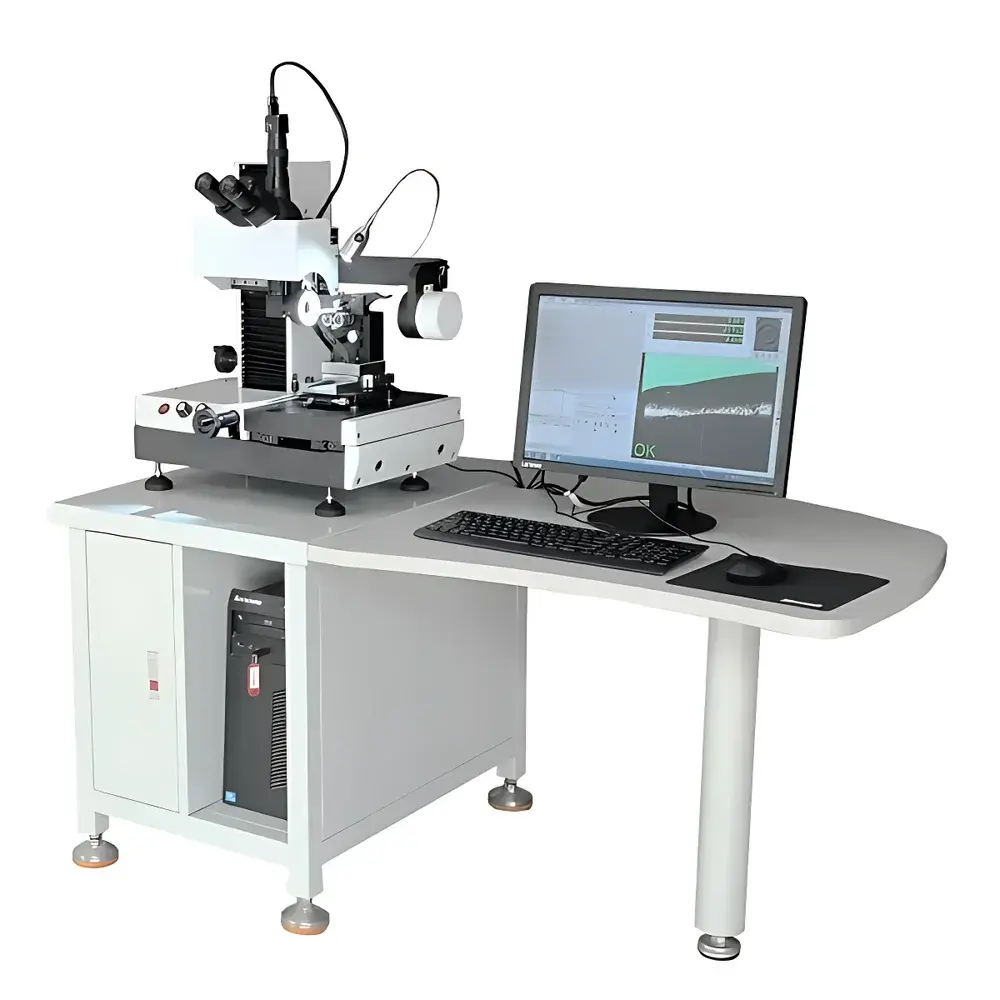
Pinzhichuangsi DTC600S-1 Tool Measuring Microscope
| Brand | Pinzhichuangsi (Product Intelligence and Creativity) |
|---|---|
| Origin | Beijing, China |
| Manufacturer Type | Authorized Distributor |
| Country of Origin | China |
| Model | DTC600S-1 |
| X-axis Travel | 150 mm |
| Y-axis Travel | 100 mm |
| Z-axis Travel | 100 mm |
| Measuring Accuracy (X/Y) | ≤ (3 + L/200) µm (L in mm) |
| Resolution (X/Y/Z) | 0.001 mm |
| Optical Magnification (Visual) | 10×–65× (10× binocular eyepieces + 1.0×–6.5× zoom objective, including distortion) |
| Image Magnification (Digital) | 30×–225× |
| Camera | 6 MP GigE color CCD with 1.0× C-mount adapter |
| Illumination | Adjustable ring LED surface light + adjustable edge LED contour light + dual-axis positionable auxiliary LED lights |
| Base Material | Grade 000 granite |
| Weight | 80 kg |
| Dimensions (W×D×H) | 500 × 350 × 600 mm |
Overview
The Pinzhichuangsi DTC600S-1 Tool Measuring Microscope is a precision optical metrology system engineered for high-accuracy geometric inspection of cutting tools and complex mechanical components. It operates on the principle of coordinate-based optical projection metrology, combining stereoscopic visual observation with digital image acquisition and sub-pixel edge detection algorithms to deliver traceable dimensional and angular measurements. Designed specifically for toolroom, R&D, and quality control environments in metalworking, mold & die, and precision machining industries, the DTC600S-1 integrates a rigid granite base, motor-assisted manual motion stages, and multi-spectral illumination to ensure repeatable imaging under varying surface reflectivity and geometry. Its dual-path optical architecture—supporting both direct binocular viewing and synchronized digital capture—enables real-time correlation between operator perception and software-driven measurement, minimizing parallax-induced uncertainty and supporting ISO 10360-compliant verification protocols.
Key Features
- Grade 000 natural granite base and stage assembly, providing thermal stability, vibration damping, and long-term geometric integrity under ambient workshop conditions;
- Dual-path optical system: binocular stereomicroscope (10× wide-field eyepieces) coupled with continuously variable zoom objective (1.0×–6.5×), delivering 10×–65× total magnification with ≤0.08% magnification error;
- Gigabit Ethernet interface 6-megapixel color CCD camera with 1.0× C-mount adapter, enabling real-time streaming at full resolution (3072 × 2048) and supporting pixel-level calibration via NIST-traceable grid targets;
- Triaxial manual translation stage (X: 150 mm, Y: 100 mm, Z: 100 mm) with vernier-scaled digital readouts offering 1 µm resolution and compliance with ISO 230-2 positioning accuracy requirements;
- Multi-directional illumination suite: coaxial ring LED surface light (intensity-adjustable), backlit LED contour illumination, and two independently positionable auxiliary LED sources for shadow-free edge contrast enhancement;
- Horizontal 360° rotating platform and vertical 360° tilting fixture, enabling full circumferential and axial profiling of end mills, drills, reamers, and indexable inserts without re-fixturing;
- Integrated crosshair flicker capture algorithm for dynamic edge stabilization during manual focus or stage adjustment, reducing operator-dependent measurement drift.
Sample Compatibility & Compliance
The DTC600S-1 accommodates a broad spectrum of tool geometries—including solid carbide end mills, HSS twist drills, gear hobs, broaches, and PCD-tipped inserts—as well as non-tool components such as stamped sheet metal parts, cam profiles, watch movement components, and micro-electromechanical contact terminals. Its open-stage design supports sample heights up to 100 mm and weights up to 5 kg. All optical and mechanical subsystems conform to IEC 61000-6-2 (immunity) and IEC 61000-6-3 (emission) standards. The measurement uncertainty budget—validated per ISO/IEC 17025 guidelines—accounts for environmental factors (temperature gradient ≤1°C/h, humidity 40–60% RH), lens distortion correction (via 12-point polynomial model), and camera sensor linearity (≤0.1% deviation across full dynamic range). While not FDA 21 CFR Part 11-certified out-of-the-box, audit-ready data logs (including timestamped image thumbnails, operator ID, calibration status, and measurement parameters) can be exported in CSV and PDF formats for GLP/GMP documentation workflows.
Software & Data Management
The proprietary Pinzhichuangsi VisionMetrology Suite v4.2 provides a deterministic measurement environment with configurable workflow templates. Core functions include automated edge detection using Sobel-Canny hybrid operators, dynamic reference line anchoring for angle metrology (e.g., rake angle, clearance angle, helix angle), and chord-length-based arc radius computation compliant with ISO 1101 geometric tolerancing principles. Software modules support comparative analysis (e.g., nominal vs. actual profile overlay with deviation heatmaps), GD&T symbol annotation (per ASME Y14.5–2018), and batch reporting with statistical process control (SPC) charts (X̄–R, Cp/Cpk). All measurement sessions generate immutable .vmr project files containing raw image data, calibration metadata, and operator-defined tolerances. Export options include DXF (for CAD comparison), STEP AP214 (for downstream simulation), and XML-based metrology reports compatible with enterprise MES platforms.
Applications
- Quantitative evaluation of cutting tool geometry: flank angle, relief angle, helix angle, chip groove depth and width, land width, and point angle on end mills, drills, taps, and milling cutters;
- Contour analysis of non-circular profiles: cam lobe shapes, turbine blade sections, and injection mold cavity surfaces;
- Dimensional verification of precision stampings: terminal pitch, bend radii, and feature-to-feature distances in automotive connectors;
- Surface defect mapping: chipping, micro-cracking, and coating delamination on coated carbide inserts using high-contrast edge-enhanced imaging;
- Reverse engineering support: extraction of spline curves and NURBS-fit profiles from scanned tool edges for CNC toolpath regeneration;
- Calibration verification of tactile CMM probes using certified step gauges and radius artifacts imaged under identical lighting and focus conditions.
FAQ
What is the maximum recommended working distance for accurate measurement of deep-flute end mills?
The DTC600S-1 achieves optimal depth-of-field consistency within ±15 mm of the calibrated focal plane; for flutes exceeding 30 mm in depth, use the Z-axis fine-focus knob with incremental 1 µm steps and enable software-based focus stacking (requires ≥3 image layers).
Does the system support automated measurement routines for serial production inspection?
Yes—VisionMetrology Suite includes scriptable macro recording (VBScript-compatible) and pass/fail threshold logic that triggers audible alerts and exports results to shared network folders upon completion.
Can the granite base be recalibrated after relocation?
Granite base flatness and stage orthogonality must be verified annually using an autocollimator and laser interferometer; Pinzhichuangsi provides certified recalibration services with ISO 17025-accredited certificates.
Is third-party calibration software (e.g., Q-DAS, Minitab) compatible with exported measurement data?
All CSV exports adhere to ANSI/ISO 8601 timestamp formatting and include column headers aligned with PTB (Physikalisch-Technische Bundesanstalt) metrological metadata conventions, ensuring seamless import.
What maintenance intervals are recommended for the zoom objective and illumination modules?
Lens cleaning and LED output verification should occur every 500 operational hours; annual factory service includes collimation check, encoder linearity validation, and distortion map renewal using NIST-traceable test plates.



