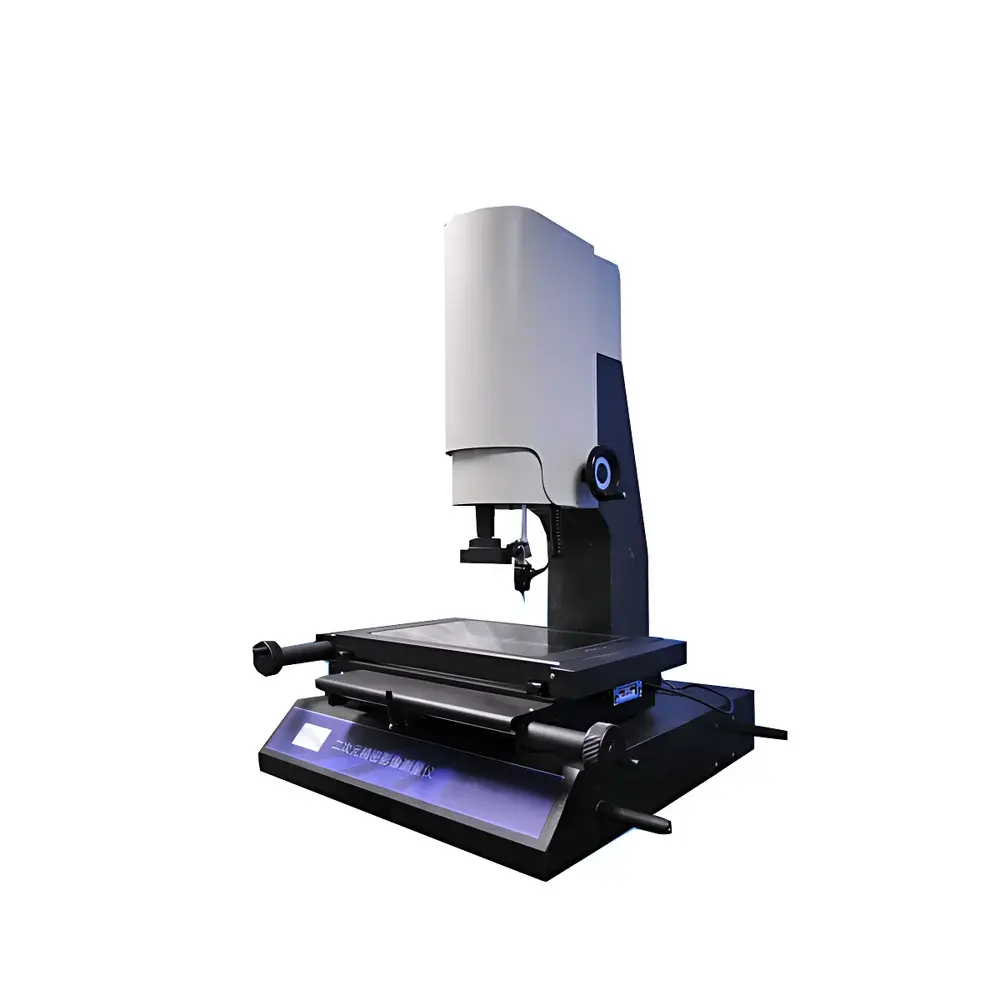
Pinzhichuangsi PZ-2515G Advanced 2.5D Vision Measuring System
| Brand | Pinzhichuangsi (Product Intelligence and Creativity) |
|---|---|
| Origin | Beijing, China |
| Manufacturer Type | Authorized Distributor |
| Country of Origin | China |
| Model | PZ-2515G |
| Resolution | 0.001 mm (X/Y/Z axes) |
| Optical Zoom | 0.7×–4.5× |
| Video Magnification | 40×–400× |
| Field of View | 10.6 mm – 1.6 mm |
| Camera | 1/3″ Sony CCD (upgradeable to 1.3 MP CMOS) |
| Light Source | Adjustable LED ring light (top & bottom) |
| Stage Material | Natural granite base and stage |
| Linear Guide | Precision V-groove roller guides with non-adhesive screw sleeve mounting |
| Drive System | Servo motor-driven XYZ axes |
| Auto-focus & edge detection | Yes |
| SPC & reporting | Integrated statistical process control and Excel/Word export |
Overview
The Pinzhichuangsi PZ-2515G is a high-precision 2.5D vision measuring system engineered for metrological-grade geometric inspection of machined, molded, stamped, and fabricated components. It operates on the principle of digital optical coordinate metrology: a high-stability granite platform supports a motorized XYZ stage equipped with calibrated linear encoders; a telecentric or parfocal zoom lens projects a magnified, distortion-corrected image of the part onto a low-noise CCD or CMOS sensor; and sub-pixel edge detection algorithms compute dimensional coordinates in a user-defined Cartesian frame. Unlike traditional projection comparators, this system captures quantitative spatial data—not just silhouette overlays—enabling traceable, repeatable, and auditable measurements compliant with ISO 10360-7 (coordinate measuring machines) and ISO 1101 (geometrical tolerancing). Its 0.001 mm encoder resolution, thermally stable granite architecture, and hardware-based motion calibration ensure long-term accuracy without reliance on software-only compensation—a critical requirement for GLP/GMP-regulated quality labs and first-article inspection workflows.
Key Features
- Natural granite base and stage structure eliminates thermal stress deformation and provides exceptional vibration damping (≤0.5 µm RMS displacement under ambient floor vibration).
- V-groove precision roller guides mounted via non-adhesive screw sleeves eliminate thermal drift and mechanical loosening—ensuring guide alignment stability over 10+ years of continuous operation.
- XYZ servo motor drive with programmable acceleration profiles enables repeatable positioning within ±0.002 mm (2σ), supporting automated measurement routines per ISO 14253-1.
- Optical zoom lens (0.7×–4.5×) with calibrated magnification maintains pixel-to-micron linearity across full video range (40×–400×); field of view adjustable from 10.6 mm down to 1.6 mm for multi-scale feature analysis.
- Dual-illumination LED ring light (top surface + bottom transmitted) offers independent intensity control for optimal edge contrast on reflective, translucent, or opaque materials—including PCB solder masks, plastic gears, and metal stampings.
- Z-axis secondary focus capability allows depth profiling of blind holes, grooves, and stepped features using focus-stack triangulation—extending measurement beyond strict 2D silhouette analysis into controlled 2.5D topography.
Sample Compatibility & Compliance
The PZ-2515G accommodates parts up to 250 mm × 150 mm × 100 mm (L×W×H) on its granite stage, with optional glass insert (306 mm × 196 mm) for backlight transmission measurement. It measures metallic, polymeric, ceramic, and composite components with surface finishes ranging from mirror-polished to matte-textured. The system meets mechanical and environmental requirements defined in ISO 22476-1 for metrology equipment installation: operating temperature 20–25 °C (±1 °C/hour gradient), relative humidity 50–60 % RH, and ambient particulate count <45,000 particles/ft³ (>0.5 µm). All measurement data logs include timestamp, operator ID, calibration certificate reference, and audit trail metadata—fully compatible with FDA 21 CFR Part 11 electronic record requirements when deployed with validated software configuration.
Software & Data Management
The embedded 2.5D metrology software provides ISO/IEC 17025-aligned measurement workflows: automatic edge detection (sub-pixel centroid and Sobel gradient algorithms), GD&T evaluation per ASME Y14.5 and ISO 1101 (straightness, parallelism, perpendicularity, circularity, position, etc.), and real-time overlay comparison against imported DXF/DWG engineering drawings. SPC modules generate X-bar/R, Cpk, Ppk, and histogram reports with auto-color-coded out-of-spec results. Measurement records export natively to .xlsx and .docx formats with embedded images and coordinate tables; JPEG/BMP snapshots retain scale metadata and annotation layers for traceable archival. The software supports customer-defined coordinate systems—eliminating fixture repositioning—and includes reverse engineering tools that export point clouds and vector sketches directly to AutoCAD for rapid prototyping iteration.
Applications
This system is routinely deployed in Tier-1 automotive suppliers for GD&T validation of injection-molded interior trim; in medical device manufacturers for dimensional release testing of stainless steel surgical instrument components; in electronics contract manufacturers for BGA pad alignment verification and flex circuit fiducial inspection; and in precision tool & die shops for wear analysis of EDM-machined cavity inserts. Typical measurable features include hole center distances (±0.003 mm), radius deviations (R ≤ 0.1 mm), angular tolerances (±0.05°), profile of a line/surface, and positional tolerance zones (MMC/LMC modifiers supported). Its robustness in production-floor environments—validated by IP52-rated enclosure options and ESD-safe stage coating—makes it suitable for both lab-based calibration and shop-floor SPC gate checks.
FAQ
Does the PZ-2515G support third-party calibration certificates?
Yes—certified calibration reports traceable to NIM (National Institute of Metrology, China) or ISO/IEC 17025-accredited laboratories are available upon request, including encoder linearity, stage orthogonality, and lens distortion mapping.
Can the system measure thread pitch or gear tooth profiles?
While optimized for 2.5D planar geometry, specialized add-on modules (e.g., rotary table + profile analysis plugin) enable pitch diameter, lead angle, and involute deviation measurement—subject to pre-installation feasibility review.
Is remote software update and technical support available outside China?
Yes—firmware and software updates are delivered via secure HTTPS portal; English-language remote diagnostics and application engineering support are provided through SLA-backed service contracts.
What is the typical recalibration interval under ISO 9001 quality system requirements?
Annual recalibration is recommended; however, internal verification using certified gauge blocks and step gauges (included in standard accessory kit) should be performed daily or per shift per ISO 10012.
Does the Z-axis measurement satisfy ISO 12181-2 roundness standards?
No—the Z-axis implements focus-based height sampling, not tactile probing; for full ISO 12181-2 roundness or cylindricity, a dedicated roundness tester is required. The PZ-2515G reports circularity as a 2D cross-sectional parameter only.