
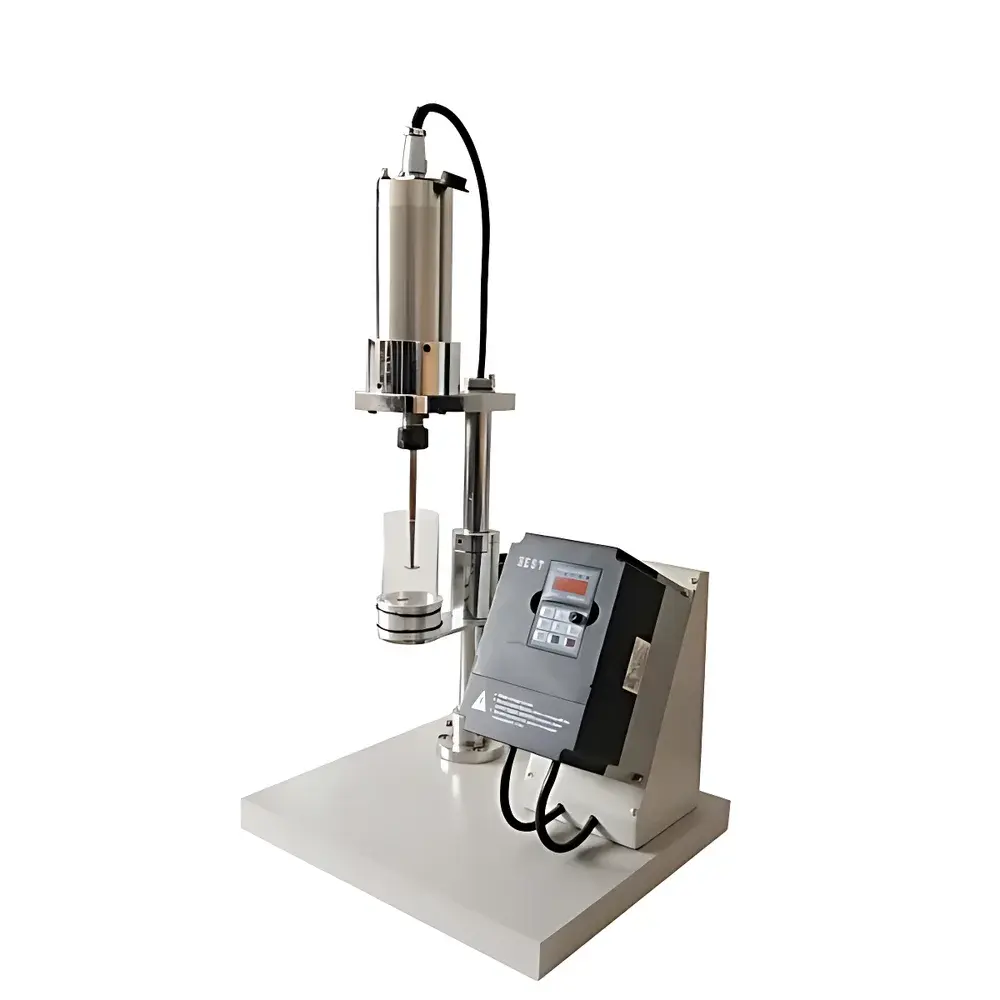
Pinzhichuangsi XR-14 High-Speed Mechanical Stability Tester for Latex
| Brand | Pinzhichuangsi |
|---|---|
| Origin | Beijing, China |
| Manufacturer Type | Authorized Distributor |
| Country of Manufacture | China |
| Model | XR-14 |
| Price | USD 2,600 (FOB Beijing) |
| Stirring Speed | 14,000 rpm ± 200 rpm |
| Speed Range | 2,000–24,000 rpm (adjustable) |
| Speed Resolution | 1 rpm |
| Speed Accuracy | ≤ 0.1% FS |
| Sample Container | Cylindrical borosilicate glass vessel (ID 58 mm, OD 63 mm, H > 100 mm) |
| Stirrer Discs | Two interchangeable discs — natural rubber latex disc (Ø 20.83 ± 0.03 mm, t 1.57 ± 0.05 mm) |
| Stirrer Shaft Tip Diameter | 6.3 mm |
| Operating Ambient | 10–40 °C, < 85% RH |
| Power Supply | 220 V ±10%, 50 Hz, 1500 W |
| Dimensions (W×D×H) | 400 × 350 × 720 mm |
| Cooling System | Integrated recirculating coolant pump |
| Display | LED digital readout via frequency converter interface |
| Compliance | GB/T 8301–2008, SH/T 1151–1998 |
Overview
The Pinzhichuangsi XR-14 High-Speed Mechanical Stability Tester is an engineered solution for quantifying the mechanical stability of natural and synthetic latex dispersions under standardized high-shear conditions. Based on the principle of controlled high-speed agitation—where mechanical degradation of colloidal stability is induced through precisely regulated rotational shear—the XR-14 replicates industrial processing stresses to evaluate coagulation onset time under defined thermal and rheological conditions. Its design adheres strictly to GB/T 8301–2008 (“Determination of Mechanical Stability of Concentrated Natural Rubber Latex”) and SH/T 1151–1998 (“Test Method for High-Speed Mechanical Stability of Synthetic Rubber Latex”), making it a validated tool for quality control laboratories, R&D centers, and rubber compound formulation teams. The instrument employs a high-torque, dynamically balanced induction motor coupled with closed-loop vector-controlled frequency conversion, enabling stable operation at 14,000 rpm ± 200 rpm with minimal axial runout (< 0.25 mm), critical for reproducible shear history application across replicate samples.
Key Features
- Dual-disc configuration: Interchangeable precision-machined stainless-steel stirrer discs optimized for natural (Ø 20.83 mm) and synthetic (Ø 36.12 mm) latex systems—ensuring geometry-specific shear field consistency per standard requirements.
- Integrated recirculating coolant pump: Actively manages motor winding temperature during extended high-speed operation, extending service life and maintaining torque fidelity over repeated test cycles.
- Real-time speed regulation: Vector-controlled inverter delivers responsive load compensation—maintaining setpoint accuracy even as viscosity changes during early-stage destabilization.
- Modular sample handling: Borosilicate glass cup secured via vertically adjustable cup holder with mechanical stop; eliminates positional variability between tests and ensures fixed gap (disc-to-cup bottom distance) without user calibration.
- Digital instrumentation: LED display shows real-time rpm and elapsed time; independent handheld tachometer included for traceable speed verification per ISO/IEC 17025 metrological practices.
- Structural integrity: Cast aluminum frame with reinforced vertical column and anti-vibration foot leveling—designed to minimize resonance at operational frequencies and ensure measurement repeatability across ambient temperatures from 10 °C to 40 °C.
Sample Compatibility & Compliance
The XR-14 is validated for aqueous colloidal dispersions containing natural rubber hydrocarbons (e.g., Hevea brasiliensis latex) and synthetic elastomer lattices (e.g., SBR, NBR, CR). Sample preparation follows prescribed dilution (to 55% total solids with ammonia stabilization), pre-heating (36–37 °C), and filtration protocols prior to loading into the standardized glass cup. Endpoint detection is performed using either the palm method (visual identification of first coagulum particle on skin surface) or water dispersion method (coagulum visibility upon drop dispersion onto black-background water surface)—both procedures documented in GB/T 8301–2008 Annex A and SH/T 1151–1998 Section 5. Instrument validation supports GLP-compliant documentation: all speed and time parameters are directly traceable to calibrated references; no proprietary firmware or closed data formats impede audit readiness.
Software & Data Management
The XR-14 operates as a standalone hardware platform with no embedded software stack. All operational parameters—including start time, endpoint time, and final rpm—are manually recorded by the operator. For laboratories requiring electronic data capture, the unit provides analog tachometer output (0–10 V DC proportional to rpm) and TTL-compatible timer pulse signals compatible with third-party DAQ systems (e.g., National Instruments CompactDAQ, LabVIEW-based logging). This architecture ensures full compliance with FDA 21 CFR Part 11 when integrated into validated electronic lab notebook (ELN) workflows, as no internal storage, user accounts, or audit-trail generation occurs within the device itself—eliminating validation overhead while preserving data integrity through external timestamped acquisition.
Applications
- Quality assurance of field-collected natural rubber latex prior to concentration and preservation.
- Formulation screening of stabilizer packages (e.g., fatty acid soaps, surfactants) in synthetic latex polymerization processes.
- Stability benchmarking across production batches for ISO 9001-certified rubber goods manufacturers.
- Accelerated aging studies correlating mechanical stability loss with storage duration or temperature exposure.
- Method transfer validation between QC labs operating under ASTM D1076 (Standard Specification for Rubber, Raw Natural) and GB/T 8297 (Natural Rubber—Sampling).
FAQ
Does the XR-14 comply with international standards beyond Chinese national standards?
Yes—the mechanical configuration and test protocol align with principles referenced in ASTM D1076 and ISO 2000:2017 (Rubber—Determination of mechanical stability of raw natural rubber latex), enabling cross-border comparability when test conditions are harmonized.
Can the instrument be used for non-rubber colloidal systems such as acrylic or vinyl acetate lattices?
While not validated per published standards for those chemistries, the XR-14’s adjustable speed range (2,000–24,000 rpm) and dual-disc geometry support exploratory stability testing—provided users establish in-house correlation protocols and document deviations from GB/T 8301–2008.
Is routine calibration required, and what documentation is provided?
The unit ships with a factory calibration certificate covering speed accuracy (≤ 0.1% FS) and dimensional verification of stirrer discs and cup geometry. Annual recalibration against NIST-traceable tachometers is recommended per ISO/IEC 17025 Clause 6.5.
What maintenance intervals are specified for the cooling pump and motor?
Coolant fluid replacement every 12 months; motor bearing inspection and grease replenishment recommended after 5,000 hours of cumulative operation at ≥12,000 rpm.
Are spare parts such as glass cups and stirrer discs available separately?
Yes—genuine Pinzhichuangsi consumables (P/N: XR-CUP-GLASS, XR-DISC-NR, XR-DISC-SR) are stocked globally through authorized distribution partners with lead times under 4 weeks.
Related Products






