
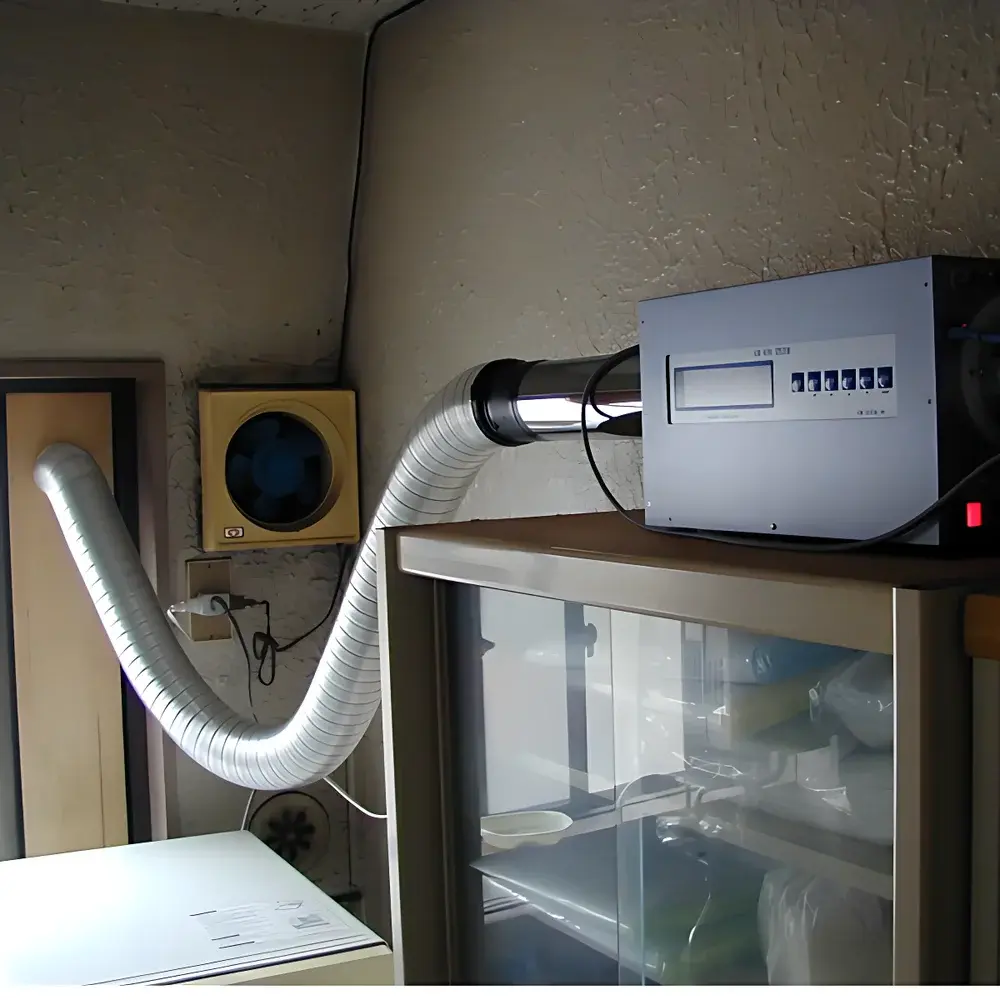
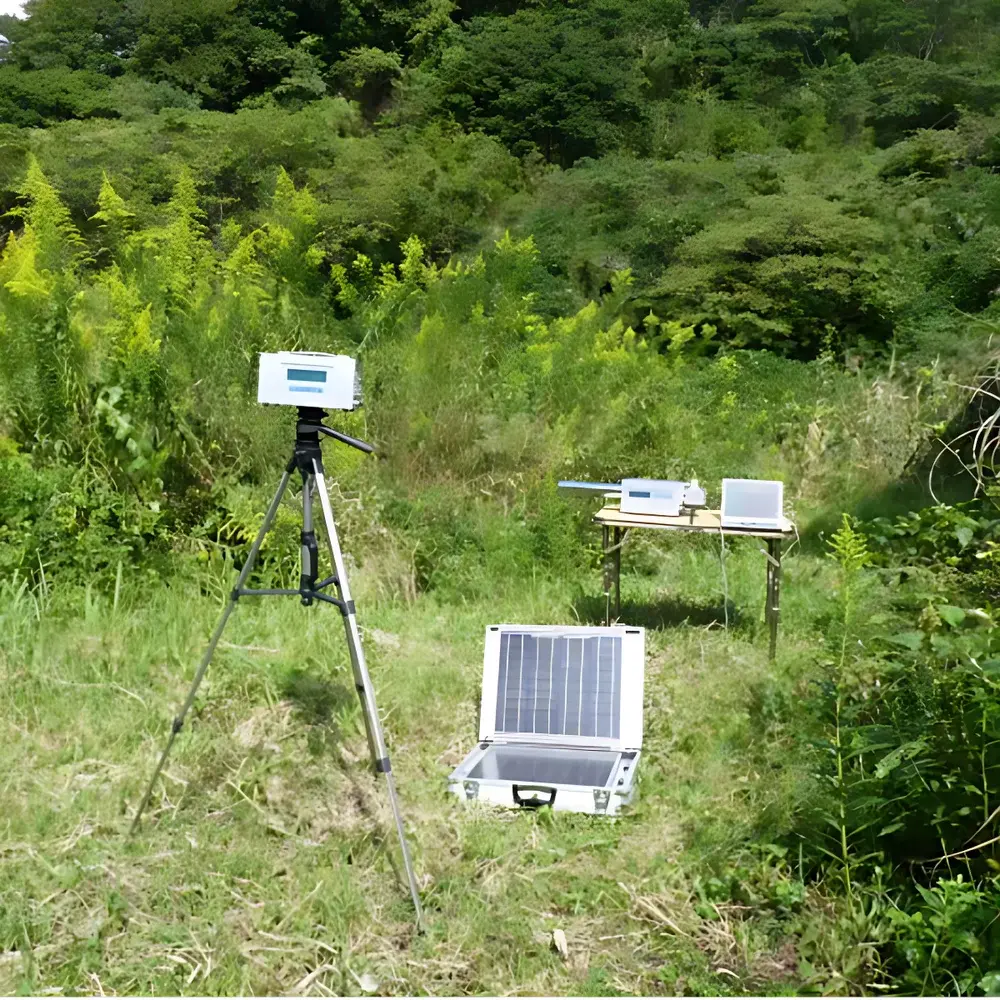
PKSAIR COM-3700 Air Ion Counter
| Brand | PKSAIR |
|---|---|
| Origin | Japan |
| Model | COM-3700 |
| Measurement Principle | Gerdien Capacitor Method |
| Ion Polarity | Simultaneous Positive & Negative Ion Detection |
| Mobility Range | 0.00269 – 5.38 cm²/V·s (equivalent to ~2000 cm²/V·s in standard mobility scale) |
| Measurement Modes | Auto (dual-polarity) and Manual (single-polarity) |
| Concentration Range | R1: 0–8,000 ions/cm³ |
| R2 | 0–50,000 ions/cm³ |
| R3 | 0–500,000 ions/cm³ |
| R4 | 0–5,000,000 ions/cm³ |
| Display | 16-character × 2-line STN LCD with backlight and ON/OFF control |
| Data Logging | Internal memory for time-stamped measurements |
| Interface | RS-232C output for PC connectivity |
| Compliance | Designed for field-deployable environmental ion monitoring per JIS B 7951 and ISO 16000-22 (indoor air quality — measurement of airborne ions) |
Overview
The PKSAIR COM-3700 Air Ion Counter is a high-sensitivity, field-deployable instrument engineered for quantitative measurement of both positive and negative air ions in ambient and indoor environments. It operates on the well-established Gerdien capacitor principle — where airborne ions are drawn into a cylindrical condenser under a controlled electric field, inducing a measurable current proportional to ion concentration and mobility. This method provides direct, real-time, and polarity-resolved ion density data without reliance on indirect proxies or calibration drift-prone electrostatic sensors. The COM-3700 supports a wide ion mobility range (0.00269–5.38 cm²/V·s), covering the full spectrum of naturally occurring small, intermediate, and large ions — critical for atmospheric electricity studies, indoor air quality assessment, and geophysical precursor research. Its design emphasizes operational robustness in variable temperature and humidity conditions, with thermal stabilization of the aspiration system to minimize flow-rate variability and ensure measurement reproducibility across extended deployments.
Key Features
- Gerdien-type dual-polarity ion detection with independent electrode configuration for simultaneous positive/negative ion quantification
- Four selectable concentration ranges (R1–R4), enabling precise resolution from background-level natural ionization (≤10³ ions/cm³) to highly charged industrial or thunderstorm-affected atmospheres (up to 5×10⁶ ions/cm³)
- Integrated real-time clock with year/month/day/second timestamping for all stored measurements — essential for time-series analysis in seismic precursor monitoring or diurnal ion variation studies
- Backlit STN LCD display (16×2 characters) with user-controllable backlight intensity and clear polarity-specific readouts
- RS-232C serial interface for direct connection to Windows-based PCs; compatible with custom LabVIEW, Python, or MATLAB acquisition scripts for automated long-term logging
- Low-power consumption architecture optimized for battery-operated field use (external 12 V DC input supported)
- Calibration traceability documented per manufacturer’s internal reference protocol; optional factory recalibration service available with NIST-traceable ion source verification
Sample Compatibility & Compliance
The COM-3700 is designed for direct sampling of unfiltered ambient air, conditioned indoor air, and low-turbulence boundary-layer environments. It does not require aerosol filtration prior to measurement, preserving native ion–aerosol interactions critical for interpreting atmospheric charge balance. The instrument meets functional requirements outlined in ISO 16000-22 (Indoor air — Part 22: Determination of air ions) for sampling geometry, airflow control, and electrical shielding. While not certified to IEC 61000-4 electromagnetic immunity standards out-of-box, its metal-shielded sensor housing and differential signal processing provide inherent noise rejection in typical laboratory and field settings. For regulatory reporting contexts (e.g., occupational health assessments or GLP-compliant indoor air audits), users must implement documented SOPs for zero-checking, mobility-dependent correction factors, and periodic inter-unit comparison — practices aligned with ASTM D7002 guidance for atmospheric ion instrumentation.
Software & Data Management
The COM-3700 outputs ASCII-formatted serial data packets containing timestamp, polarity flag, selected range identifier, and raw count value. No proprietary software is bundled; instead, it supports open-protocol integration via standard terminal emulators (e.g., Tera Term, PuTTY) or custom scripting environments. Users may develop audit-ready data pipelines that enforce 21 CFR Part 11–compliant metadata tagging (user ID, instrument ID, location tag, calibration status) during ingestion. Internal memory retains up to 1,024 time-stamped records with rollover protection. For continuous monitoring applications, external data loggers (e.g., Campbell Scientific CR1000X) can be interfaced using TTL-level RS-232 adapters, enabling synchronized acquisition with meteorological or radon sensors in multi-parameter geophysical arrays.
Applications
- Geophysical precursor research: Long-term monitoring of anomalous negative ion surges potentially correlated with crustal stress accumulation and radon exhalation prior to seismic events
- Indoor environmental quality (IEQ) evaluation: Mapping spatial ion gradients in hospitals, cleanrooms, schools, and offices to assess ventilation efficacy and electrostatic particle behavior
- Materials science: Quantifying ion emission from functional surfaces (e.g., photocatalytic tiles, mineral-based wall coatings, tourmaline textiles)
- Forestry and alpine ecology: Studying biogenic ion generation mechanisms linked to terpene oxidation and cosmic ray modulation at high-altitude stations
- Validation of ionizer performance: Objective verification of commercial air ionizers’ output stability, polarity balance, and decay kinetics under controlled chamber conditions
FAQ
What ion mobility range does the COM-3700 cover, and how is it calibrated?
The instrument measures ions across a mobility range of 0.00269–5.38 cm²/V·s, corresponding to diameters from ~0.36 nm (small cluster ions) to ~3.2 nm (intermediate ions). Calibration is performed using a reference radioactive ²¹⁰Po source under laminar flow conditions; mobility scaling follows the standard Knudsen–Chapman transformation per ISO 16000-22 Annex B.
Can the COM-3700 distinguish between small, intermediate, and large ions?
No — it reports total ion concentration within its defined mobility window. Size-class differentiation requires tandem differential mobility analyzers (DMA) or mobility spectrometry. However, its wide mobility acceptance enables detection of shifts in mobility distribution when used with upstream voltage-scanned pre-separators.
Is the device suitable for outdoor deployment in rain or high humidity?
It is rated for indoor and sheltered outdoor use (IP20). Prolonged exposure to precipitation or >90% RH may affect aspiration stability and increase condensation risk in the collector cylinder; use with a heated inlet or weatherproof enclosure is recommended for unattended field operation.
Does the COM-3700 comply with FDA or EU regulatory requirements for medical device use?
No — it is classified as a general-purpose environmental measurement instrument, not a medical device. Clinical or therapeutic claims related to air ion exposure fall outside its intended use and regulatory scope.
Related Products







