
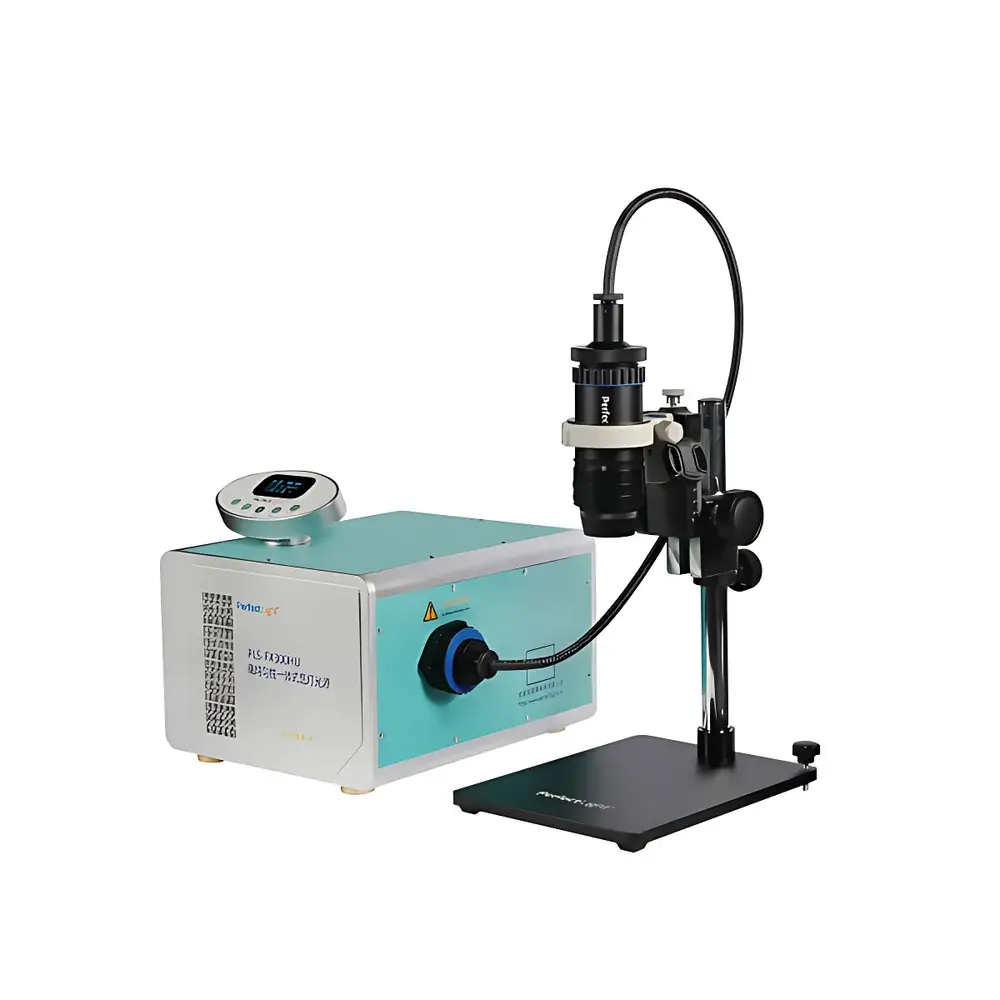
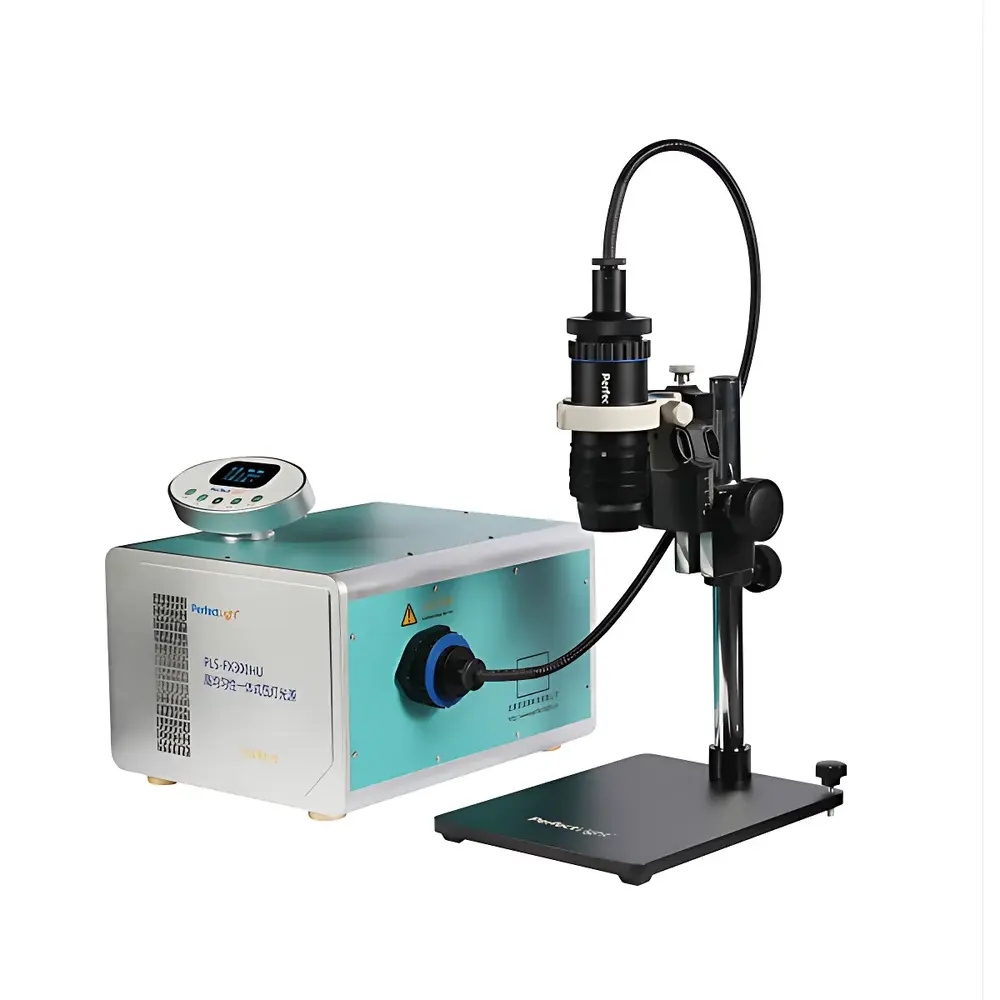
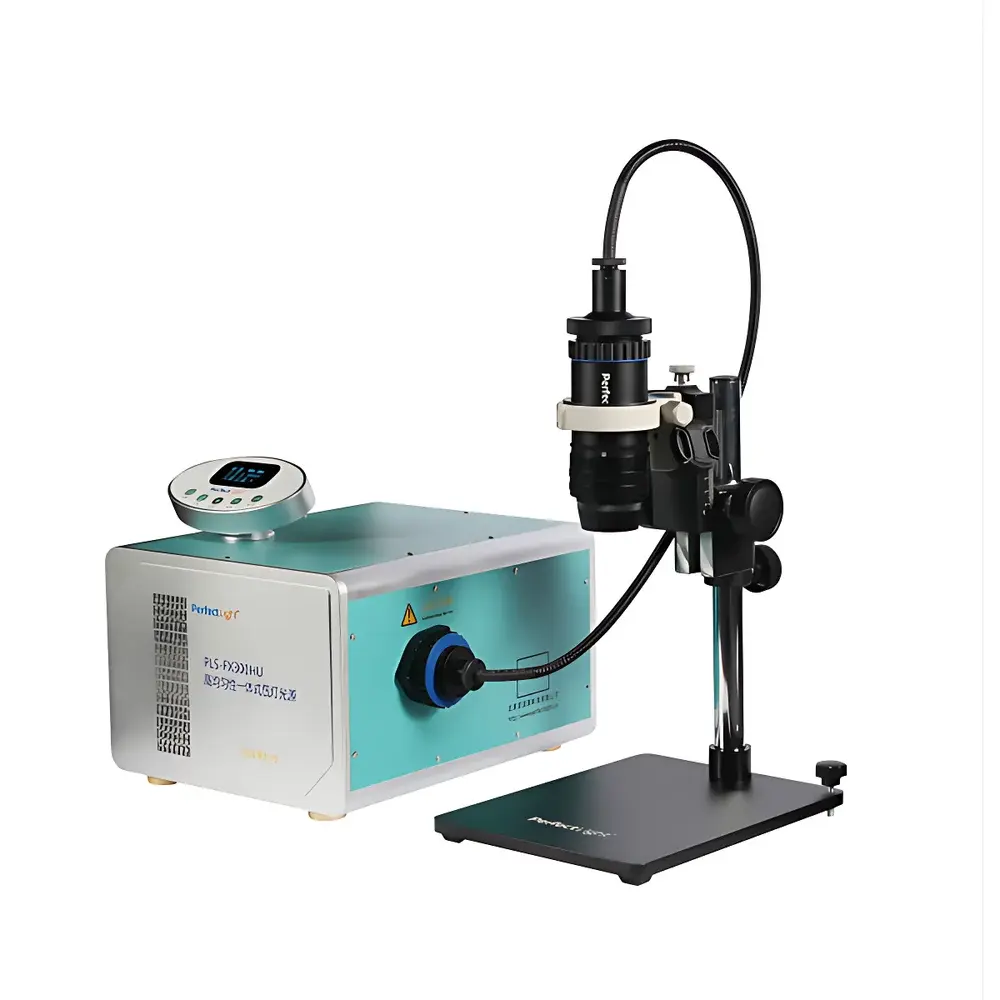
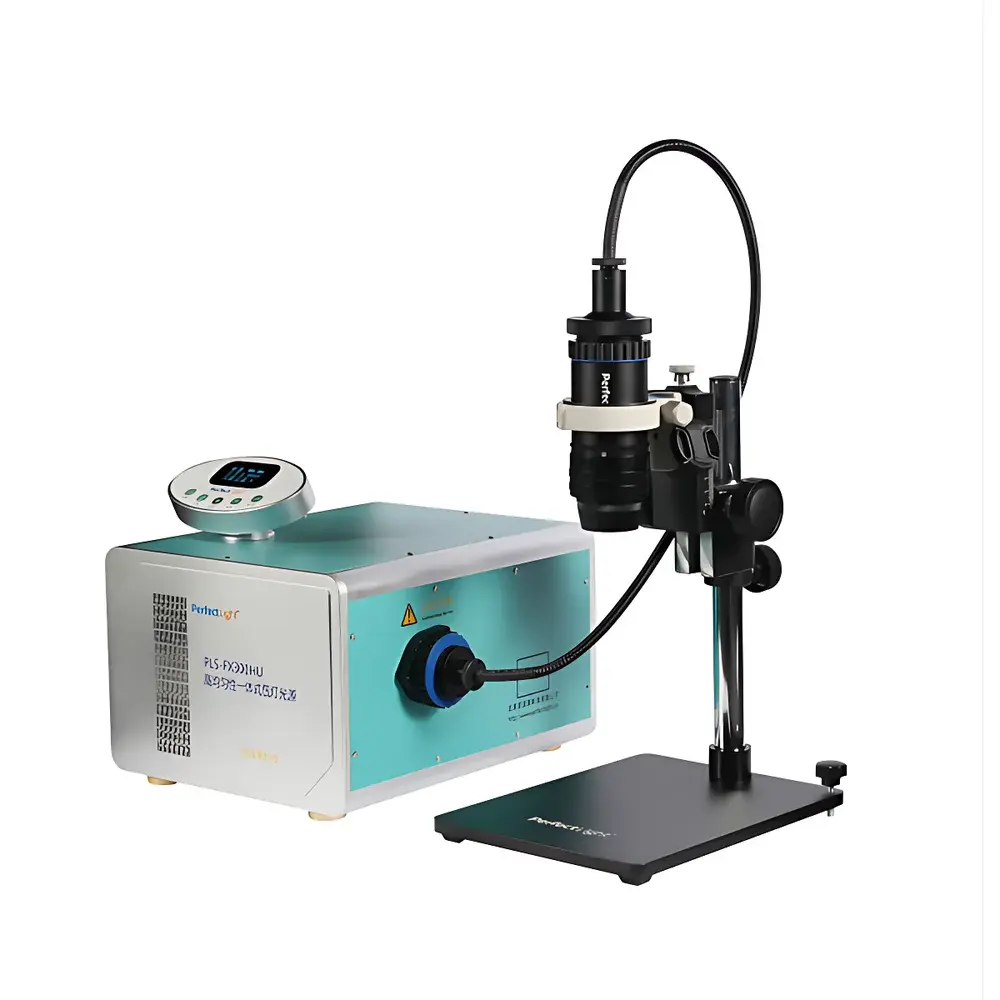
PLS-FX300HU High-Uniformity Integrated Xenon Light Source
| Brand | PerfectLight (PoPhilai) |
|---|---|
| Origin | Beijing, China |
| Model | PLS-FX300HU |
| Light Source Type | Xenon Arc Lamp |
| Illumination Mode | External Irradiation |
| Output Beam Shape | Rectangular |
| Adjustable Beam Area | 10×10 to 50×50 mm² |
| Spectral Range | 320–800 nm |
| Total Optical Power | 50 W |
| Irradiance Uniformity (≤20×20 mm²) | < ±4% (meets ASTM E927 Class A solar simulator requirement) |
| Long-Term Stability (8 h) | < 2% |
| Spatial Non-Uniformity | ±1% |
| Max. Irradiance | ≥3000 mW/cm² (at 10×10 mm², direct output with focusing tube) |
| Intensity Control | Precision current regulation + motorized iris diaphragm |
| Lamp Lifetime | >1000 h (under standard photocatalytic operating conditions) |
| Safety Features | Fan-failure interlock, post-shutdown fan delay, over-current/over-load auto-shutdown |
| Power Management | Embedded micro-CPU digital control system |
| Filter Compatibility | UV-, visible-, and narrowband bandpass filters |
Overview
The PLS-FX300HU High-Uniformity Integrated Xenon Light Source is an engineered optical irradiation platform designed specifically for quantitative photoelectrochemical (PEC) characterization, solar cell evaluation, and controlled photocatalytic reaction studies. It employs a stabilized 300 W short-arc xenon lamp as its primary emitter, coupled with a precision collimation and homogenization optical train to generate a spatially uniform, rectangular beam. Unlike conventional point-source or fiber-coupled systems, the PLS-FX300HU delivers direct external illumination with minimal divergence and high spectral fidelity across the 320–800 nm range—encompassing the full UV-A, visible, and near-IR bands relevant to semiconductor bandgap excitation and molecular photoreactivity. Its integrated architecture eliminates inter-unit alignment errors and thermal drift between lamp housing and power supply, ensuring repeatable irradiance delivery critical for IPCE (Incident Photon-to-Current Efficiency) mapping, quantum yield determination, and accelerated aging protocols.
Key Features
- Rectangular beam output with continuous adjustability from 10×10 mm² to 50×50 mm², enabling precise matching to electrode dimensions in three-electrode PEC cells or active areas of thin-film photovoltaic devices.
- Achieves ≤±4% spatial irradiance non-uniformity at beam sizes ≤20×20 mm²—validated against ASTM E927-22 Class A solar simulator criteria—ensuring metrological traceability for certified efficiency measurements.
- Dual-stage intensity modulation: fine-tuned via digitally regulated lamp current (0–21 A limit) and coarse/fine attenuation through a programmable motorized iris, supporting dynamic range from sub-mW/cm² to ≥3000 mW/cm² at 10×10 mm².
- Real-time optical feedback loop using a calibrated photodiode sensor mounted in the beam path, enabling closed-loop irradiance stabilization with <2% long-term drift over 8-hour continuous operation.
- Embedded micro-CPU controller manages thermal load, fan speed ramping, arc ignition sequencing, and fault logging—supporting GLP-compliant audit trails when interfaced with external data acquisition systems.
- Integrated safety architecture includes fan-failure shutdown, post-operation cooling delay (≥60 s), over-current cutoff, and lamp-end-of-life detection based on voltage rise and luminous decay trends.
Sample Compatibility & Compliance
The PLS-FX300HU is compatible with standard electrochemical quartz cells (e.g., 10 mm path length, side-irradiated configurations), custom-built gas-phase photoreactors (e.g., annular flow reactors for VOC oxidation), and liquid-phase slurry reactors equipped with quartz windows. Its external irradiation geometry avoids internal light-path obstructions and enables simultaneous integration with potentiostats, gas chromatographs, or in-situ spectroelectrochemical accessories. The system complies with IEC 61000-6-3 (EMC emission limits) and meets mechanical safety requirements per IEC 61010-1 for laboratory electrical equipment. While not certified as a Class AAA solar simulator, its uniformity and stability performance satisfies ISO 9001-aligned internal calibration procedures for R&D labs conducting comparative photocatalytic activity screening under reproducible irradiance conditions.
Software & Data Management
The PLS-FX300HU operates in standalone mode via front-panel keypad or remotely via RS-232/USB interface using ASCII command protocol. Optional LabVIEW™ and Python SDKs enable synchronization with potentiostat sweeps (e.g., CHI760E), gas analyzers (e.g., Agilent 490 Micro GC), or time-resolved fluorescence detectors. All operational parameters—including setpoint current, measured irradiance, fan RPM, lamp voltage, and runtime—are timestamped and exportable as CSV files. The embedded controller logs thermal events and fault codes compliant with 21 CFR Part 11 audit trail requirements when deployed in GMP-regulated materials qualification workflows.
Applications
- Photoelectrochemical water splitting and CO₂ reduction kinetics studies requiring spatially resolved incident photon flux.
- Quantitative IPCE and external quantum efficiency (EQE) mapping of perovskite, dye-sensitized, and organic photovoltaic devices.
- Gas-phase photocatalytic degradation of formaldehyde, NOₓ, SOₓ, and volatile organic compounds under simulated solar irradiance.
- Liquid-phase pollutant decomposition (e.g., methylene blue, phenol, benzene derivatives) with controlled photon dose tracking.
- Photostability assessment of photoanodes and co-catalysts under sustained high-flux illumination.
- Calibration reference source for radiometric sensors and spectroradiometers in the 320–800 nm band.
FAQ
What spectral filters are compatible with the PLS-FX300HU?
Standard 25.4 mm diameter, 1–5 mm thick bandpass, longpass, and shortpass filters (e.g., UG11, BG38, Schott KG series) can be inserted into the designated filter holder upstream of the homogenizer.
Can the PLS-FX300HU be used for accelerated UV aging tests?
Yes—when paired with appropriate UV-transmitting optics and quartz components, it supports controlled UV-A and UV-B exposure protocols; however, prolonged operation below 350 nm requires periodic lamp output recalibration due to xenon spectral shift.
Is remote triggering supported for time-resolved experiments?
Yes—the unit provides TTL-compatible trigger input/output ports for synchronization with pulsed lasers, shutter controllers, or data acquisition cards.
How is irradiance calibrated and maintained over time?
Factory calibration uses NIST-traceable thermopile sensors; users may perform field verification with a calibrated photodiode-based power meter; the built-in optical feedback system compensates for lamp aging-induced drift during operation.
Does the system support vacuum or inert-atmosphere reactor integration?
Yes—the external irradiation design allows coupling to glovebox-integrated reactors or vacuum-sealed quartz cells via standard CF or KF flanges with anti-reflective coated windows.



