
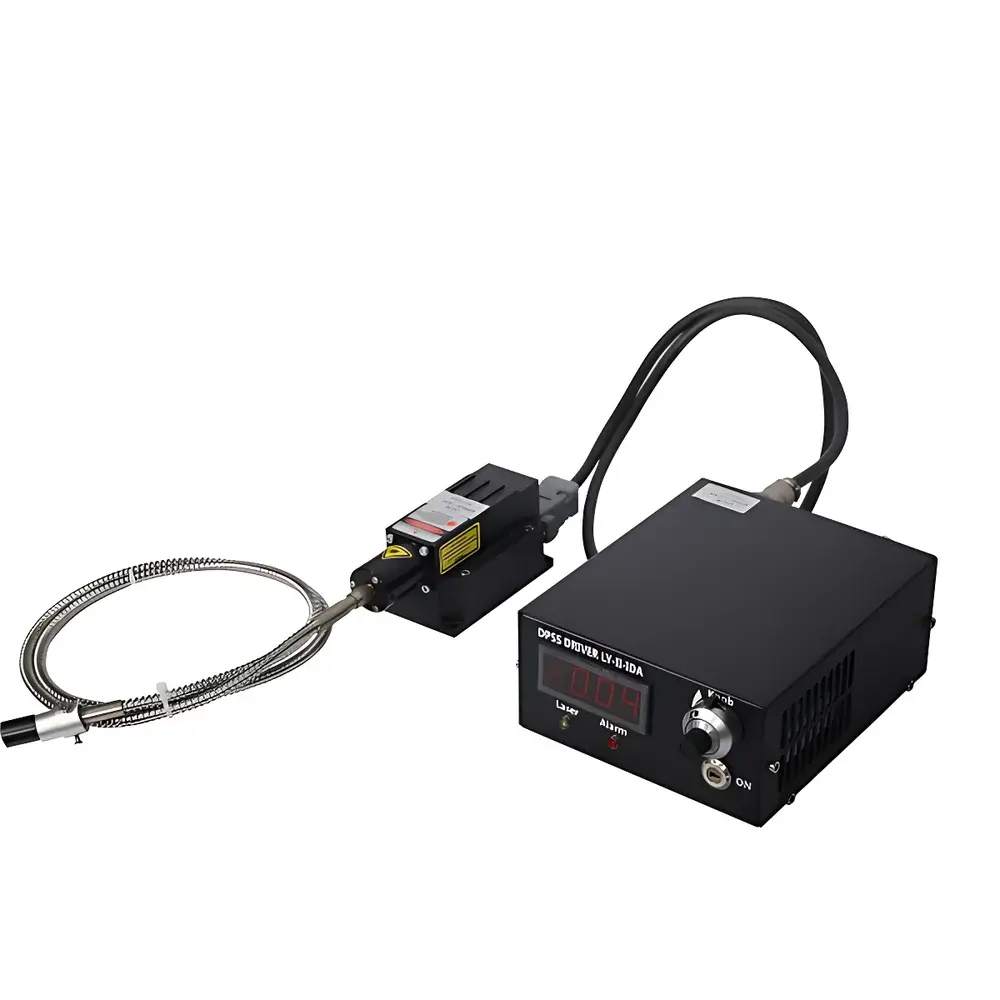
PLS-LD Laser Light Source by PerfectLight
| Brand | PerfectLight |
|---|---|
| Origin | Beijing, China |
| Model | PLS-LD |
| Light Source Type | Diode Laser |
| Irradiation Mode | Internal Illumination |
| Output Power | >100 mW (wavelength-dependent) |
| Spectral Bandwidth (FWHM) | <2.5 nm |
| Beam Divergence | ≤60° (with fiber + collimating lens), ≤1.2 mrad (collimated beam) |
| Collimated Beam Diameter (Entrance Pupil) | 40 mm |
| Available Wavelengths | 405 nm, 447 nm, 473 nm, 532 nm, 635 nm, 671 nm |
| Output Options | Free-space direct output or fiber-coupled (with optional coupling kit) |
| Warm-up Time | <8 min |
| Modulation Support | TTL and analog input, max frequency <20 kHz |
Overview
The PLS-LD Laser Light Source is a high-stability, narrow-band diode laser system engineered for quantitative photochemical and photoelectrochemical research. Unlike broadband sources such as xenon or mercury arc lamps—whose spectral output requires extensive filtering to isolate target wavelengths—the PLS-LD delivers intrinsic monochromatic irradiation via semiconductor laser diodes. Its fundamental operating principle relies on stimulated emission in gain media optimized for discrete wavelength emission, resulting in exceptional spectral purity (FWHM <2.5 nm) and minimal thermal drift. This enables precise photon flux control essential for quantum yield determination, action spectrum analysis, and kinetic studies where wavelength-specific photonic energy must be rigorously defined and reproducible. Designed for integration into custom optical benches, electrochemical cells, and gas-phase photoreactors, the PLS-LD supports both collimated (40 mm entrance pupil) and fiber-coupled configurations, facilitating flexible experimental geometry while maintaining beam uniformity and spatial coherence.
Key Features
- High-spectral-purity output with FWHM <2.5 nm—significantly narrower than filtered xenon/mercury lamp systems or LED-based irradiators, minimizing spectral contamination in quantum efficiency calculations.
- Active temperature stabilization and precision current regulation ensure long-term power stability (<±2% over 8 h) and wavelength consistency (drift <0.05 nm/°C), critical for extended photocatalytic experiments.
- Adjustable beam divergence: ≤1.2 mrad for collimated output; ≤60° when coupled with fiber-optic delivery and collimation optics—enabling compatibility with both macro-scale reactors and microfluidic illumination setups.
- Dual modulation capability: TTL and analog inputs support external triggering and intensity ramping up to 20 kHz, allowing synchronization with potentiostats, lock-in amplifiers, or time-resolved detection systems.
- Modular design includes optional fiber coupling kits (SMA905 interface), heat-dissipating baseplate mounting, and interchangeable collimation lenses—supporting rapid reconfiguration across experimental platforms.
Sample Compatibility & Compliance
The PLS-LD is compatible with standard quartz- or fused-silica-windowed photoelectrochemical cells (e.g., three-electrode configurations), gas-tight photocatalytic reactors, and solid-state thin-film sample holders. Its collimated 40 mm beam profile ensures uniform irradiance across typical 1–2 cm² electrode or catalyst areas. The system complies with IEC 60825-1:2014 Class 3B laser safety requirements; integrated interlock connectors support integration into lab-wide safety circuits. While not certified to ISO/IEC 17025 or GLP out-of-the-box, its stable output characteristics and traceable calibration protocols (via NIST-traceable power meters) support adherence to ASTM E2733–21 (Standard Practice for Determining Quantum Yields of Photocatalytic Reactions) and ISO 22197-1 (Photocatalytic Air Purification Materials).
Software & Data Management
The PLS-LD operates in standalone mode with front-panel controls but integrates seamlessly with third-party data acquisition systems via 0–5 V analog input and 5 V TTL logic. No proprietary software is required; users commonly synchronize output intensity and timing with LabVIEW, Python (PyVISA), or MATLAB environments using standard GPIB or USB-to-serial adapters. All operational parameters—including setpoint power, modulation duty cycle, and thermal status—are accessible via RS-232 serial interface for logging and audit trail generation. For regulated environments (e.g., GMP-compliant R&D labs), the analog/TTL interface supports 21 CFR Part 11–compliant electronic records when paired with validated SCADA or LIMS platforms.
Applications
- Quantum Yield Measurement: Enables absolute actinometry using chemical (e.g., potassium ferrioxalate) or physical (photodiode + calibrated filter) standards under strictly monochromatic excitation—eliminating errors from spectral overlap inherent in broadband + filter systems.
- Photoelectrochemical (PEC) Characterization: Provides stable, wavelength-resolved incident photon-to-current efficiency (IPCE) mapping for semiconductor photoanodes/cathodes, supporting band-edge analysis and charge-transfer kinetics modeling.
- Photocatalytic H₂/O₂ Evolution: Delivers consistent photon flux for stoichiometric gas evolution assays, enabling direct comparison of catalyst performance across literature datasets.
- CO₂ Photoreduction Studies: Facilitates product selectivity analysis by isolating specific electronic transitions (e.g., 405 nm for TiO₂ vs. 635 nm for plasmonic Cu₂O), reducing side-reaction interference.
- Photochromic Kinetics & Photopolymerization: Supports millisecond-resolution irradiation control for studying ring-opening/closure dynamics or radical initiation thresholds.
FAQ
Is the PLS-LD suitable for use in inert-atmosphere gloveboxes?
Yes—the unit features air-cooled thermal management and no internal vacuum or gas-fill requirements; optional feedthrough-compatible mounting brackets are available for sealed environment integration.
Can output power be calibrated traceably to NIST standards?
Yes—PerfectLight provides factory calibration reports referencing NIST-traceable thermopile sensors; users may perform in-lab recalibration using calibrated photodiodes (e.g., Thorlabs S120VC) with appropriate neutral density filters.
What safety interlocks are supported?
The PLS-LD includes a 2-pin key switch and an emergency stop loop (3.3 V logic level) compliant with EN 60204-1; external door interlocks or shutter controllers can be daisy-chained via the rear-panel connector.
Does the system support continuous-wave (CW) and pulsed operation?
It operates natively in CW mode; pulsed output is achieved via external TTL gating at frequencies up to 20 kHz—duty cycles down to 1% are supported without thermal penalty.
How does beam uniformity compare between collimated and fiber-coupled modes?
Collimated output achieves >90% top-hat uniformity (measured via CCD beam profiler across 40 mm aperture); fiber-coupled output exhibits Gaussian-like profile with M² <1.3 when used with AR-coated multimode fiber (core Ø 400 µm, NA 0.22).






