
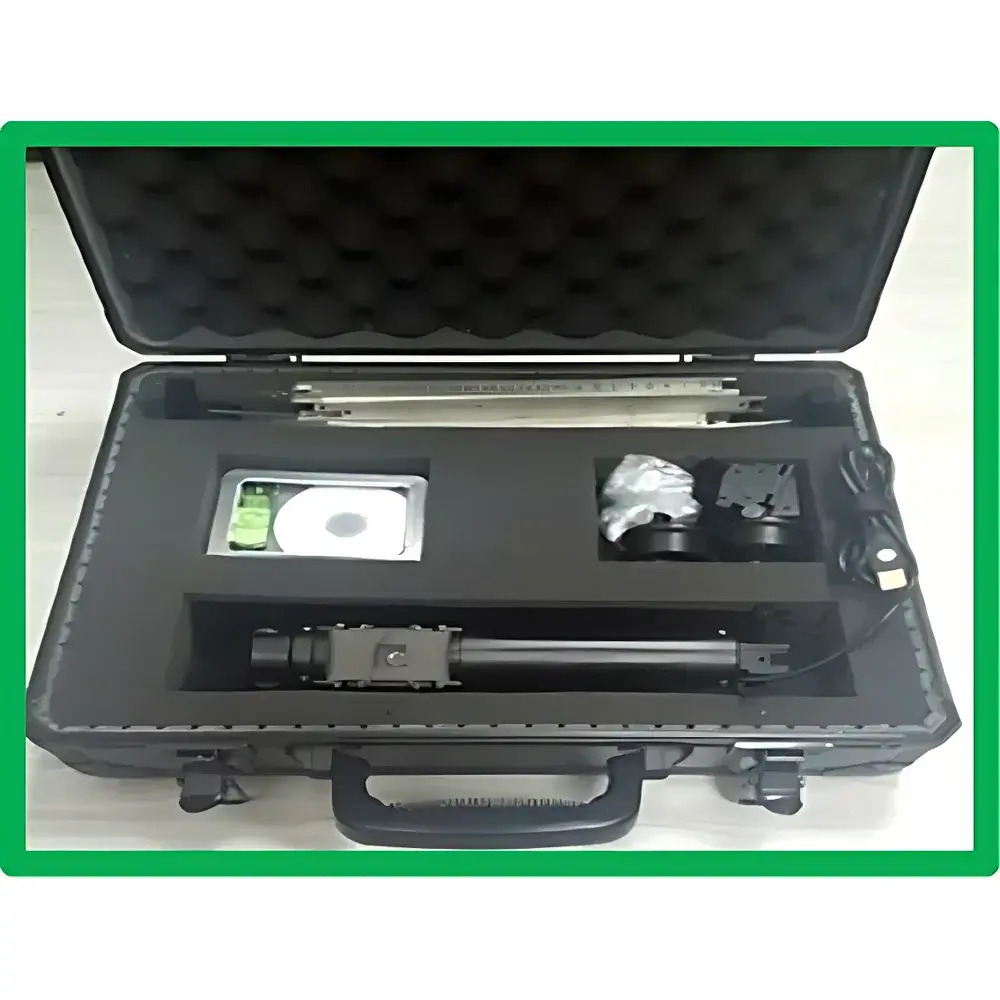
PM-Tech RTC-V17 In Situ Root Growth Monitoring System
| Brand | PM-Tech |
|---|---|
| Origin | Germany |
| Model | RTC-V17 |
| Camera Resolution | 17.8 MP RGB |
| Imaging Area | 55 mm (W) × 40 mm (H) |
| Light Sources | White, Red, Green, UV (software-controlled intensity) |
| Power Supply | 5 V DC via USB |
| Operating Temperature | 0–50 °C |
| Relative Humidity | 0–100% RH (non-condensing) |
| Image Acquisition Time | <1 s |
| Integrated Sensors | 12-bit temperature sensor (−50 to +85 °C), water immersion detection with auto-shutdown |
| Software Modes | Pregizer / Topology / Custom topology |
| Data Export | CSV, Excel-compatible formats |
| Language Support | English, Simplified Chinese, Traditional Chinese |
Overview
The PM-Tech RTC-V17 In Situ Root Growth Monitoring System is an engineered field-deployable imaging platform designed for non-destructive, high-fidelity longitudinal observation of root architecture under natural soil conditions. It operates on the principle of macroscopic optical imaging through transparent rhizotron-compatible micro-rhizotrons (1 m length, 50 mm diameter), enabling repeated in situ visualization of root development without excavation or disturbance. The system employs a high-resolution 17.8 MP RGB camera coupled with spectrally tunable illumination (white, red, green, and UV) to support both structural phenotyping and physiological assessment—including live/dead root differentiation via UV-induced autofluorescence. Its USB-powered architecture eliminates external power supplies or control enclosures, ensuring rapid deployment in remote or resource-constrained field sites. All image acquisition, real-time preview, and preliminary processing occur directly on a Windows-based laptop or tablet, making it suitable for GLP-aligned experimental workflows where traceability and reproducibility are critical.
Key Features
- Single-unit, USB-powered design: No intermediate controllers, battery packs, or signal conditioning hardware required—connects directly to host device via standard USB 3.0 interface.
- Multi-spectral illumination system: Independently adjustable white, red, green, and UV LED arrays enable spectral contrast optimization for root segmentation, lignin detection, and viability assessment without physical filter changes.
- Integrated environmental sensing: Factory-calibrated 12-bit temperature sensor (−50 to +85 °C) and capacitive water immersion detector provide real-time environmental metadata and automatic circuit protection upon moisture ingress.
- Sub-pixel spatial calibration: Software-supported XY-directional resolution correction using embedded millimeter-scale reference ruler; supports dynamic magnification tracking during focal depth adjustment.
- Live root discrimination: UV excitation (365 nm peak) induces chlorophyll and lignin autofluorescence, allowing qualitative screening and quantitative pixel-intensity-based classification of metabolically active root segments.
- Rhizotron-ready mechanical interface: Precision-machined mounting collar and depth-stop mechanism ensure repeatable insertion and angular alignment across sequential imaging sessions.
Sample Compatibility & Compliance
The RTC-V17 is validated for use with standard 50 mm inner-diameter acrylic or quartz micro-rhizotrons installed vertically or at shallow angles (≤15°) in mineral soils, peat substrates, hydroponic media, and growth pouches. It complies with ISO 22393:2020 (Plant phenotyping — General requirements for instrumentation) and supports audit-ready data collection per FDA 21 CFR Part 11 when deployed with timestamped, user-authenticated software sessions and immutable raw image storage. Sensor firmware and analysis algorithms are developed and maintained exclusively by PM-Tech (Germany), ensuring full traceability of calibration coefficients and measurement uncertainty budgets. No third-party sensor integration is performed—temperature and immersion sensors are co-manufactured with the imaging module to guarantee thermal and electrical stability across environmental gradients.
Software & Data Management
The bundled Plant Phenotyping Software (Root Edition) provides a modular, scriptable environment for root trait extraction and longitudinal modeling. Core analytical modules include three topology inference engines (Pregizer, Topology, Custom), two color-space decomposition models (RHS hue-saturation-value and UCL uniform color space), and adaptive background suppression optimized for heterogeneous soil matrices. All measurements—root length, projected area, surface area, branching density, angular distribution, and biomass proxies—are computed using sub-pixel edge detection and skeletonization with pruning thresholds adjustable per experiment. Data export follows FAIR principles: CSV tables contain column headers compliant with MIAPPE v1.1 metadata standards; time-series outputs include embedded geotags, operator ID, rhizotron ID, and environmental sensor logs. Integration with MATLAB and R is supported via native .mat and .rds serialization; Excel exports retain formula links for automated reporting pipelines.
Applications
The RTC-V17 supports hypothesis-driven research in root plasticity under abiotic stress (drought, salinity, hypoxia), genotype-by-environment interaction studies in crop breeding programs, and ecological investigations of mycorrhizal colonization dynamics. Its ability to resolve fine lateral root emergence (<100 µm diameter) over weeks to months enables quantification of root turnover rates, cortical aerenchyma formation, and exudation zone mapping when combined with adjacent chemical imaging techniques. Field deployments have been documented in USDA ARS long-term agroecosystem trials, EU H2020 ROOTS project field sites, and JAXA space biology experiments evaluating gravitropic response in simulated partial gravity environments.
FAQ
Is the RTC-V17 compatible with existing rhizotron infrastructure?
Yes—the system interfaces with industry-standard 50 mm ID transparent tubes and includes depth-stabilizing collars for consistent positioning across repeated visits.
Does the software support batch processing of time-series image stacks?
Yes—automated alignment, background normalization, and trait extraction workflows can be applied to folders containing timestamped image sequences, with progress logging and error flagging.
Can root viability metrics be exported as quantitative indices?
Yes—UV-excited fluorescence intensity profiles are normalized to reference regions and reported as relative pixel-value ratios with coefficient-of-variation statistics per root segment.
What level of technical support is provided post-purchase?
PM-Tech offers firmware updates, software patch releases, and remote configuration assistance for 36 months; on-site service contracts are available in EEA, North America, and APAC regions.
Are calibration certificates included with shipment?
Each unit ships with a factory-issued calibration report documenting camera MTF, illumination uniformity maps, and sensor linearity curves—traceable to PTB (Physikalisch-Technische Bundesanstalt) standards.
Related Products






