
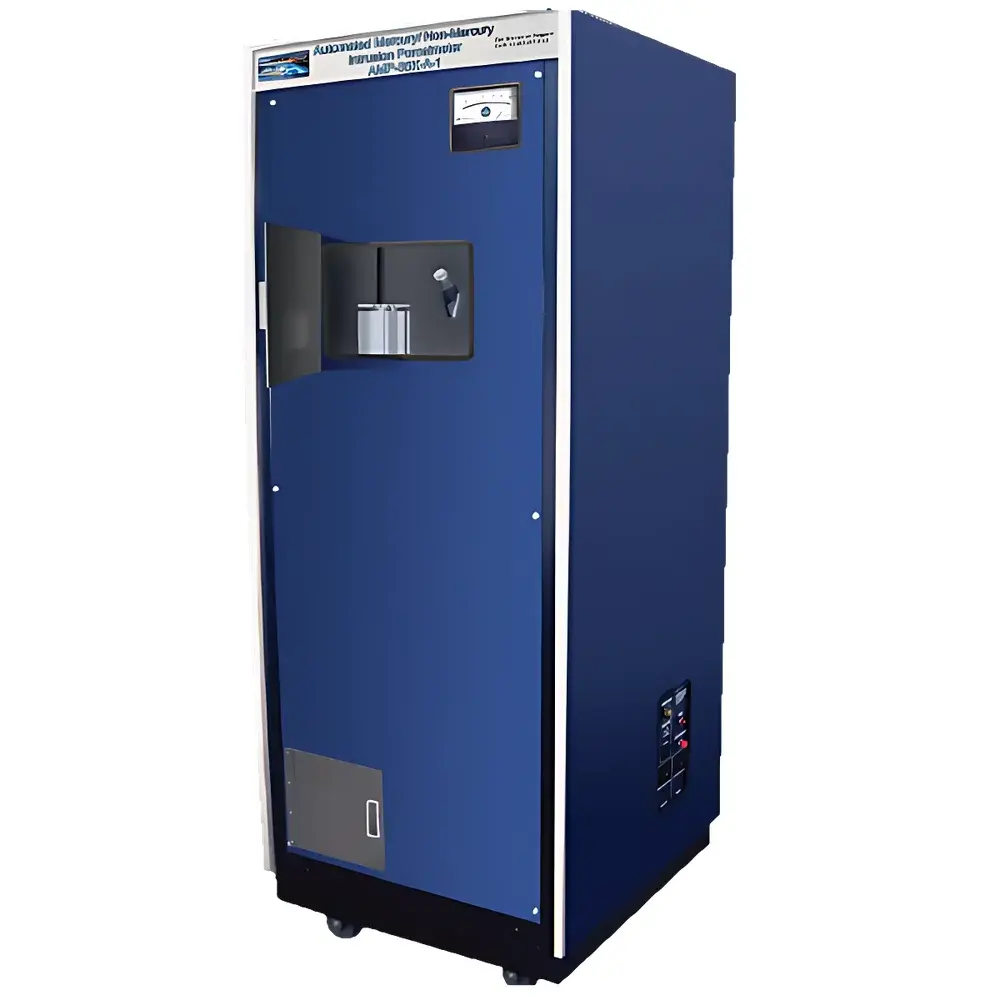
PMI AMP-60K-A-1 Advanced Mercury Intrusion Porosimeter
| Brand | PMI Porometer / Porous Materials Inc. |
|---|---|
| Origin | USA |
| Manufacturer Type | Authorized Distributor |
| Origin Category | Imported |
| Model | AMP-60K-A-1 |
| Price | Upon Request |
| Pore Size Range | 3 nm – 500 µm (calculated per Washburn equation, dependent on mercury surface tension and contact angle) |
| Pressure Range | 0–60,000 psi (high-pressure station), 0–33,000 psi (dual-range configuration available) |
| Measurement Accuracy | Compliant with ASTM D4404 and ISO 15901-1 for mercury intrusion porosimetry |
| Sample Chamber Capacity | Standard 10 mL (customizable from 10–100 mL) |
| Number of Sample Stations | Single or dual chamber configuration |
| Intrusion Medium | High-purity mercury with isopropanol-assisted recovery system |
| Pressure Transducers | Triple-stage (low: 0–1000 Torr ≈ 20 psia |
| medium | 0–3000 psia |
| high | 0–60,000 psia) |
| Micrometered Dosing Tube Volume | Up to 2.1 cc (standard) |
Overview
The PMI AMP-60K-A-1 Advanced Mercury Intrusion Porosimeter is a fully automated, high-pressure analytical instrument engineered for precise quantification of pore size distribution, total pore volume, bulk density, and specific surface area in rigid, non-collapsible porous solids. Based on the fundamental principle of mercury intrusion porosimetry (MIP), the system applies controlled hydrostatic pressure to force non-wetting mercury into interconnected and isolated pores — with pore diameter inversely proportional to applied pressure according to the Washburn equation. Designed and manufactured under stringent U.S.-based quality protocols, the AMP-60K-A-1 complies with international standards including ASTM D4404 (Standard Test Method for Determination of Pore Size Distribution of Catalyst Substrates by Mercury Porosimetry) and ISO 15901-1 (Porous materials — Mercury porosimetry and gas adsorption methods — Part 1: Mercury porosimetry). Its operational architecture supports routine QC/QA workflows in catalyst development, ceramic sintering validation, geological core analysis, pharmaceutical excipient characterization, and advanced battery electrode material qualification.
Key Features
- Triple-stage pressure architecture: Integrated low-, medium-, and high-pressure transducers (0–1000 Torr, 0–3000 psia, and 0–60,000 psia) enable seamless, auto-switched transitions across the full measurable pore range (3 nm to 500 µm) without manual intervention.
- Engineered mercury containment: All wetted components — including stainless-steel sample reservoirs, sealed manifold pathways, and mercury-recovery chambers — are constructed from electropolished 316L stainless steel to prevent corrosion, permeation, or structural failure under sustained high pressure.
- Fail-safe operator protection: Interlocked safety door with real-time vapor monitoring, integrated exhaust ventilation (≥15 ACH), and internal mercury-trap collection vessels minimize exposure risk to elemental mercury vapor (Hg⁰) during operation and maintenance.
- Isopropanol-assisted mercury recovery: Patented pressurized solvent displacement system enables >98% mercury retrieval post-analysis, reducing consumable cost, minimizing hazardous waste generation, and eliminating benchtop residue contamination.
- Modular sample handling: Standard 10 mL sample chamber; optional configurations support 25 mL, 50 mL, and 100 mL capacities — accommodating powders, monoliths, extrudates, and irregularly shaped geological or ceramic specimens.
- Full automation protocol: From vacuum degassing and initial low-pressure equilibration to final high-pressure intrusion and automatic mercury return, the entire sequence executes unattended with audit-trail logging compliant with FDA 21 CFR Part 11 requirements.
Sample Compatibility & Compliance
The AMP-60K-A-1 accepts rigid, mercury-wettable materials stable under vacuum and high hydrostatic pressure — including metal oxides, zeolites, activated carbons, sintered metals, refractory ceramics, geological shales, and hardened cementitious matrices. It excludes elastomers, gels, soft polymers, or any material exhibiting plastic deformation above 1000 psi. Instrument validation documentation supports GLP/GMP environments; calibration certificates traceable to NIST standards are provided upon installation. System compliance includes adherence to OSHA Hg exposure limits (0.05 mg/m³ TWA), EPA RCRA waste classification guidelines, and ISO/IEC 17025 method validation frameworks.
Software & Data Management
Controlled via Prowin™ software — a native Windows application compatible with 32-bit and 64-bit Windows 7, 8, and 10 platforms — the interface requires no specialized hardware drivers beyond standard USB 2.0 connectivity. Prowin enables full parameter scripting: user-defined ramp rates (psi/min), dwell times per pressure step, auto-refill thresholds, dynamic surface tension (485 mN/m default, adjustable) and contact angle inputs (130°–140° typical for mercury on silicates). Raw intrusion curves, derivative dV/d(log D) distributions, cumulative pore volume plots, and BET-equivalent surface area estimates are exportable in CSV, XML, and PDF formats. Audit trails record operator ID, timestamp, parameter changes, and system error logs — supporting regulatory submissions under ICH M4, USP <1217>, and EMA Annex 11.
Applications
- Catalyst substrate optimization: Correlating macropore interconnectivity (≥50 nm) with diffusion-limited reaction kinetics in FCC and hydroprocessing catalysts.
- Battery electrode porosity mapping: Quantifying tortuosity and binder-induced pore constriction in Li-ion cathode composites (NMC, LFP) pre- and post-cycling.
- Geomechanical core analysis: Differentiating primary intergranular porosity from secondary microfracture networks in shale gas reservoir evaluation.
- Pharmaceutical tablet compactness: Validating compression-induced pore closure and predicting dissolution rate variability across batch releases.
- Ceramic green-body densification: Monitoring pore elimination kinetics during sintering cycles via sequential MIP measurements.
FAQ
What pore size range is physically achievable with the AMP-60K-A-1?
The theoretical lower limit is ~3 nm at 60,000 psi using standard mercury (σ = 485 mN/m, θ = 140°); upper limit extends to 500 µm at sub-ambient pressures. Actual resolution depends on sample mechanical stability and mercury purity.
Does the system support multi-sample throughput?
Yes — dual-chamber configurations allow sequential or parallel analysis with independent pressure profiles and scheduling.
How is mercury purity maintained between runs?
Integrated filtration cartridges (0.2 µm PTFE) and isopropanol-flush cycles remove particulate carryover and oxidized mercury residues prior to each analysis.
Can Prowin software generate reports compliant with regulatory submissions?
Yes — all raw data, metadata, and electronic signatures adhere to ALCOA+ principles and are exportable in eCTD-compatible structures.
Is on-site installation and IQ/OQ/PQ validation available?
PMI-certified field engineers provide full commissioning, including mechanical verification, pressure transducer calibration, and GMP-compliant qualification documentation.



