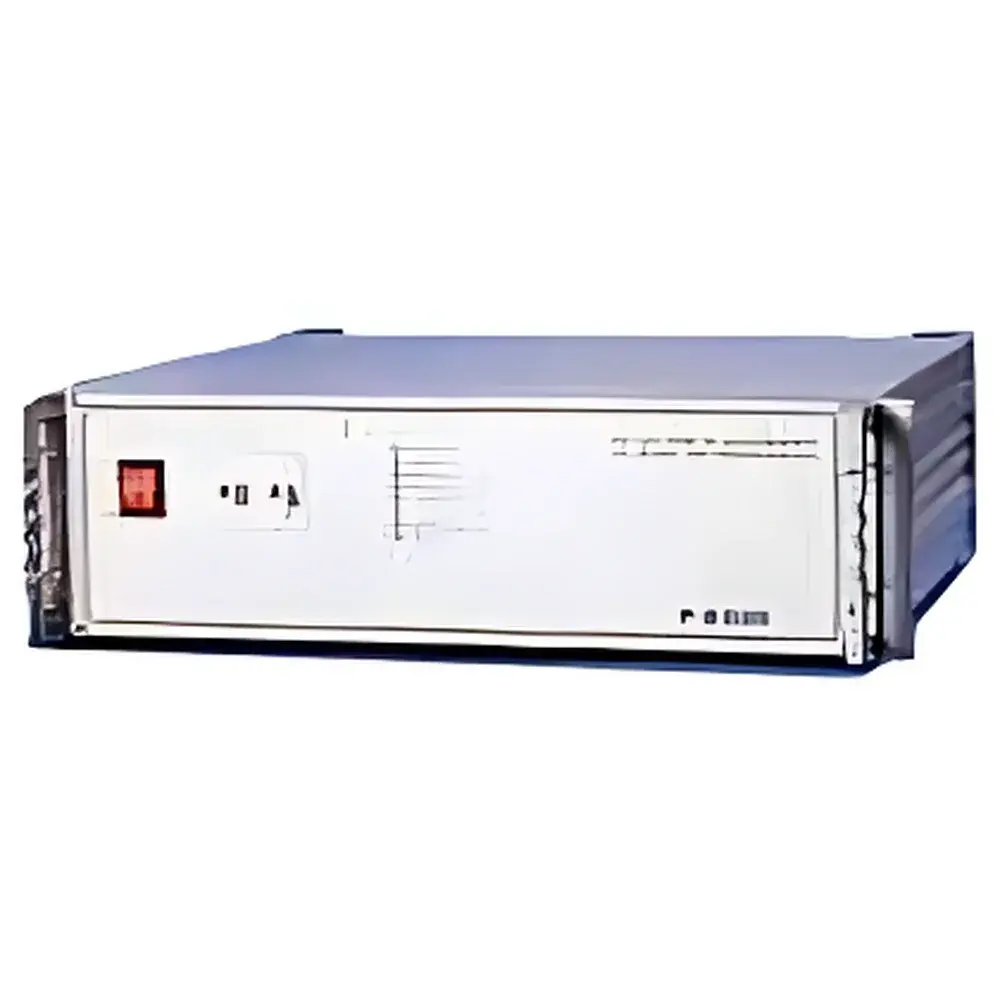
PMM 1000 Flicker and Harmonic Analyzer
| Brand | PMM |
|---|---|
| Origin | Italy |
| Model | PMM 1000 |
| Processor | Motorola DSP56002 & Intel 80C186/187 |
| Input Resolution | 18-bit per channel |
| ADC Interface | IEEE-488 (GPIB) |
| Self-test | On power-up |
| Power Supply | 180–250 VAC / 90–125 VAC, 50–60 Hz |
| Max Power Consumption | 40 W |
| Dimensions | 460 × 448 × 132 mm |
| Weight | 12 kg |
| Operating Temperature | 0–50 °C |
| Storage Temperature | −20–80 °C |
| Storage Humidity | ≤92% RH, non-condensing |
| Software Platform | Windows-based |
| Harmonic Standards Compliance | IEC 61000-3-2, IEC 61000-3-4, IEC 61000-4-7, IEC 555-2 |
| Flicker Standards Compliance | IEC 61000-3-3 (replaces IEC 1000-3-3), IEC 60468 (Amend. 1), IEC 60555-3 (Amend. 1), IEC 60868 (Amend. 1) |
| Voltage Input Range | 90–300 Vrms (flicker: 40–504 Vrms) |
| Current Input Range | 5 mA–16 A (shunt ranges: 0.16 / 0.8 / 4 / 20 A) |
| Voltage Channel Input Impedance | >8 MΩ |
| Current Channel Impedance | <3.03 mΩ (max range) |
| Max Potential Difference | 150 mV |
| Accuracy | Better than ±0.2% for harmonics |
| Anti-aliasing Filter Attenuation | 70 dB |
| Transient Harmonic Smoothing | Low-pass filter, 1° phase shift (1.5 s period) |
| Measurement Modes | Single-shot, time-limited, continuous |
| Data Storage | Ring-buffer architecture retaining last 2.5 minutes of continuous measurement |
| FFT Points | 2048 |
| Frequency Range | 45–65 Hz (extendable to 16–2500 Hz) |
| Flicker Metrics | Pst, Plt, Pmax, P50%, P10%, P3%, P1%, P0.1%, CPF, d(t), dmax, dc |
| Voltage Fluctuation Resolution | ±2% error for d(t) and dmax |
| AC Power Supply Options | TPS 1500 (1-phase, 1.5 kVA), TPS-K10 (3-phase, 10 kVA), TPS-K20 (3-phase, 20 kVA) |
Overview
The PMM 1000 Flicker and Harmonic Analyzer is a precision-engineered digital instrumentation platform developed by PMM S.r.l. (Italy) for comprehensive electromagnetic compatibility (EMC) assessment in accordance with international regulatory frameworks. It implements dual-processor architecture—featuring a Motorola DSP56002 digital signal processor and an Intel 80C186/187 microcontroller—to ensure deterministic real-time execution of harmonic spectral analysis and voltage fluctuation evaluation. The instrument operates on the fundamental principles of fast Fourier transform (FFT)-based spectral decomposition, combined with standardized flicker perception modeling as defined in IEC 61000-3-3 and IEC 60868. Its 18-bit per-channel analog-to-digital conversion, coupled with hardware-level anti-aliasing filtering (70 dB attenuation), guarantees metrological traceability and high reproducibility across laboratory, calibration facility, and industrial production line environments. Designed explicitly for compliance verification—not generic signal analysis—the PMM 1000 delivers calibrated RMS, active/reactive/apparent power, power factor (λ), harmonic distortion indices (KV%, KI%), and time-domain flicker metrics (PST, PLT, CPF) under rigorously controlled sampling conditions aligned with IEC 61000-4-7 Class A requirements.
Key Features
- Dual-processor architecture enabling concurrent harmonic spectrum computation and flicker metric derivation without computational trade-offs
- 18-bit resolution ADC per input channel, ensuring quantization noise floor below −108 dBFS across full dynamic range
- Galvanically isolated voltage and current inputs supporting simultaneous dual-channel acquisition with up to 50° phase tolerance between channels
- IEEE-488 (GPIB) interface for deterministic, low-latency data transfer to host systems—fully compatible with automated test benches and GLP/GMP audit-ready data acquisition workflows
- Real-time FFT engine computing 2048-point spectra over non-overlapping 16-segment time windows, synchronized to fundamental frequency (45–65 Hz)
- Comprehensive transient harmonic smoothing via configurable low-pass filtering (1° phase shift, 1.5 s integration window) to suppress spurious spectral leakage
- Ring-buffer memory architecture preserving the most recent 2.5 minutes of continuous measurement data—enabling retrospective analysis of event-triggered anomalies
- Integrated self-test routine executed at power-on, verifying analog front-end integrity, clock stability, and processor health prior to measurement initiation
Sample Compatibility & Compliance
The PMM 1000 supports direct connection to single-phase and three-phase AC networks via optional external power supplies (TPS 1500, TPS-K10, TPS-K20), accommodating nominal voltages from 90 Vrms to 504 Vrms and currents up to 20 A (shunt mode). Its input impedance profile (>8 MΩ for voltage, <3.03 mΩ for max-current shunt) minimizes circuit loading effects during in-situ measurements. All core measurement functions conform to mandatory EMC standards applicable to equipment connected to public low-voltage supply systems: IEC 61000-3-2 (harmonic current emissions), IEC 61000-3-3 (voltage fluctuations and flicker), IEC 61000-4-7 (instrumentation requirements for harmonic and interharmonic measurement), and legacy references including IEC 60555-2/3 and IEC 60468. The analyzer satisfies Class A instrumentation accuracy requirements per IEC 61000-4-7 and meets the uncertainty budget stipulated in IEC 60868 Amendment 1 for short-term flicker perception (PST) and long-term flicker perception (PLT). Its design inherently supports FDA 21 CFR Part 11-compliant data handling when integrated with validated Windows-based software and secure audit-trail-enabled storage protocols.
Software & Data Management
The PMM 1000 operates with a dedicated Windows-compatible application suite that provides full configuration, real-time visualization, and post-processing capabilities. The software enables user-defined limit templates for C-class and D-class equipment per IEC 61000-3-2, supports dynamic threshold weighting across multiple time domains, and exports measurement datasets in CSV and binary formats compatible with MATLAB, LabVIEW, and statistical process control (SPC) platforms. All acquired data—including raw waveforms, harmonic amplitude/phase tables, flicker time-series (d(t)), and computed metrics (PST, PLT, CPF)—are timestamped with millisecond resolution and annotated with environmental metadata (temperature, supply voltage, firmware revision). Audit trails record operator actions, parameter changes, and calibration events—supporting ISO/IEC 17025 and GLP-aligned quality management systems. Optional GPIB-controlled automation allows integration into fully traceable EMC test suites compliant with EN 55032, CISPR 32, and MIL-STD-461G.
Applications
- Pre-compliance and formal certification testing of consumer electronics, lighting equipment, UPS systems, and variable-speed drives against IEC 61000-3-2 and IEC 61000-3-3
- Root-cause analysis of grid instability events in distributed generation sites, particularly where inverter-based resources introduce harmonic resonance or flicker propagation
- Design validation of active power filters and dynamic voltage restorers requiring high-fidelity harmonic injection profiling
- Calibration laboratory reference instrumentation for accredited verification of harmonic analyzers and flicker meters
- Quality assurance monitoring in manufacturing lines producing medical devices, industrial controllers, and household appliances subject to CE marking and UKCA regulatory obligations
- Field diagnostics of voltage fluctuation sources in commercial buildings, data centers, and railway traction substations
FAQ
Does the PMM 1000 support three-phase harmonic analysis?
Yes—it accepts three-phase voltage and current inputs via optional external power conditioners (e.g., TPS-K10/K20) and computes individual phase harmonics as well as interharmonic components per IEC 61000-4-7 Annex B.
Is firmware upgrade capability available remotely?
Firmware updates require local USB or serial connection using PMM-provided utilities; remote update functionality is not implemented to maintain measurement integrity and regulatory compliance.
Can the instrument perform simultaneous harmonic and flicker measurement?
Yes—the dual-processor architecture enables concurrent acquisition and parallel processing of both harmonic spectra and flicker time-series without time multiplexing or data loss.
What is the maximum harmonic order measurable?
At 50 Hz fundamental, the PMM 1000 resolves up to the 40th harmonic (2 kHz); at 60 Hz, up to the 41st (2.46 kHz), consistent with IEC 61000-4-7 Class A bandwidth requirements.
Are calibration certificates provided with shipment?
Each unit ships with a factory calibration certificate traceable to national metrology institutes (NIST, PTB, NPL); accredited calibration services are available upon request with ISO/IEC 17025 reporting.