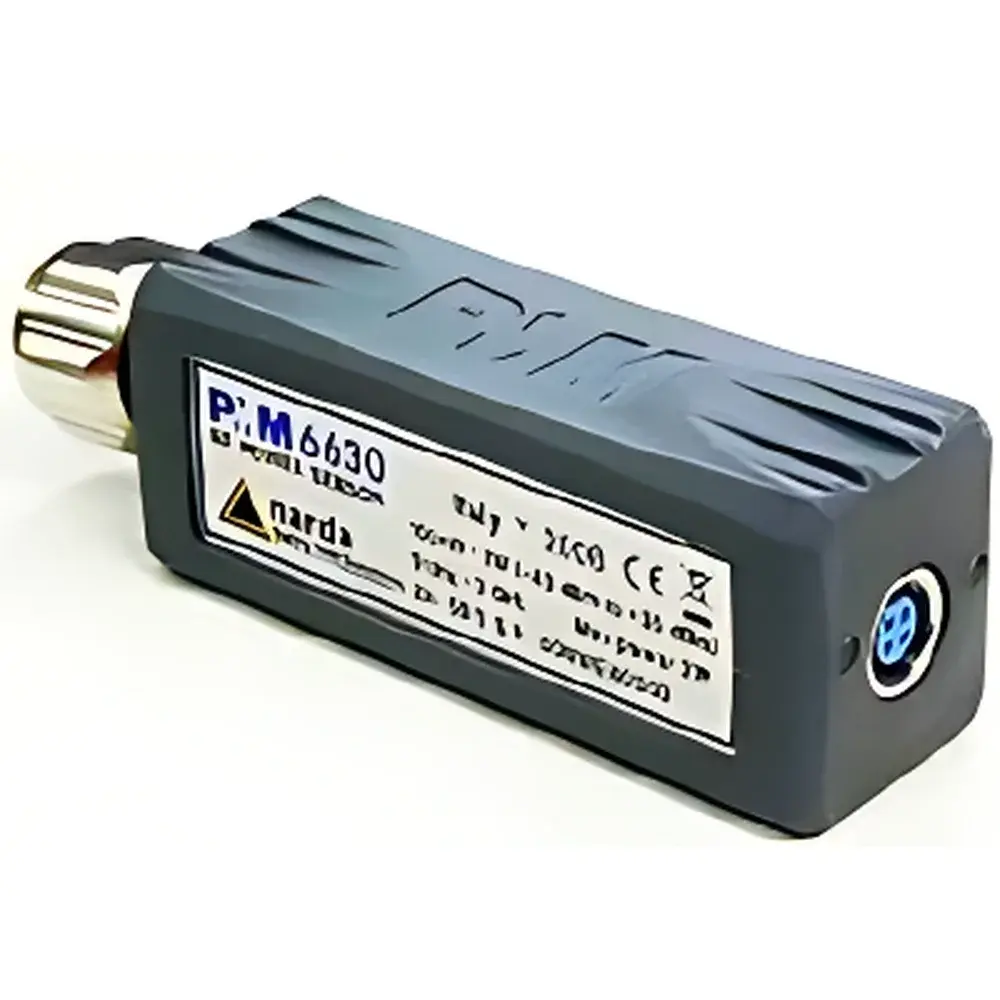
PMM 6630/6630D/6600/6600D RF Power Meter
| Frequency Range | 9 kHz–3 GHz (6600/6600D: up to 1 GHz) |
|---|---|
| Power Range | 100 nW–1 W (-40 dBm to +30 dBm) |
| Linearity | ±0.2 dB (typ.) |
| Measurement Units | dBm, W, Vrms |
| Interface | USB 1.0/1.1/2.0 (6600/6600D: RS-486) |
| Probe Integration | Integrated sensor and meter architecture |
| RMS Detection | True RMS, >70 dB dynamic range |
| Bidirectional Measurement | Forward & reverse power |
| Calibration | Reference-source-free operation |
Overview
The PMM 6630, 6630D, 6600, and 6600D series represent a family of compact, integrated RF power meters engineered for precision amplitude measurement across laboratory, production, and field service environments. These instruments operate on the principle of thermal-based true RMS detection—leveraging thermocouple or thermistor sensor elements embedded directly within the meter housing—to deliver frequency-independent power readings for both continuous-wave (CW) and complex modulated signals (e.g., GSM, LTE, WLAN, and pulsed RF). Unlike diode-based detectors, which exhibit amplitude-dependent nonlinearity and limited dynamic range, the PMM series maintains high accuracy over a 70 dB span without requiring external zeroing or reference calibration sources. The 6630/6630D models cover 9 kHz to 3 GHz, while the 6600/6600D variants are optimized for sub-1 GHz applications—making them suitable for EMC pre-compliance testing, amplifier characterization, antenna system verification, and RF safety assessments in accordance with IEC 62232 and EN 50492.
Key Features
- Integrated sensor-and-meter architecture eliminates cable loss uncertainty and probe-to-meter interface errors common in modular systems
- True RMS response ensures traceable, waveform-agnostic power measurement for CW, AM/FM, OFDM, and burst-mode signals
- ±0.2 dB typical linearity across full dynamic range supports high-fidelity gain/loss validation in RF subsystems
- Bidirectional measurement capability enables simultaneous forward and reflected power analysis—critical for VSWR estimation and impedance matching verification
- Reference-source-free operation reduces calibration overhead and improves measurement reproducibility between labs and shifts
- USB 2.0 interface (6630/6630D) provides plug-and-play connectivity with Windows/Linux hosts; 6600/6600D models feature RS-486 for industrial control integration
- Compact, battery-operable design facilitates portable use in shielded rooms, anechoic chambers, and on-site transmitter installations
Sample Compatibility & Compliance
The PMM series is compatible with standard 50 Ω RF interfaces (N-type or SMA, depending on probe variant) and supports direct connection to signal generators, power amplifiers, filters, couplers, and antenna feedlines. It meets mechanical and electrical requirements for IEC 61000-4-3 (radiated immunity) and IEC 61326-1 (EMC for test equipment). While not certified as a primary standard, its traceability path aligns with national metrology institutes (NMIs) via factory calibration against NIST-traceable standards. For regulated environments—including ISO/IEC 17025-accredited labs—the instrument supports user-defined calibration intervals and generates audit-ready calibration logs compliant with GLP and GMP documentation practices.
Software & Data Management
PMM provides native PC software (Windows-compatible) enabling real-time waveform visualization, statistical data logging (min/max/avg/std dev), and automated report generation in PDF/CSV formats. The API supports SCPI command set over USB/RS-486, allowing seamless integration into LabVIEW, MATLAB, or Python-based test automation frameworks. All measurements include timestamping, instrument identification, and environmental metadata (e.g., ambient temperature). Audit trails record user actions, configuration changes, and calibration events—supporting compliance with FDA 21 CFR Part 11 when deployed in pharmaceutical or medical device RF testing workflows.
Applications
- RF power amplifier efficiency and compression point (P1dB) characterization
- Transmitter output stability monitoring during thermal soak tests
- EMC pre-scan and radiated emissions source strength estimation
- Antenna matching network tuning using forward/reflected power ratio
- Wireless module production line pass/fail screening per IEEE 802.11 or 3GPP conformance criteria
- Educational RF lab instruction on signal integrity, impedance mismatch, and power transfer theory
FAQ
What is the difference between the 6630 and 6600 series?
The 6630/6630D models support full 9 kHz–3 GHz operation and use USB 2.0; the 6600/6600D are cost-optimized for 9 kHz–1 GHz applications and communicate via RS-486.
Can the PMM measure modulated signals such as 5G NR or Wi-Fi 6?
Yes—its true RMS architecture ensures accurate average power measurement regardless of modulation bandwidth or crest factor, provided the signal remains within the specified frequency and power limits.
Is external calibration required before first use?
No—each unit ships with a factory calibration certificate traceable to national standards; however, periodic recalibration is recommended annually or per ISO/IEC 17025 quality management requirements.
Does the instrument support averaging or peak-hold functions?
Yes—the embedded firmware includes selectable averaging modes (linear/RMS), peak detection, and hold functions for transient event capture.
How is traceability maintained for regulatory submissions?
Calibration reports include uncertainty budgets, environmental conditions, and metrological traceability statements—fully compatible with accreditation body requirements for technical records under Clause 7.7 of ISO/IEC 17025:2017.
Related Products