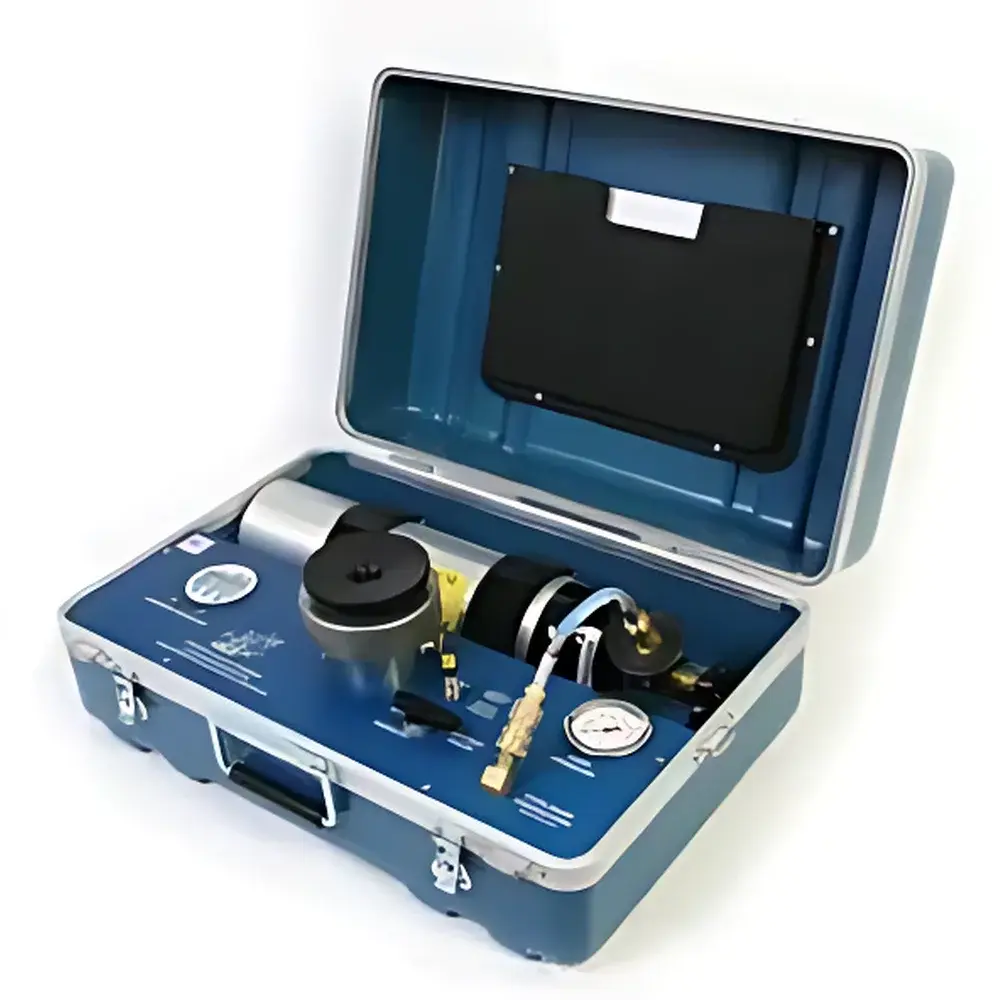
PMS 1515D Portable Plant Water Potential Pressure Chamber
| Brand | PMS |
|---|---|
| Origin | USA |
| Model | 1515D |
| Measurement Range | 0–100 bar |
| Accuracy | ±1% of reading (at 50 bar, half-scale) |
| Chamber Material | Stainless Steel |
| Chamber Internal Dimensions | 6.35 cm ID × 12.7 cm depth |
| Display | Digital backlit pressure gauge with selectable units (bar, MPa, psi) |
| Gas Supply | Integrated 20 ft³ aluminum nitrogen cylinder (max pressure 207 bar) |
| Weight | ~16 kg (instrument only) |
| cylinder | 3.9 kg |
| Overall Dimensions | 56 × 38 × 26 cm |
| Seal Options | Standard 6.35 mm compression seal |
| Accessories | 7× and 3.5× magnifying eyepieces (AAA-powered), LED-illuminated 10× handheld eyepiece, gas-saver valve (full- or half-range), sample insertion tools (1/8", 3/16", 1/4" OD), reusable moisture-equilibration sample bags (species-specific sizing), stainless steel chamber base caps (9.525 mm, 12.7 mm, grass-leaf) |
Overview
The PMS 1515D Portable Plant Water Potential Pressure Chamber is an engineered field instrument designed for the direct, in situ determination of plant water potential (Ψleaf) via the pressure bomb method—based on the thermodynamic principle that the pressure required to force xylem sap to exude from a cut stem surface equals the negative water potential of the tissue prior to excision. This technique remains the internationally accepted reference standard for validating indirect methods (e.g., psychrometry, thermocouple hygrometry) and is widely cited in peer-reviewed plant physiology literature. The 1515D operates at up to 100 bar maximum pressure, enabling reliable measurement across diverse species—including high-water-potential desert succulents, drought-stressed cereals, woody perennials, and irrigated horticultural crops. Its fully sealed, ruggedized aluminum enclosure ensures operational integrity under variable ambient conditions (−10 °C to 45 °C), while the integrated 20 ft³ nitrogen cylinder supports ≥60–80 measurements at typical field pressures (e.g., 12 bar), minimizing logistical dependency on refilling infrastructure.
Key Features
- High-pressure digital pressure gauge with backlighting and dual-unit display (bar, MPa, psi), calibrated to ±1% accuracy at half-scale (50 bar), traceable to NIST standards.
- Stainless steel sample chamber (6.35 cm internal diameter × 12.7 cm depth) with precision-machined sealing surfaces and corrosion-resistant hardware for long-term repeatability.
- Modular sealing system: Standard 6.35 mm compression seal with optional interchangeable rubber gaskets and matching metal inserts (3.175 mm, 9.525 mm, 12.7 mm, grass-leaf, apricot-leaf profiles) to accommodate anatomically diverse petioles and stems.
- Ergonomic field deployment: Integrated carrying handle, detachable shoulder strap, and five reinforced mounting rings compatible with ATVs, UTVs, or vehicle roof racks.
- Gas-efficient operation: Optional full- or half-range gas-saver valve reduces nitrogen consumption by up to 40%, extending cylinder service life without compromising pressure ramp fidelity.
- Visual confirmation system: Includes 7× and 3.5× magnifying eyepieces (battery-powered, AAA) plus an LED-illuminated 10× handheld eyepiece for unambiguous detection of first xylem sap exudation—critical for endpoint determination per ASTM D7091 and ISO 13041 protocols.
Sample Compatibility & Compliance
The 1515D accommodates leafy shoots, herbaceous stems, and woody twigs across broad taxonomic groups—from Zea mays and Triticum aestivum to Vitis vinifera, Prunus armeniaca, and Juglans regia. Reusable equilibration sample bags (species-specific dimensions) enable standardized 10-minute pre-measurement hydration equilibrium, reducing diurnal variability and improving inter-laboratory reproducibility. All sealing components comply with FDA-compliant elastomer specifications (USP Class VI silicone-free nitrile). Instrument design adheres to IEC 61010-1 safety standards for portable pressurized equipment. Data acquisition workflows support GLP/GMP-aligned documentation when paired with external logging software; though the unit itself does not include electronic data export, its analog pressure output can be interfaced with validated third-party DAQ systems compliant with 21 CFR Part 11 requirements.
Software & Data Management
The 1515D is a stand-alone analog-digital hybrid instrument: pressure readings are displayed locally on the backlit LCD but are not natively stored or transmitted. For regulatory or longitudinal study applications, users may integrate the device with external data loggers (e.g., Campbell Scientific CR1000X, HOBO UX120) via 0–5 V analog output (available upon request with OEM adapter). Field-collected values are typically recorded manually into structured spreadsheets or LIMS platforms aligned with FAO’s AquaCrop or USDA-ARS irrigation scheduling frameworks. PMS provides comprehensive SOP templates—including calibration verification logs, seal integrity checklists, and temperature-compensated Ψleaf correction tables—for audit readiness under ISO/IEC 17025-accredited laboratories.
Applications
- Field-based irrigation scheduling: Quantifying crop water status to optimize water use efficiency in viticulture, orchard management, and row-crop agriculture.
- Drought phenotyping: Screening germplasm for water-use efficiency traits in breeding programs targeting climate-resilient cultivars.
- Ecohydrological research: Assessing plant–soil–atmosphere continuum dynamics across gradients of aridity, salinity, and elevation.
- Post-harvest physiology: Monitoring water potential shifts during storage and transport of horticultural commodities.
- Regulatory compliance: Supporting EPA and USDA evaluations of drought mitigation strategies and conservation reserve program (CRP) effectiveness.
FAQ
What is the recommended calibration frequency for the 1515D pressure transducer?
Annual recalibration against a certified deadweight tester is advised; field verification using zero-pressure and known-pressure test points should be performed before each intensive sampling campaign.
Can the 1515D measure roots or soil samples?
No—the instrument is validated exclusively for excised shoot tissues. Root or soil water potential requires alternative methodologies (e.g., tensiometry, thermocouple psychrometry).
Is nitrogen the only acceptable pressurizing gas?
Yes. Compressed air introduces moisture and oxygen, risking oxidation of xylem sap and inconsistent exudation kinetics. High-purity nitrogen (≥99.998%) is mandatory per ASTM D7091 Section 6.2.
How does temperature affect measurement accuracy?
Chamber temperature must remain within ±2 °C of ambient leaf temperature during equilibration; the 1515D includes thermal mass stabilization to minimize drift, but users should avoid direct solar exposure during operation.
Are replacement seals and inserts available as consumables?
Yes—PMS stocks all gasket sizes (nitrile, EPDM), metal inserts, base caps, and sample bags under catalog numbers accessible via authorized distributors; lead time is typically 5–7 business days for international shipment.
Related Products