
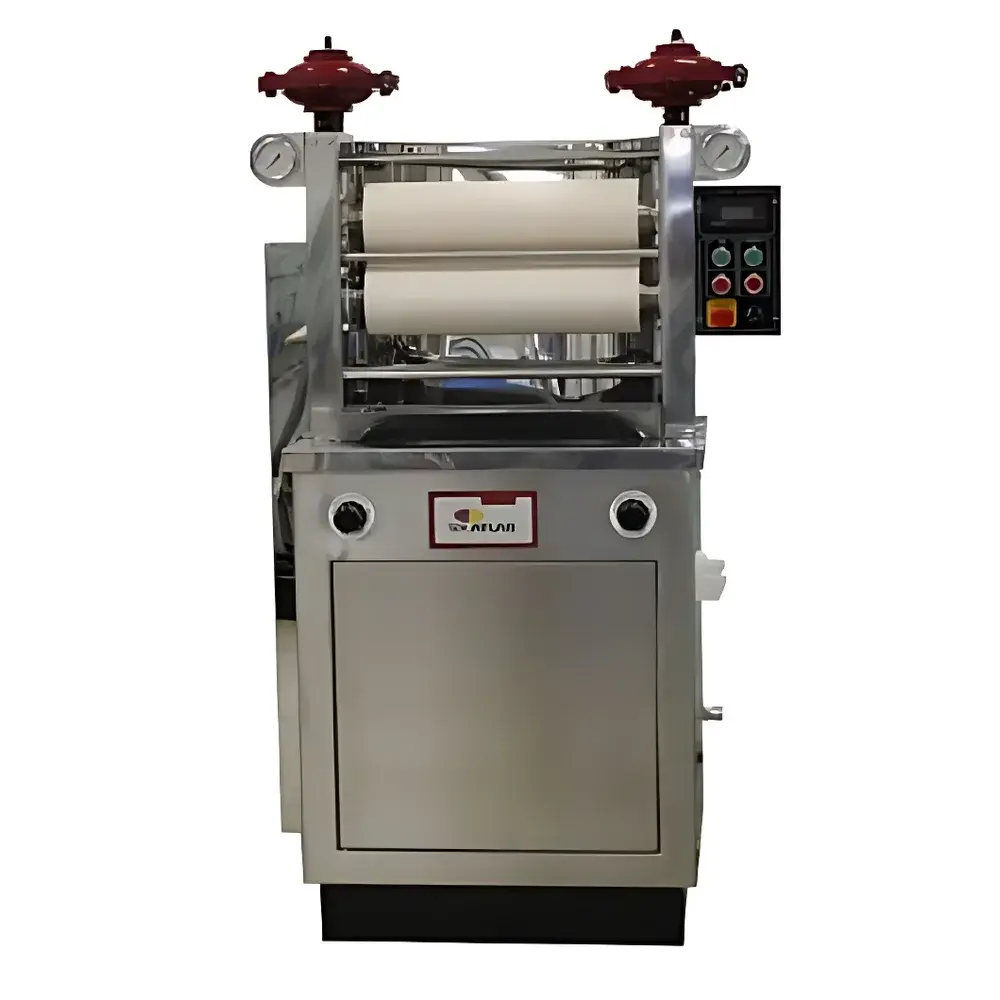
Pneumatic Heavy-Duty Padding Mangle – SDLATLAS D394A
| Brand | SDLATLAS |
|---|---|
| Origin | Guangdong, China |
| Manufacturer Type | Direct Manufacturer |
| Country of Origin | China |
| Model | D394A |
| Pricing | Upon Request |
| Roller Width | 450 mm |
| Roller Diameter | 125 mm |
| Pneumatic Pressure Setting | 5 kg/cm² |
| Clamp Force | 3 tonnes |
| Independent Left/Right Nip Pressure Adjustment | Yes |
| Fixed Speed | 10 RPM (optional variable-speed Conally drive system available) |
| Padding Roller Hardness | 70 ± 5 Shore A |
| Trough Capacity | ~1000 mL |
| Safety Features | Safety Rod, Emergency Stop Button, Knee-Operated Stop Pedal |
Overview
The SDLATLAS D394A Pneumatic Heavy-Duty Padding Mangle is an industrial-grade, floor-standing textile mangle engineered for reproducible and controllable wet processing in dyeing, printing, and chemical finishing applications. Designed according to fundamental principles of nip compression mechanics and fluid-saturated fabric expression, the D394A applies precisely regulated pneumatic force across a defined roller contact zone to achieve consistent liquor pickup, uniform padding, and repeatable add-on levels. Its robust cast-iron frame and precision-machined rollers ensure long-term dimensional stability under continuous operational loads—critical for quality assurance in ISO 9001-certified textile laboratories and pilot-scale production facilities. The unit operates on standard industrial compressed air (5 kg/cm²), delivering a nominal clamp force of 3 tonnes at the nip, enabling reliable processing of heavy denims, nonwovens, technical textiles, and multi-layer laminates where conventional manual or light-duty mangles fail to maintain linearity or pressure fidelity.
Key Features
- Heavy-duty structural architecture with reinforced base frame and vibration-damped mounting—optimized for uninterrupted operation in high-humidity laboratory or pilot plant environments.
- Pneumatically actuated top roller with calibrated pressure regulation (5 kg/cm² input) ensuring stable, drift-free nip force across full width (450 mm) and over extended service intervals.
- Independent left/right hydraulic-pneumatic pressure adjustment mechanism—enables compensation for roller crown wear, fabric edge tension differentials, or substrate asymmetry without mechanical recalibration.
- Fixed-speed 10 RPM main drive (IEC-compliant AC motor with gearmotor reduction); optional Conally variable-frequency drive system available for speed range 2–20 RPM with ±0.2 RPM repeatability.
- Padding roller fabricated from high-resilience polyurethane compound, Shore A hardness 70 ± 5—certified per ASTM D2240; alternative hardness grades (e.g., 55 A, 80 A) available upon request for specialized substrate interaction profiles.
- Integrated 1000 mL stainless-steel trough with overflow drain port and level indicator—designed for compatibility with aqueous, solvent-based, and reactive dye systems compliant with Oeko-Tex Standard 100 and ZDHC MRSL v3.0.
- Triple-redundant safety architecture: (1) spring-loaded safety rod interrupting air supply upon accidental override, (2) illuminated emergency stop button meeting IEC 60204-1 Category 0 requirements, and (3) foot-activated knee pedal with positive-break contact—fully documented in machine risk assessment per ISO 12100.
Sample Compatibility & Compliance
The D394A accommodates fabric widths up to 430 mm (effective processing width), with thickness tolerance from 0.2 mm (single-layer silk) to 8.5 mm (quilted composites). It supports continuous feeding of woven, knitted, nonwoven, and coated substrates—including flame-retardant, antimicrobial, and nano-functionalized textiles. All wet-contact components comply with FDA 21 CFR 177.2600 for indirect food-contact polymers where applicable. Electrical design conforms to CE marking directives (2014/30/EU EMC, 2014/35/EU LVD), and documentation includes EU Declaration of Conformity, EC Type Examination Certificate, and full traceability of pressure vessel components per PED 2014/68/EU Annex I.
Software & Data Management
While the base D394A operates as a stand-alone mechanical system, optional digital integration enables audit-ready process logging. When paired with the SDLATLAS LabLink™ Interface Module (sold separately), real-time parameters—including applied pressure (bar), nip force (kN), elapsed runtime (s), and trough temperature (°C)—are timestamped and exported via USB or Ethernet to CSV or SQL-compatible databases. All electronic records support ALCOA+ principles (Attributable, Legible, Contemporaneous, Original, Accurate, Complete, Consistent, Enduring, Available) and are compatible with 21 CFR Part 11-compliant LIMS platforms when deployed with qualified user authentication and electronic signature modules.
Applications
- Standardized pad-dry-cure process simulation per AATCC Test Method 76, ISO 105-X12, and GB/T 4841.1 for colorfastness and chemical fixation studies.
- Controlled liquor ratio (L:R) application in reactive dyeing trials, particularly for cellulose-based substrates requiring precise alkali and electrolyte dosing.
- Functional finish application—e.g., flame retardants (FR), water repellents (DWR), and antimicrobial agents—under GLP-aligned conditions for regulatory dossier generation (EU REACH, US EPA).
- Pre-treatment uniformity validation prior to digital inkjet printing, ensuring consistent surface energy and capillary uptake across roll-to-roll batches.
- Process correlation studies between lab-scale padding performance and full-width industrial stenter frames—facilitated by its scalable force/width ratio and ISO-traceable calibration protocol.
FAQ
Is the D394A suitable for use with corrosive finishing chemicals such as sodium hydroxide or sodium hypochlorite?
Yes—the trough, roller shaft seals, and pneumatic actuator housings are constructed from 316 stainless steel and EPDM-elastomer compounds rated for continuous exposure to pH 1–14 solutions per ASTM C1090.
Can the machine be integrated into an automated wet-processing line?
Yes—optional PLC interface kits (Siemens S7-1200 or Allen-Bradley CompactLogix compatible) provide dry-contact I/O for start/stop, fault signaling, and analog pressure feedback.
What maintenance schedule is recommended for long-term accuracy?
Monthly verification of pneumatic regulator setpoint and annual recalibration of pressure transducers using NIST-traceable deadweight testers are advised per SDLATLAS Maintenance Protocol MP-D394A Rev. 4.
Is operator training provided with purchase?
Yes—on-site commissioning includes 4 hours of hands-on SOP development, safety protocol walkthrough, and GMP-aligned record-keeping practice aligned with ISO/IEC 17025 Clause 6.2.





