
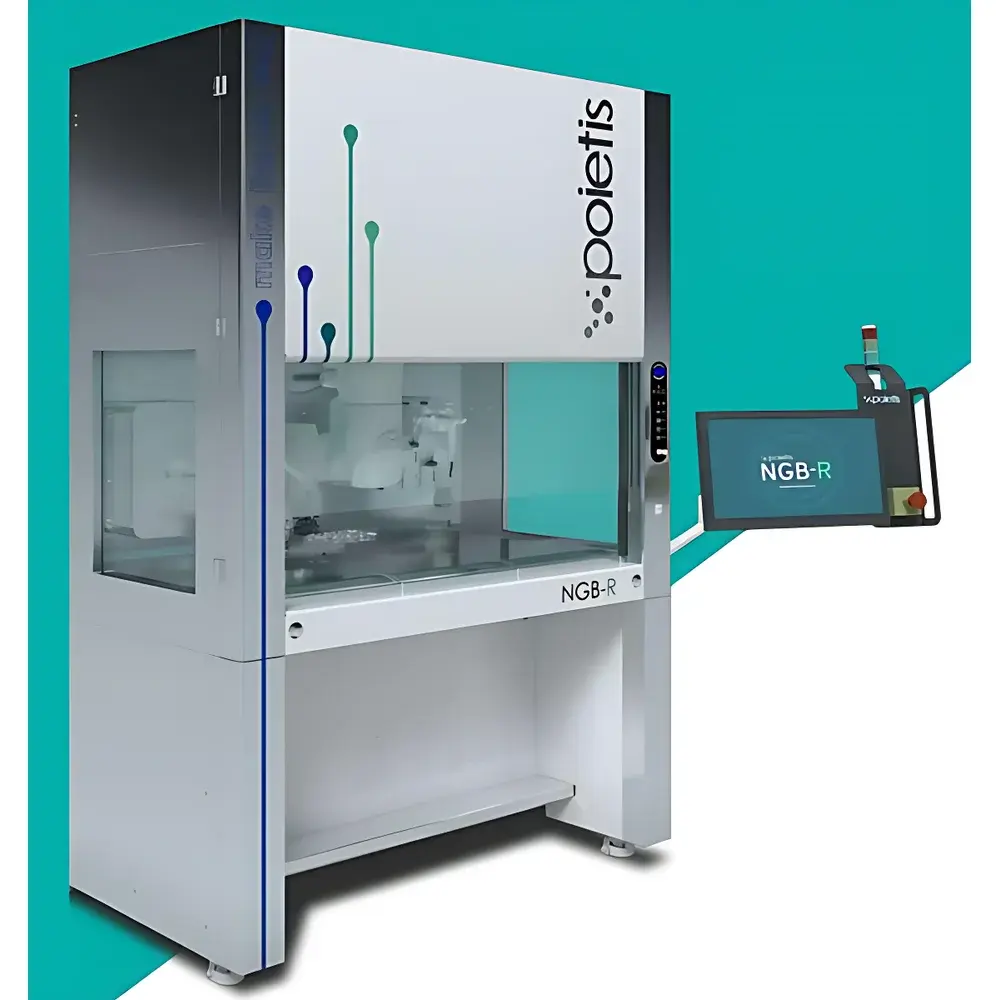
Poietis NGB-R 4D Biological Bioprinter
| Origin | France |
|---|---|
| Manufacturer Type | Authorized Distributor |
| Origin Category | Imported |
| Model | NGB-R |
| Price Range | USD 270,000 – 680,000 |
Overview
The Poietis NGB-R 4D Biological Bioprinter is an integrated, Class II biological safety-compliant platform engineered for high-precision, cell-level spatial patterning in regenerative medicine and advanced tissue engineering. Unlike conventional extrusion-based or inkjet bioprinters, the NGB-R employs laser-assisted bioprinting (LAB) — a nozzle-free, contactless deposition technology grounded in photothermal-induced forward transfer. A pulsed UV laser (355 nm) selectively activates a light-absorbing layer beneath a bioink-coated donor ribbon, generating transient microcavitation that ejects picoliter-to-nanoliter bioink droplets with single-cell resolution. This principle eliminates shear stress, nozzle clogging, and thermal degradation — enabling >95% post-printing cell viability and functional retention across primary human cells, stem cells, and co-cultures. The system extends beyond static 3D architecture by enabling time-resolved structural maturation (the “4th dimension”), supporting dynamic tissue morphogenesis, vascular network formation, and stimulus-responsive remodeling under controlled physiological conditions.
Key Features
- Laser-assisted bioprinting (LAB) head with single-cell resolution and programmable droplet ejection (1–100 cells/droplet; up to 10,000 droplets/sec)
- Dual-head modular architecture: LAB head + precision microvalve head + temperature-regulated extrusion head (4–40 °C), supporting hydrogels (e.g., gelatin-methacryloyl, hyaluronic acid), viscous bioinks, and cell-free biomaterials
- Integrated Class II biological safety cabinet (BSC) with HEPA filtration, laminar airflow, and ISO 5 cleanroom compliance — enabling sterile, closed-loop printing without sample transfer
- Industrial-grade 6-axis robotic arm with sub-10 µm repeatability and 300 × 300 × 150 mm build volume
- Built-in high-resolution inverted microscope (10×–40× objective, motorized Z-stage) for real-time, non-invasive monitoring of cell distribution, confluence, and early tissue organization — all within the BSC
- 21-inch industrial touchscreen HMI with intuitive workflow-driven interface, supporting DICOM/STL/3MF import, multi-material layer sequencing, and G-code-based motion scripting
Sample Compatibility & Compliance
The NGB-R accommodates a broad spectrum of biologically relevant materials: cell-laden hydrogels (viscosity range: 10–200 Pa·s), decellularized matrix bioinks, synthetic PEG-based scaffolds, and acellular viscoelastic gels (e.g., collagen I, fibrin). It supports both adherent and suspension cell types — including iPSC-derived cardiomyocytes, hepatocytes, neural progenitors, and endothelial cells — with validated protocols for viability maintenance (>95% at 72 h post-print) and phenotype stability. The system complies with ISO 13485:2016 (medical device quality management), ISO 14644-1 Class 5 for cleanroom integration, and meets essential requirements of EU MDR 2017/745 Annex I for laboratory instrumentation used in preclinical tissue model development. All software modules adhere to ALCOA+ principles for data integrity and support audit trails aligned with GLP and FDA 21 CFR Part 11 readiness.
Software & Data Management
NGB-R operates on Poietis’ proprietary BioPrint Suite v4.x — a validated, Windows-based application enabling end-to-end digital workflow control: from 3D model segmentation (via built-in tools or third-party import) to voxel-level bioink assignment, temporal layer scheduling (for 4D maturation timelines), and real-time print log generation. The software includes automated calibration routines (laser focus, droplet trajectory, head alignment), batch protocol templating, and encrypted local storage with optional cloud backup (AWS HIPAA-eligible infrastructure). Export formats include TIFF (microscopy), CSV (cell count/droplet metrics), STL (structural geometry), and JSON (metadata-rich print logs) — fully traceable for regulatory submissions and peer-reviewed publication.
Applications
- High-fidelity in vitro tissue models: skin epidermis/dermis equivalents, vascularized tumor spheroids, liver sinusoid mimics, and neuromuscular junction constructs
- Personalized implantable scaffolds: patient-specific osteochondral grafts with zonal chondrocyte/fibrochondrocyte patterning
- Drug screening platforms: multi-cellular organotypic assays with spatially resolved pharmacokinetic gradients
- Developmental biology studies: controlled investigation of morphogen-mediated cell migration and self-organization dynamics
- Biomanufacturing R&D: scalable process development for clinical-grade tissue products under GMP-aligned workflows
FAQ
What distinguishes 4D bioprinting from conventional 3D bioprinting on the NGB-R?
4D bioprinting refers to the intentional design of time-dependent functional evolution — such as controlled swelling, enzymatic degradation, or cell-mediated matrix remodeling — enabled by spatiotemporally resolved bioink placement and environmental conditioning (e.g., temperature, oxygen tension). The NGB-R supports this through programmable multi-phase print sequences and integrated environmental monitoring.
Can the NGB-R print vascular networks with luminal patency?
Yes — via sequential LAB-based endothelial cell patterning followed by sacrificial or enzymatically degradable support structures, validated for perfusable microvascular channels ≥50 µm in diameter.
Is remote operation and monitoring supported?
The system supports secure remote access via VPN-authenticated VNC for troubleshooting and protocol review; however, live bioprinting execution requires local physical presence per biosafety policy.
Does Poietis provide application support and method transfer assistance?
Authorized distributors offer installation qualification (IQ), operational qualification (OQ), and application-specific protocol development — including co-development of custom bioink formulations and validation reports compliant with ISO/IEC 17025 guidelines.



