
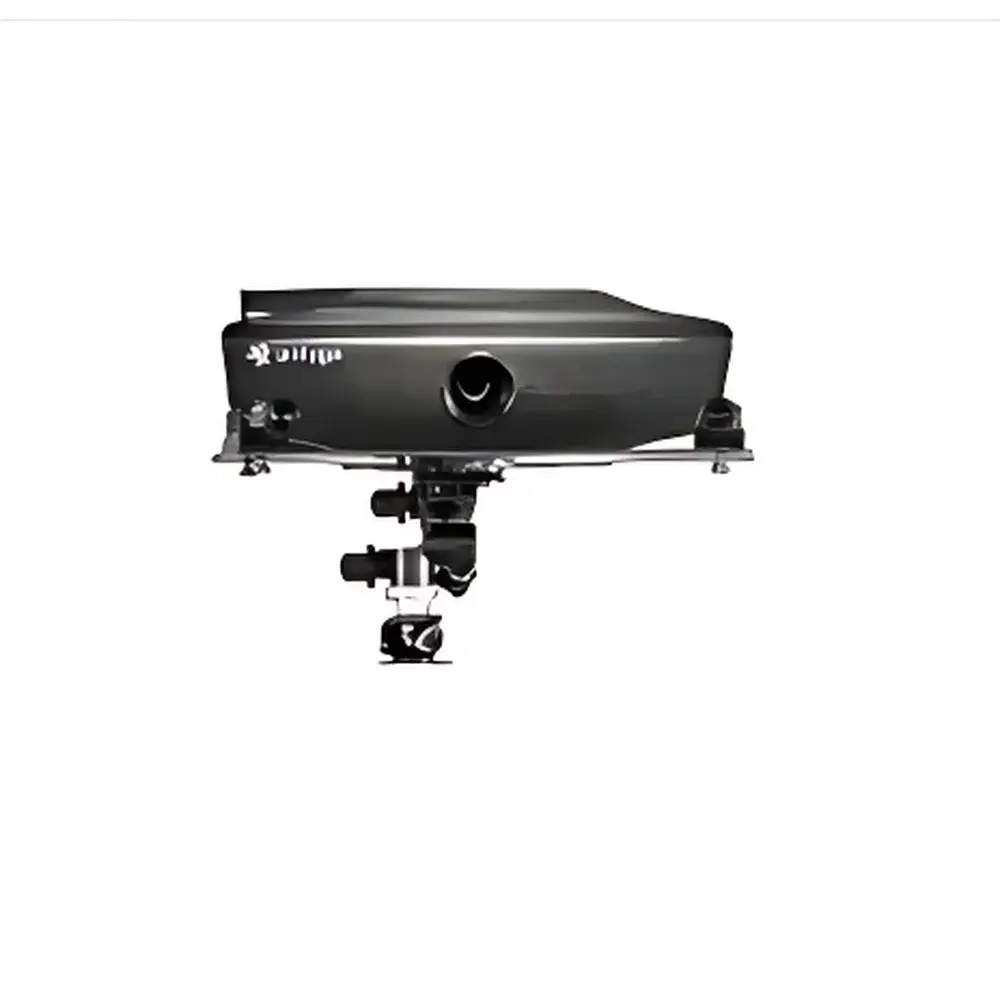
Polyga HDI Carbon Color 3D Scanner
| Brand | Polyga |
|---|---|
| Origin | Canada |
| Model | HDI Carbon Color |
| Imaging Technology | Structured Light Scanning |
| Camera Configuration | Dual 2 MP Industrial CCD Cameras |
| Calibration | Factory-Pre-Calibrated |
| Measurement Method | Non-Contact Optical 3D Metrology |
| Compliance | CE, RoHS |
| Target Users | Research Laboratories, Academic Institutions, Film & VFX Studios, R&D Engineering Teams |
| Software Platform | HDI Basic / HDI Advanced (Optional) |
| Interface | USB 3.0 |
| Operating System Support | Windows 10/11 (64-bit) |
Overview
The Polyga HDI Carbon Color 3D Scanner is a high-precision, industrial-grade structured light 3D imaging system engineered for rapid, non-contact surface digitization of physical objects. Unlike laser-based or time-of-flight systems, the HDI Carbon Color employs multi-frequency phase-shifting fringe projection combined with synchronized dual 2 MP monochrome and color CCD cameras to reconstruct full-field 3D geometry with sub-millimeter accuracy and photorealistic texture mapping. Its optical architecture is optimized for laboratory and production-floor environments where repeatability, geometric fidelity, and ease of integration are critical—particularly in applications requiring traceable dimensional metrology, reverse engineering, or digital archiving under controlled ambient lighting conditions.
Key Features
- Dual-sensor optical head: Integrated pair of high-sensitivity, global-shutter industrial CCD cameras—monochrome for precision geometry capture and color for true-spectrum surface texture registration.
- Factory pre-calibration: Delivered with NIST-traceable calibration certificates; no user recalibration required prior to deployment—reducing setup time and eliminating operator-induced variability.
- Modular scanning volume scalability: Interchangeable lens kits (standard, macro, wide-angle) enable adaptation to object sizes ranging from small mechanical components (<50 mm) to large-scale prototypes (>1 m), maintaining consistent point-cloud density and measurement uncertainty across configurations.
- Real-time mesh generation: On-device processing pipeline delivers registered, watertight polygonal meshes (STL/OBJ) within seconds per scan, supporting immediate visual verification and iterative alignment workflows.
- Ruggedized aluminum housing with passive thermal management: Designed for continuous operation in temperature-stable lab environments (18–24°C); IP52-rated enclosure protects against dust ingress and incidental moisture exposure.
Sample Compatibility & Compliance
The HDI Carbon Color is compatible with non-reflective, matte-finished, or lightly textured surfaces—including plastics, ceramics, painted metals, and composite materials. For highly reflective, transparent, or black-absorptive specimens, application of removable, ISO 10110-compliant matte spray (e.g., MR-3 or similar) is recommended to ensure uniform fringe contrast and phase unwrapping stability. The system complies with CE marking requirements for electromagnetic compatibility (EN 61326-1) and low-voltage safety (EN 61000-6-3). All firmware and software modules adhere to ISO/IEC 17025 principles for measurement traceability, and optional audit-log features support GLP/GMP-aligned documentation protocols when integrated with validated laboratory information management systems (LIMS).
Software & Data Management
The scanner operates natively with Polyga’s HDI Basic software suite (included), offering intuitive scan planning, automatic markerless alignment, noise filtering, and export to standard formats (STL, OBJ, PLY, XYZ). Optional HDI Advanced licensing enables batch processing, GD&T evaluation (per ASME Y14.5–2018), deviation color-mapping against CAD references, and automated report generation with embedded metadata (timestamp, operator ID, environmental sensor logs). Data integrity is preserved through SHA-256 hash validation of raw fringe images and reconstructed point clouds; software supports FDA 21 CFR Part 11-compliant electronic signatures and role-based access control when deployed on domain-authenticated Windows networks.
Applications
- Academic research: Biomechanical modeling, anthropology digitization, cultural heritage preservation, and materials science surface characterization.
- Industrial R&D: Rapid prototyping validation, tooling inspection, assembly fit-check analysis, and tolerance stack-up simulation input.
- Film and visual effects: High-fidelity character asset capture, prop replication, set extension reference modeling, and motion-capture rig calibration.
- Quality assurance labs: First-article inspection, supplier part verification, and dimensional stability monitoring over production cycles.
- Medical device development: Anatomical model generation for surgical planning, custom orthotic design, and regulatory submission documentation (ISO 13485-aligned).
FAQ
Does the HDI Carbon Color require external calibration hardware or periodic recalibration?
No—each unit ships with factory-applied calibration parameters stored in onboard memory. Recalibration is only necessary if the optical housing is physically disassembled or subjected to severe mechanical shock; routine verification using supplied ceramic calibration artifacts is recommended every 6 months in GLP-regulated environments.
Can the system capture moving objects or perform real-time scanning?
It is designed for static object acquisition only. Motion during fringe projection causes phase ambiguity and reconstruction artifacts; vibration isolation tables or pneumatic mounts are advised for unstable platforms.
Is the software compatible with third-party CAD or metrology platforms?
Yes—HDI software exports industry-standard neutral formats (STEP, IGES, STL) and provides API access (C++/Python SDK) for custom integration with Siemens NX, Geomagic Control X, PolyWorks, or in-house metrology pipelines.
What environmental conditions are required for optimal performance?
Ambient illumination must be stable and diffuse (≤500 lux, no direct sunlight or flickering fluorescent sources); temperature should remain within ±1°C over measurement duration to minimize thermal drift in camera sensors and projector optics.




