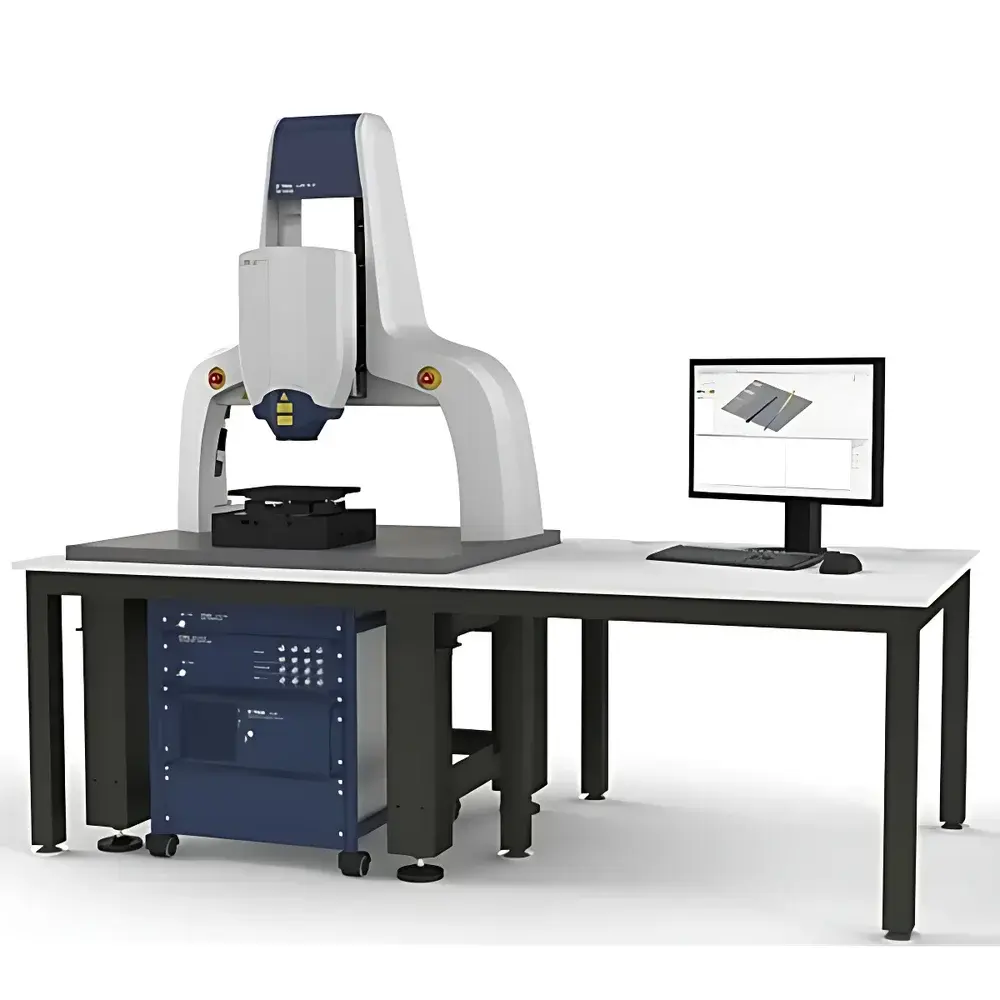
Polytec MSA-100-3D Microsystem Analyzer – 3D Scanning Laser Doppler Vibrometer
| Brand | Polytec |
|---|---|
| Origin | Germany |
| Model | MSA-100-3D |
| Measurement Principle | Heterodyne Laser Doppler Interferometry |
| Max. Bandwidth | 25 MHz |
| Out-of-plane & In-plane Resolution | Sub-picometer (≤ 0.5 pm/√Hz) |
| Laser Spot Size | < 4 µm (at focal plane) |
| Working Distance | Up to 38 mm |
| Scan Area | Programmable XY stage with software-controlled positioning |
| Compliance | ISO 18436-2, ASTM E1876 (for material dynamic characterization), GLP-ready data traceability |
Overview
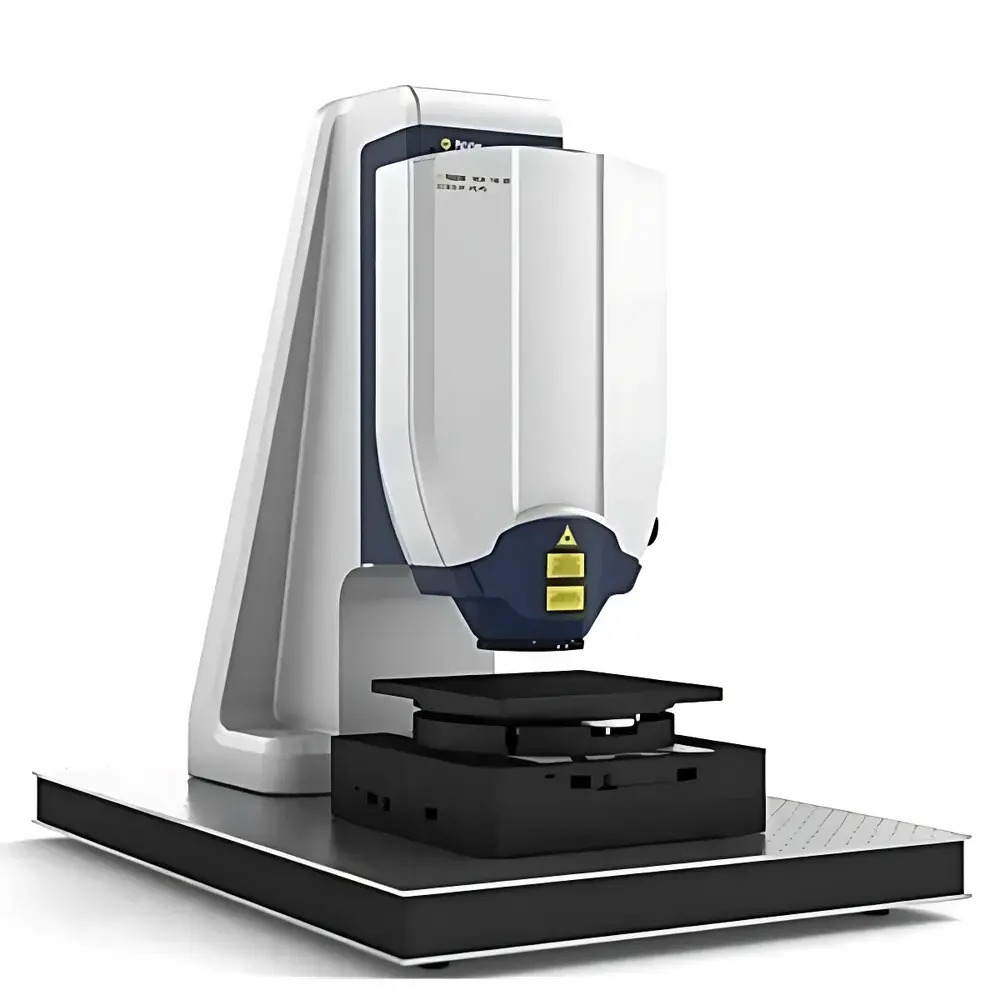
The Polytec MSA-100-3D Microsystem Analyzer is a high-precision, non-contact 3D scanning laser Doppler vibrometer engineered for quantitative dynamic characterization of microscale devices and structures. Operating on heterodyne laser Doppler interferometry, it simultaneously captures full vector vibration motion—X, Y, and Z components—in real time across a bandwidth spanning DC to 25 MHz. Unlike conventional single-axis or sequential multi-axis systems, the MSA-100-3D employs three orthogonally aligned interferometric channels with actively stabilized optical paths, enabling true synchronous acquisition of all three spatial velocity components at each measurement point. This architecture eliminates phase misalignment errors inherent in time-multiplexed approaches and ensures phase-coherent reconstruction of complex 3D mode shapes—critical for validating finite element models of MEMS resonators, piezoelectric actuators, RF filters, and micro-opto-electro-mechanical systems (MOEMS). Its sub-picometer amplitude resolution (≤ 0.5 pm/√Hz, typical at 1 kHz) and < 4 µm diffraction-limited spot size provide metrological-grade spatial discrimination, supporting measurements on features as small as single transistor gates or cantilever beam anchors.
Key Features
- True simultaneous 3D vibration acquisition via three independent interferometric channels with common-mode noise rejection
- Real-time, high-bandwidth measurement from DC to 25 MHz—enabling analysis of ultrafast transients, ring-down behavior, and harmonic distortion in MEMS devices
- Sub-picometer velocity resolution (0.5 pm/√Hz @ 1 kHz) and nanoradian angular sensitivity for out-of-plane and in-plane motion detection
- Integrated high-precision XYZ scanning stage with closed-loop position feedback; programmable scan patterns (raster, spiral, user-defined ROI)
- Working distance flexibility up to 38 mm—compatible with standard probe stations, environmental chambers, and vacuum-compatible sample holders
- Optical design optimized for low coherence length lasers, minimizing speckle noise and interference artifacts on rough or reflective microstructures
Sample Compatibility & Compliance
The MSA-100-3D is validated for use with silicon, silicon nitride, aluminum, gold, and polymer-based microstructures—including unreleased MEMS devices, packaged sensors, and biohybrid constructs. Its non-contact methodology avoids mass loading, electrostatic perturbation, or thermal drift associated with piezoelectric or capacitive probes. The system complies with ISO 18436-2 (Condition monitoring and diagnostics of machines — Requirements for qualification and assessment of personnel) for vibration analyst certification pathways, and supports traceable calibration per ASTM E1876 (Standard Test Method for Dynamic Young’s Modulus, Shear Modulus, and Poisson’s Ratio by Impulse Excitation of Vibration). Data export formats (HDF5, MATLAB .mat, CSV) are structured to meet FDA 21 CFR Part 11 requirements for electronic records and signatures when deployed in regulated R&D environments under GLP or pre-GMP protocols.
Software & Data Management
Polytec’s VibSoft 4 platform provides integrated control, visualization, and post-processing capabilities. It enables automated modal parameter extraction (resonant frequency, damping ratio, effective mass), operating deflection shape (ODS) animation, and cross-channel coherence mapping. All raw interferometric signals are stored with full metadata—including laser power, focus status, environmental temperature/humidity logs, and stage encoder positions—to support audit-ready documentation. Exported datasets include timestamp-synchronized trigger inputs for external excitation sources (e.g., arbitrary waveform generators, piezo shakers), facilitating closed-loop stimulus-response validation. Software licensing supports concurrent multi-user access and role-based permissions, aligning with enterprise IT security policies.
Applications
- MEMS development: Characterization of comb-drive actuators, capacitive accelerometers, gyroscopes, and energy harvesters under electrostatic, piezoelectric, or thermal actuation
- Microacoustics: Mapping acoustic radiation modes of ultrasonic transducers and MEMS speakers; identifying parasitic vibrations affecting signal fidelity
- Failure analysis: Detecting delamination, stiction, or anchor fatigue in released microstructures through localized damping anomalies
- Biomedical microdevices: Quantifying vibration transfer efficiency in microfluidic pumps, lab-on-chip valves, and optogenetic stimulation platforms
- Nanomechanical testing: Deriving elastic modulus and loss tangent of thin-film coatings via resonant frequency shift and Q-factor analysis
FAQ
Does the MSA-100-3D require vacuum or inert atmosphere operation for MEMS measurements?
No—its optical design permits ambient air operation with no performance degradation. For hermetically sealed or wafer-level packaged devices, measurements can be performed directly through glass lids or quartz windows.
Can the system measure vibration on transparent or highly reflective surfaces without coating?
Yes—via polarization-sensitive interferometry and adaptive gain control, it achieves stable lock-on to dielectric thin films, bare silicon, and metallized traces without surface treatment.
Is third-party integration supported for automated test sequences?
Yes—VibSoft 4 exposes a COM/ActiveX API and TCP/IP command interface compatible with LabVIEW, Python (pywin32), and MATLAB, enabling synchronization with wafer probers, parametric testers, and thermal controllers.
What calibration services are available for ISO/IEC 17025 traceability?
Polytec offers factory calibration with NIST-traceable reference accelerometers and laser wavelength standards; on-site verification and uncertainty budgeting are available upon request.