
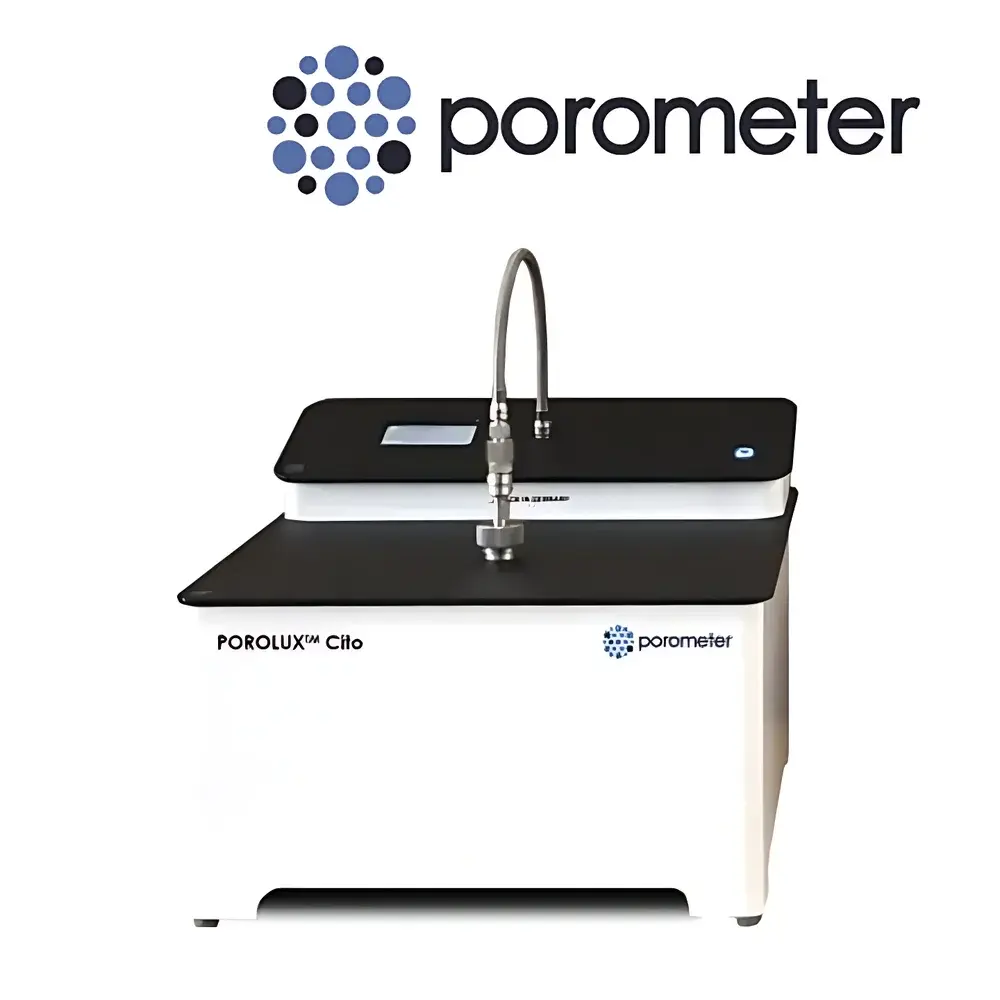
Porometer POROLUX Cito Series Gas-Liquid Porosimeter for Through-Pore Size Analysis
| Brand | Porometer |
|---|---|
| Origin | Germany |
| Manufacturer Type | Authorized Distributor |
| Origin Category | Imported Instrument |
| Model | POROLUX Cito Series |
| Price Range | USD 14,000 – 140,000 |
| Instrument Type | Specific Surface Area and Pore Size Analyzer |
| Flow Range | 200 L/min |
| Pressure Range | 35 bar (500 psi) |
| Measurement Principle | Gas-Liquid Displacement Method (Capillary Flow Porometry) |
| Repeatability | ≤1% |
Overview
The Porometer POROLUX Cito Series is a high-precision gas-liquid capillary flow porometer engineered for through-pore size characterization of porous materials. It operates on the fundamental principle of capillary flow porometry (CFP), wherein a wetting liquid (typically water or isopropanol) saturates the sample’s pores; increasing gas pressure displaces the liquid from larger to smaller pores, and the resulting gas flow is continuously monitored. This pressure-scan methodology enables quantitative determination of critical pore structural parameters—including bubble point, mean flow pore diameter, minimum pore size, pore size distribution (PSD), cumulative flow distribution, and gas permeability—without requiring assumptions about pore geometry or surface area. Designed for robust operation in regulated laboratory environments, the POROLUX Cito Series complies with core international test standards including ASTM F316-22 (Standard Test Methods for Pore Size Characteristics of Membrane Filters by Bubble Point and Mean Flow Pore Test), ISO 4022 (Plastics — Determination of pore size distribution of microporous membranes), and USP (Membrane Pore Size Characterization). Its architecture supports both R&D method development and routine QC release testing under GLP/GMP-aligned workflows.
Key Features
- Gas-liquid displacement measurement platform with automated pressure ramping from vacuum to 35 bar (500 psi), enabling full-range pore analysis from 13 nm up to several hundred micrometers.
- High-resolution mass flow sensing with ±0.5% full-scale accuracy and ≤1% intra-instrument repeatability across repeated measurements on identical samples.
- Dual-mode operation: Bubble Point Mode for rapid quality screening and Full Scan Mode for comprehensive PSD generation with logarithmic pressure stepping and real-time flow acquisition.
- Modular sample holder design accommodating flat-sheet membranes (up to 100 cm²), hollow-fiber modules, ceramic discs/tubes, sintered metal filters, nonwovens, and specialty papers—without custom fixtures.
- Integrated temperature stabilization (±0.3°C) and ambient humidity compensation to minimize thermodynamic drift during extended scans.
- CE-marked instrumentation with electrical safety compliance to IEC 61010-1 and electromagnetic compatibility per EN 61326-1.
Sample Compatibility & Compliance
The POROLUX Cito Series is validated for use with hydrophilic and hydrophobic porous media across diverse industrial sectors. Compatible sample types include polymeric flat-sheet and hollow-fiber membranes (e.g., PVDF, PTFE, polysulfone), ceramic membranes and monolithic tubes, sintered stainless steel and bronze filters, metal fiber sintered media, technical nonwovens (spunbond/meltblown), precision-woven textiles, and functional papers (e.g., battery separators, filtration papers). All measurement protocols adhere to ASTM F316-22 Annex A1 (wetting liquid selection guidance), ISO 15198 (pore size verification via mercury intrusion correlation), and FDA-relevant documentation requirements for 21 CFR Part 11–compliant data integrity when paired with optional audit-trail software modules. Instrument qualification packages support IQ/OQ protocols aligned with pharmaceutical and medical device manufacturing standards.
Software & Data Management
POROLUX Control Suite v5.x provides intuitive instrument control, real-time visualization of pressure-flow curves, and automated calculation of all standard porometric parameters per ASTM/ISO conventions. Raw data are stored in vendor-neutral CSV and XML formats; metadata (operator ID, timestamp, calibration status, environmental conditions) are embedded per ALCOA+ principles. Optional GxP Edition adds electronic signatures, role-based access control, and immutable audit trails compliant with 21 CFR Part 11 Subpart B. Batch reporting templates generate PDF/Excel outputs suitable for regulatory submissions, and API integration supports direct ingestion into LIMS or MES platforms via RESTful endpoints.
Applications
- Membrane development: Optimization of pore architecture in ultrafiltration, microfiltration, and gas separation membranes.
- Filter validation: Release testing of sterilizing-grade filters per ISO 13408-2 and PDA TR26.
- Nonwoven characterization: Correlation of pore structure with breathability, barrier efficiency, and liquid wicking performance.
- Advanced materials QA: Verification of pore uniformity in sintered metal filters used in aerospace hydraulics and fuel systems.
- Academic research: Fundamental studies of capillary transport phenomena, wetting hysteresis, and pore network modeling.
FAQ
What wetting liquids are supported, and how is liquid selection determined?
Water, isopropanol, and perfluoroether-based liquids are pre-configured; selection follows ASTM F316-22 guidelines based on surface tension, contact angle, and material compatibility.
Can the POROLUX Cito quantify blind pores or surface porosity?
No—capillary flow porometry measures only through-pores (interconnected,贯穿 pores); blind or isolated pores require complementary techniques such as mercury intrusion porosimetry or SEM-EDS cross-sectioning.
Is calibration traceable to national standards?
Yes—pressure transducers are NIST-traceable; flow sensors are calibrated using certified laminar flow elements per ISO/IEC 17025-accredited procedures.
How does the system handle highly compressible samples like foams or gels?
A dedicated low-pressure scanning mode (0–3 bar) with adaptive ramp rates minimizes mechanical deformation while preserving measurement fidelity.
What maintenance intervals are recommended for routine operation?
Wetting liquid replacement every 30 days; pressure sensor recalibration annually; full system PQ every 6 months in GxP environments.



