
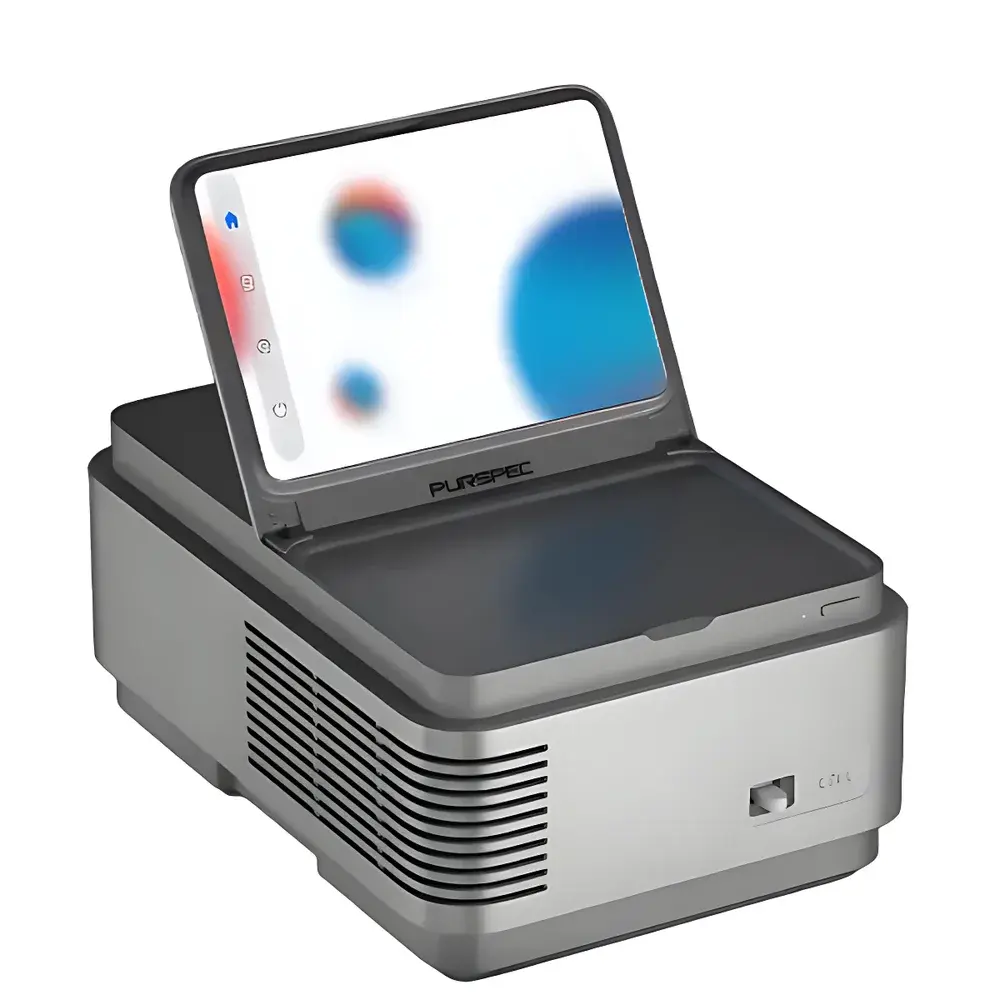
Portable Liquid Chromatography-Mass Spectrometry System CELL by 1124123/13213112
| Brand | 1124123/13213112 |
|---|---|
| Origin | Jiangsu, China |
| Manufacturer Type | Authorized Distributor |
| Instrument Type | Linear Ion Trap |
| Application Field | General-Purpose |
| Mass Range | m/z 50–1000 |
| Sensitivity | 0.5 ng/mL (for standard test compound under defined LC-MS conditions) |
| Resolution | ≤0.5 Da (FWHM at m/z 500) |
| Dimensions | 33.3 × 23.5 × 14.6 cm |
| Weight | 8.5 kg |
| Battery Life | Up to 2 hours (integrated Li-ion power supply) |
| Vacuum System | Dual-stage non-continuous atmospheric pressure interface (DAPI) with built-in turbomolecular pump |
| Analysis Time | <3 minutes from sample introduction to report-ready output |
Overview
The CELL Portable Liquid Chromatography-Mass Spectrometry (LC-MS) System is an integrated, field-deployable analytical platform engineered for real-time, on-site molecular identification and quantification. Unlike conventional benchtop LC-MS instruments relying on high-vacuum differential pumping and fixed laboratory infrastructure, the CELL system employs a non-continuous Atmospheric Pressure Interface (DAPI) coupled with a compact dual-stage vacuum architecture. This design significantly reduces gas load and eliminates dependency on external nitrogen or compressed air supplies—enabling operation in resource-constrained environments including customs checkpoints, agricultural fields, pharmaceutical manufacturing floors, and environmental monitoring sites. The core mass analyzer is a high-fidelity linear ion trap, providing unit mass resolution (FWHM ≤0.5 Da at m/z 500), multi-scan capability—including full-scan, selected ion monitoring (SIM), and data-dependent MS/MS—and robust performance across both positive and negative ionization modes. Its chromatographic module utilizes micro-bore UHPLC-compatible flow paths with integrated gradient delivery, ensuring reproducible retention time stability even under variable ambient temperatures.
Key Features
- Linear ion trap mass analyzer delivering unit-resolution spectra and reliable tandem MS capability without cryogenic cooling or RF-only trapping stages
- DAPI interface enabling direct coupling to ambient ionization sources—including integrated in-situ reagent cartridges for open-air, minimal-prep analysis
- Touchscreen-driven intelligent workflow: automated calibration, method recall, peak integration, spectral deconvolution, and report generation
- Thermally adaptive control system that dynamically adjusts quadrupole RF/DC parameters and detector gain to maintain mass accuracy ±0.2 Da across 15–35 °C ambient range
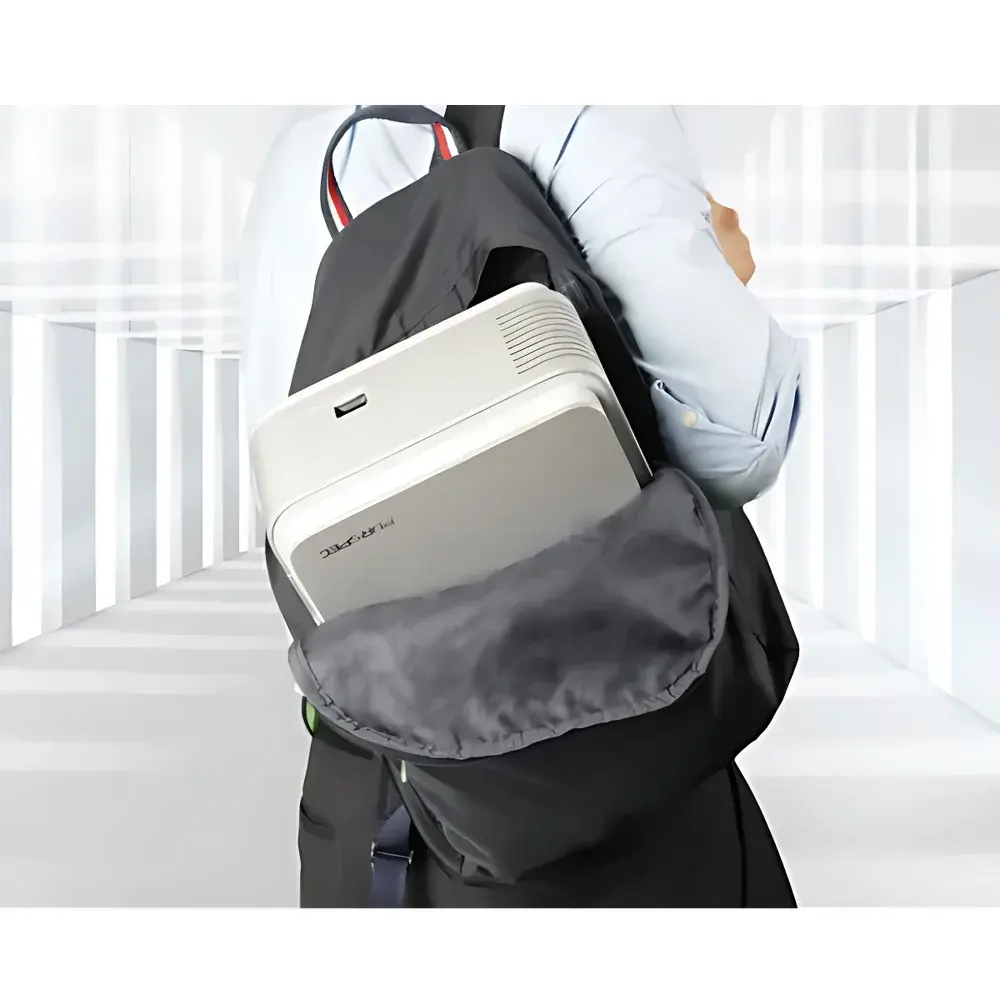
- Compact form factor (33.3 × 23.5 × 14.6 cm; 8.5 kg) compliant with IATA carry-on regulations; includes shock-absorbing 18-inch wheeled transport case rated for MIL-STD-810G vibration resistance
- Self-contained dual-stage vacuum system with integrated turbomolecular pump—no external roughing pump or gas lines required
- On-board battery supports ≥120 minutes of continuous acquisition at 1 Hz scan rate; hot-swappable with optional extended-life modules
Sample Compatibility & Compliance
The CELL system supports direct analysis of liquid, semi-solid, and surface-adhered samples via its in-situ reagent cartridge—eliminating derivatization, extraction, or filtration steps for many small-molecule applications. It has been validated for use with biological fluids (urine, saliva), food extracts, environmental swabs, and pharmaceutical formulations. All firmware and data handling routines comply with ALCOA+ principles for data integrity. Audit trails, electronic signatures, and user-access controls meet FDA 21 CFR Part 11 requirements when operated in secure network mode. Instrument qualification documentation aligns with ISO/IEC 17025:2017 Annex A.2 for portable analytical systems, and method validation protocols follow ICH Q2(R2) guidance for limit-of-detection (LOD = 0.5 ng/mL) and precision (RSD ≤12% for intra-day repeatability).
Software & Data Management
The CELL Control Suite is a Windows-based application supporting offline method development, real-time spectral visualization, and post-run processing via vendor-provided algorithms for deisotoping, background subtraction, and retention time alignment. Raw data files are stored in open-format mzML 1.1.0 compliant containers. Integrated reporting engine generates PDF outputs with embedded metadata (instrument ID, operator ID, calibration timestamp, environmental logs). Data export options include CSV (peak tables), SDF (structure-annotated results), and direct API integration with LIMS platforms via HTTPS REST endpoints. All software updates undergo cryptographic signature verification prior to installation.
Applications
- Rapid screening of controlled substances and novel psychoactive compounds at border control facilities
- In-process monitoring of active pharmaceutical ingredient (API) purity during continuous manufacturing
- Field-deployable pesticide residue testing in fresh produce supply chains
- Real-time detection of mycotoxins in grain storage silos
- Point-of-care toxicology triage in emergency departments using finger-prick blood samples
- Environmental forensics of emerging contaminants (e.g., PFAS, microplastic additives) in wastewater influent streams
FAQ
What ionization methods are supported beyond the in-situ reagent cartridge?
Electrospray ionization (ESI) and atmospheric pressure chemical ionization (APCI) source modules are available as optional accessories; both retain full compatibility with DAPI vacuum architecture.
Is method transfer possible from laboratory-grade LC-MS systems?
Yes—chromatographic methods developed on Waters ACQUITY or Thermo Vanquish systems can be ported with minor flow-rate and gradient scaling adjustments; spectral libraries (NIST, mzCloud) are fully interoperable.
How is mass calibration maintained during extended field use?
The system performs automatic internal calibration every 30 minutes using a sealed perfluorotributylamine (PFTBA) reference reservoir; drift correction is applied in real time to all acquired spectra.
Can the CELL operate under GLP/GMP-regulated environments?
When deployed with validated software configuration, access-controlled user roles, and enabled audit trail logging, it satisfies key elements of GLP (OECD 1998) and GMP (ICH Q5C) for release testing of intermediate materials.
What maintenance intervals are recommended for field operation?
Ion trap cleaning and detector gain recalibration are recommended every 200 operational hours; vacuum pump oil replacement is required every 1,000 hours—both procedures are supported by onboard diagnostics and guided service workflows.




