
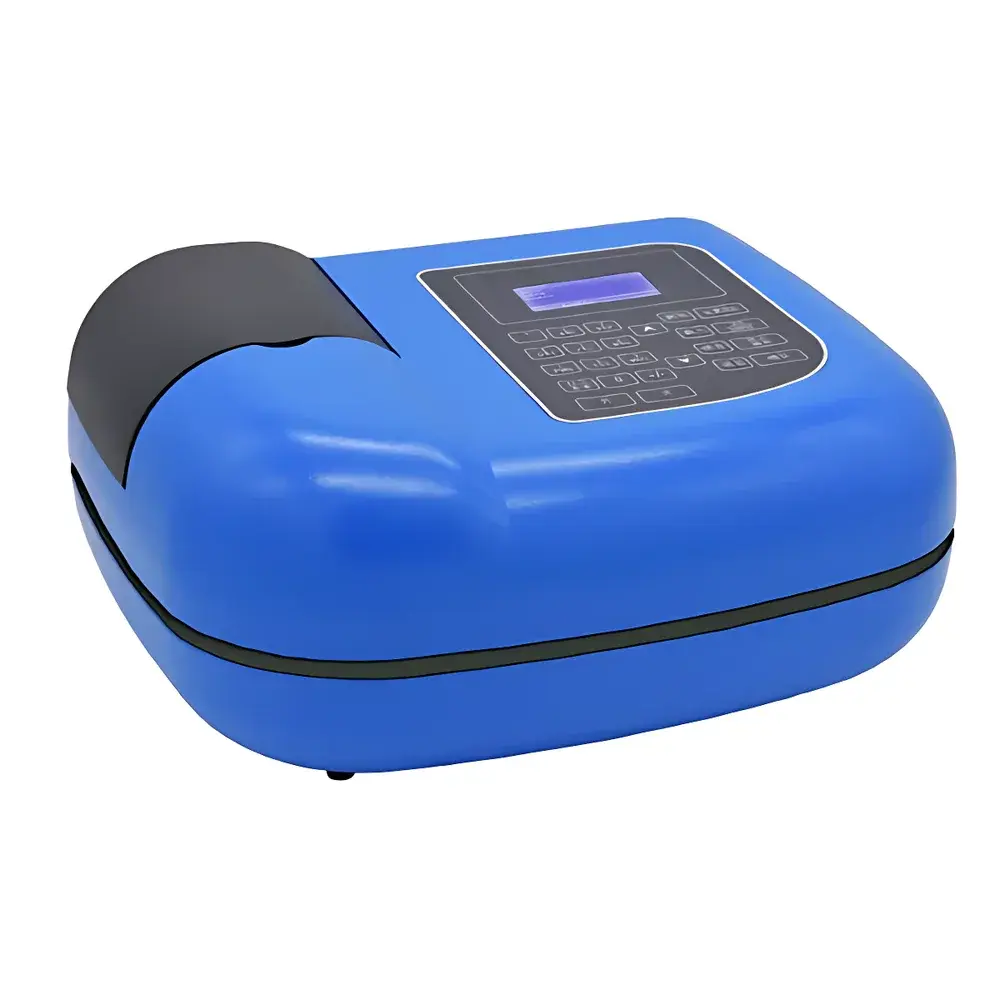
Portable Spectrophotometer Model 1600 by 1124123/13213112
| Brand | 1124123/13213112 |
|---|---|
| Origin | Jiangsu, China |
| Manufacturer Type | Authorized Distributor |
| Product Origin | Domestic (China) |
| Model | 1600 |
| Price | Upon Request |
| Wavelength Range | 325–1100 nm |
| Wavelength Repeatability | ≤1 nm |
| Wavelength Accuracy | ±2 nm |
| Spectral Bandwidth | 2 nm |
| Stray Light | ≤0.4% T |
| Optical System | Single-Beam with 1200 lines/mm Holographic Grating |
| Display | Large Backlit LCD (Wavelength Resolution: 1 nm) |
| Data Storage | Up to 100 calibration curves and 2000 measurement records |
| Interface | RS-232, USB flash drive support, Bluetooth 4.2 (for data export, mobile app sync, and optional thermal printer) |
Overview
The Portable Spectrophotometer Model 1600 is a compact, field-deployable single-beam UV-Vis spectrophotometer engineered for rapid, reliable absorbance and transmittance measurements across the 325–1100 nm spectral range. Based on holographic diffraction grating optics (1200 lines/mm) and optimized photodetector architecture, it delivers high photometric stability and consistent wavelength registration—critical for quantitative analysis in resource-constrained or non-laboratory environments. Its design prioritizes operational robustness, low power consumption, and intuitive workflow execution, making it suitable for environmental monitoring, emergency response teams, quality control in remote production sites, and educational field laboratories. The instrument adheres to fundamental principles of Beer–Lambert law-based quantification and supports traceable calibration protocols compatible with ISO/IEC 17025-aligned practices.
Key Features
- Compact, lightweight chassis (approx. 1.8 kg) with integrated ergonomic handle and shock-absorbing casing for transport and outdoor use.
- Automated optical alignment: self-calibrating wavelength positioning, intelligent dual-source management (deuterium lamp for UV, tungsten-halogen for Vis/NIR), and real-time lamp status monitoring.
- High-resolution 1 nm wavelength display with ±2 nm accuracy and ≤1 nm repeatability—validated per ASTM E275 and ISO 6223 standards for portable photometric instruments.
- Advanced photometric engine supporting multiple quantification methodologies: single-wavelength absorbance, dual-wavelength (isobestic point) analysis, and three-point correction for turbid or matrix-compromised samples.
- Flexible curve-fitting algorithms: linear regression (with/without zero-intercept), quadratic, and cubic polynomial models—enabling accurate calibration over wide dynamic ranges without manual extrapolation.
- Onboard data management: stores up to 100 user-defined calibration curves and 2000 individual measurement records with timestamp, wavelength, absorbance/transmittance, and operator ID fields.
Sample Compatibility & Compliance
The Model 1600 accepts standard 10 mm square or round cuvettes (including disposable plastic, quartz, and glass variants) and supports direct measurement of liquid, suspension, and semi-transparent solid samples via optional reflectance adapter. It complies with essential regulatory expectations for field-deployed analytical instrumentation: its firmware implements audit-trail-capable session logging (user login, method selection, calibration events), and raw data export preserves metadata required for GLP documentation. While not certified under FDA 21 CFR Part 11, the system supports electronic record integrity through password-protected user accounts, immutable data export (CSV via USB or Bluetooth), and time-stamped calibration verification logs—facilitating internal validation and external audit readiness per ISO 17025 Clause 7.7.
Software & Data Management
Data acquisition and reporting are supported via embedded firmware and companion mobile applications (iOS/Android). Bluetooth 4.2 enables secure pairing with smartphones for real-time result viewing, cloud upload (via encrypted HTTPS), and email-based report generation. Optional Bluetooth thermal printers produce compliant hard-copy outputs with embedded instrument ID, date/time stamp, and measurement parameters. All exported files include structured headers compliant with LIMS ingestion requirements (e.g., ASTM E1384-compliant metadata tagging). USB mass storage mode allows direct transfer of CSV-formatted datasets—including full calibration history and raw spectral scans—for offline statistical analysis in Excel, R, or Python-based chemometrics pipelines.
Applications
- Environmental field testing: nitrate, phosphate, heavy metal (e.g., Cr(VI), Fe²⁺), and organic pollutant (e.g., phenol, COD) quantification in surface water, wastewater, and soil extracts.
- Pharmaceutical QC: dissolution testing, excipient purity screening, and concentration verification of active pharmaceutical ingredients (APIs) in non-GMP pilot batches.
- Food & agriculture: chlorophyll-a/b, carotenoid, and anthocyanin content in plant tissues; nitrite/nitrate levels in cured meats and vegetables.
- Education & training: hands-on spectroscopy instruction covering Beer’s law validation, interference studies, and method development under variable ambient lighting conditions.
- Industrial hygiene: formaldehyde, ozone, and chlorine gas detection using colorimetric reagent kits calibrated on-site.
FAQ
What power options are available for extended field operation?
The Model 1600 operates on AC adapter (100–240 V, 50/60 Hz) or rechargeable Li-ion battery pack (optional, ≥8 hours continuous use at 25 °C). Battery state-of-charge and estimated runtime are displayed in real time.
Is wavelength calibration traceable to NIST standards?
Yes—the factory calibration uses NIST-traceable holmium oxide and didymium oxide filters. Users may perform verification checks using supplied reference standards; calibration certificates are issued upon request for ISO 17025-accredited labs.
Can the instrument be validated for regulated environments?
While the hardware meets core performance criteria outlined in USP , EP 2.2.25, and ASTM E308, full 21 CFR Part 11 compliance requires site-specific IQ/OQ/PQ documentation and integration with validated LIMS or ELN platforms.
What sample volume is required for reliable measurement?
Minimum fill volume is 2.5 mL for standard 10 mm pathlength cuvettes. Micro-cuvette adapters (50–500 µL) are available as accessories for precious or limited-volume samples.
Does the device support spectral scanning or only fixed-wavelength measurements?
The Model 1600 performs discrete-wavelength measurements only. It does not acquire full spectra; however, multi-point wavelength selection (up to 10 wavelengths per assay) enables pseudo-scan functionality for peak identification and interference assessment.




