
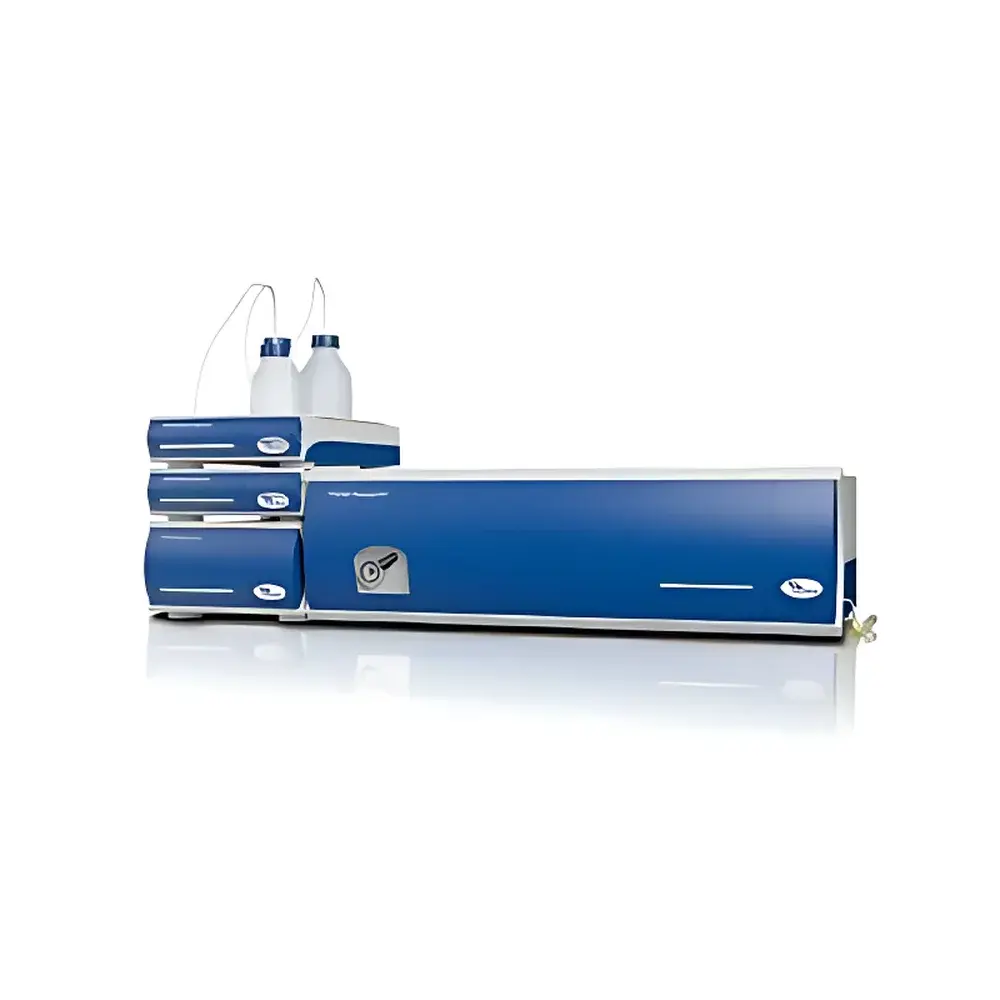
POSTNOVA TF 2000 Thermal Field Flow Fractionation (ThFFF) System
| Brand | POSTNOVA |
|---|---|
| Origin | Germany |
| Model | TF 2000 |
| Field Type | Thermal |
| Instrument Category | Field Flow Fractionation (FFF) |
| Regulatory Class | Imported Analytical Instrument for Macromolecular & Nanoparticle Characterization |
Overview
The POSTNOVA TF 2000 Thermal Field Flow Fractionation (ThFFF) System is a high-precision, non-chromatographic separation platform engineered for the orthogonal fractionation of macromolecules, nanoparticles, and complex polymeric mixtures based on both hydrodynamic size and thermodynamic interaction parameters. Unlike size-exclusion chromatography (SEC), ThFFF applies a transverse thermal gradient across a thin, ribbon-like separation channel—inducing thermodiffusion (Soret effect)—where analytes migrate at velocities proportional to their thermal diffusion coefficient (DT) and temperature-dependent partitioning behavior between the hot and cold walls. This dual-separation mechanism enables simultaneous resolution by effective particle radius *and* surface chemistry, crystallinity, or polymer segment mobility—making it uniquely suited for heterogeneous systems such as polymer blends, rubber formulations, nanocomposites, and soft colloids. The TF 2000 operates without stationary phase or chemical modification, eliminating shear-induced degradation and column fouling risks common in SEC or HPLC.
Key Features
- Thermal field generation via precisely controlled Peltier elements with ±0.1 °C stability across the channel width, ensuring reproducible Soret-driven fractionation.
- Modular flow cell design accommodating channel heights from 150 µm to 500 µm, optimized for molecular weight ranges from ~103 to >108 g/mol and particle diameters from 1 nm to 10 µm.
- Integrated degassing and pulse-dampening modules to maintain laminar, parabolic flow profiles essential for FFF theory compliance (Giddings’ retention equation).
- Real-time monitoring of thermal gradient, cross-flow rate, and detector signals via POSTNOVA’s AFS software suite with automated calibration routines.
- Robust architecture compliant with ISO/IEC 17025 laboratory infrastructure requirements; designed for continuous operation under GLP and GMP-aligned workflows.
Sample Compatibility & Compliance
The TF 2000 accommodates aqueous and organic solvent systems—including THF, DMF, chloroform, and toluene—with chemically resistant flow path materials (e.g., PEEK, fused silica, and inert stainless steel). It is routinely applied to elastomer analysis (natural/synthetic rubbers, thermoplastic vulcanizates), polymer blends (PP/EPDM, PS/PB), nanoparticle dispersions (liposomes, micelles, quantum dots), and biopolymer aggregates (amyloid fibrils, casein micelles). Method development aligns with ASTM D7984–19 (Standard Practice for ThFFF of Polymers) and supports regulatory submissions requiring traceable, first-principles-based separation data. All system logs—including temperature ramp profiles, flow calibration records, and injection metadata—are timestamped and audit-trail enabled per FDA 21 CFR Part 11 requirements when paired with validated software configurations.
Software & Data Management
AFS (Analytical Fractionation Software) v6.x provides full instrument control, real-time chromatogram visualization, peak deconvolution using multi-detector fusion (MALS, DLS, UV-Vis, RI), and automated calculation of apparent molar mass distributions (Mw, Mn, Đ) via universal calibration or light-scattering integration. Raw data are stored in vendor-neutral HDF5 format with embedded metadata (MIAME/MIAPE-compliant), supporting interoperability with third-party analysis tools (e.g., MATLAB, Python-based SciPy stacks). Secure user role management, electronic signatures, and revision-controlled method templates ensure compliance with ISO 13485 and ICH Q5E analytical validation frameworks.
Applications
- Rubber & tire industry: Quantitative separation and sizing of soluble polymer fractions versus insoluble gel networks in SBR, BR, and EPDM compounds—replacing gravimetric gel content assays with sub-2% RSD precision.
- Advanced materials R&D: Resolving coexisting crystalline/amorphous domains in polyolefin blends and assessing dispersion homogeneity of carbon black or silica fillers in elastomeric matrices.
- Nanomedicine: Characterizing thermal stability thresholds and aggregation onset temperatures of lipid nanoparticles under programmable thermal ramps.
- Quality control laboratories: Validated ThFFF methods for batch release testing of polymer therapeutics where SEC fails due to adsorption or secondary structure interference.
FAQ
How does ThFFF differ fundamentally from SEC/GPC?
ThFFF separates analytes in an open, wall-free channel using thermal diffusion—not pore exclusion—eliminating shear stress, column packing variability, and calibration dependency on narrow-standard polymers.
Can the TF 2000 be coupled to multiple detectors simultaneously?
Yes: Standard configurations include inline MALS, DLS, UV-Vis, and differential refractometry; optional coupling to ICP-MS or FTIR enables elemental or functional-group-resolved detection.
Is method transfer between labs feasible?
With documented channel geometry, thermal gradient profiles, and carrier liquid properties, ThFFF methods demonstrate high inter-laboratory reproducibility—validated in round-robin studies coordinated by the European Polymer Federation.
What maintenance protocols are required for long-term thermal stability?
Annual recalibration of Peltier modules and thermal sensors is recommended; channel cleaning follows ISO 15195 guidelines using low-viscosity solvents and controlled backflush sequences.
Does POSTNOVA provide application support for rubber gel analysis?
Yes: Dedicated application notes, SOP templates, and method validation packages—including uncertainty budgeting per EURACHEM/CITAC Guide—are available through POSTNOVA’s Technical Support Portal.





