
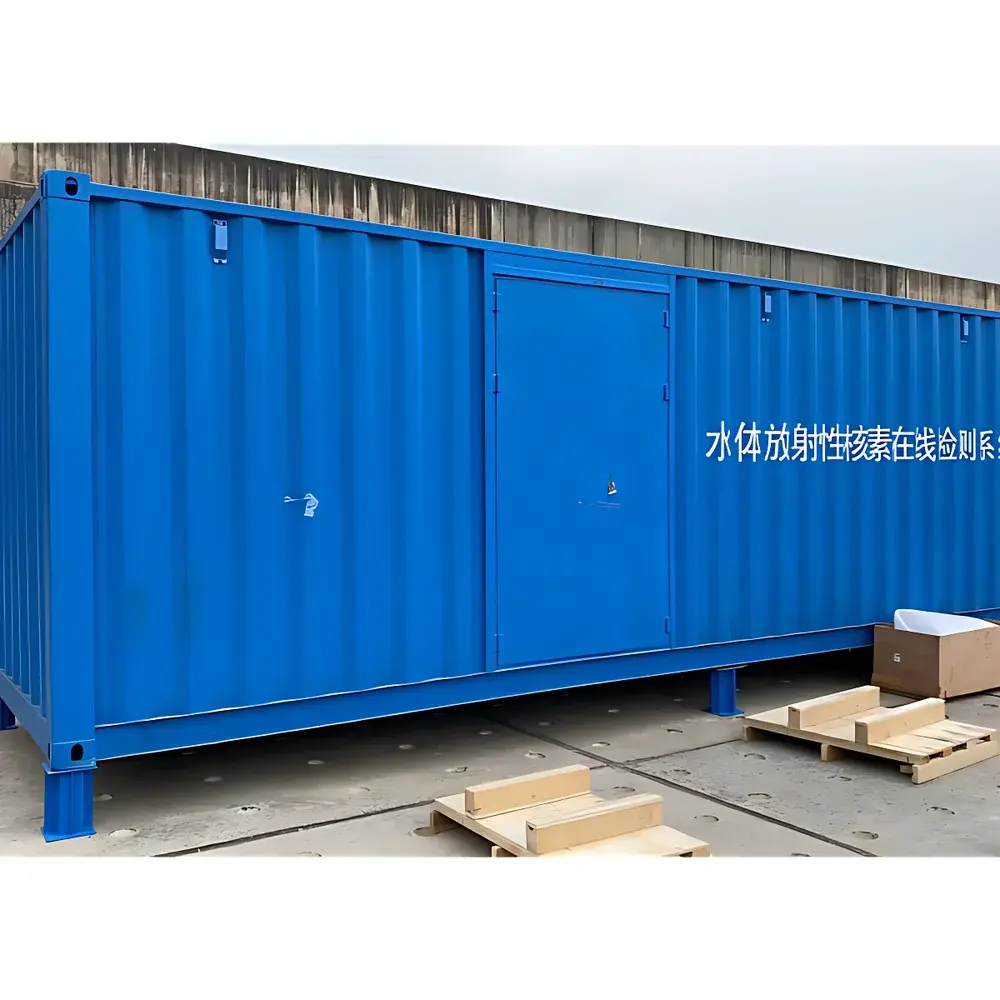
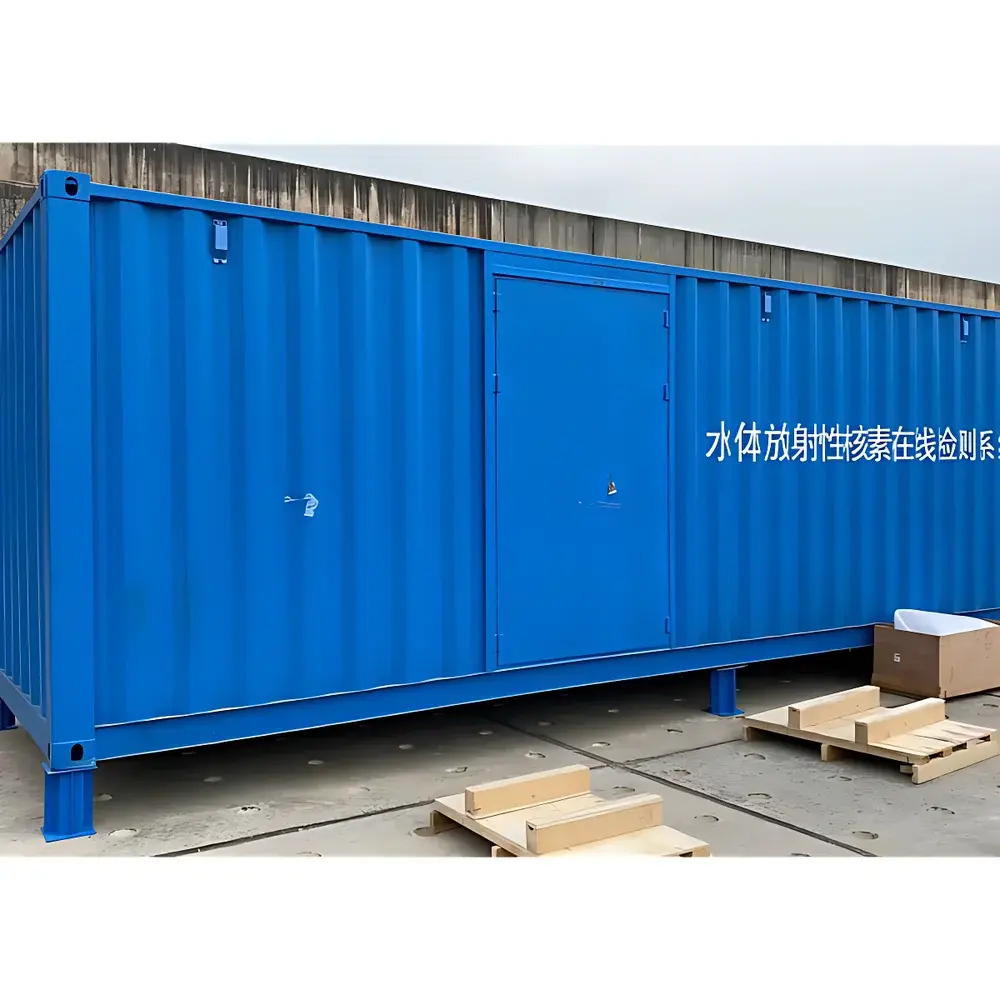
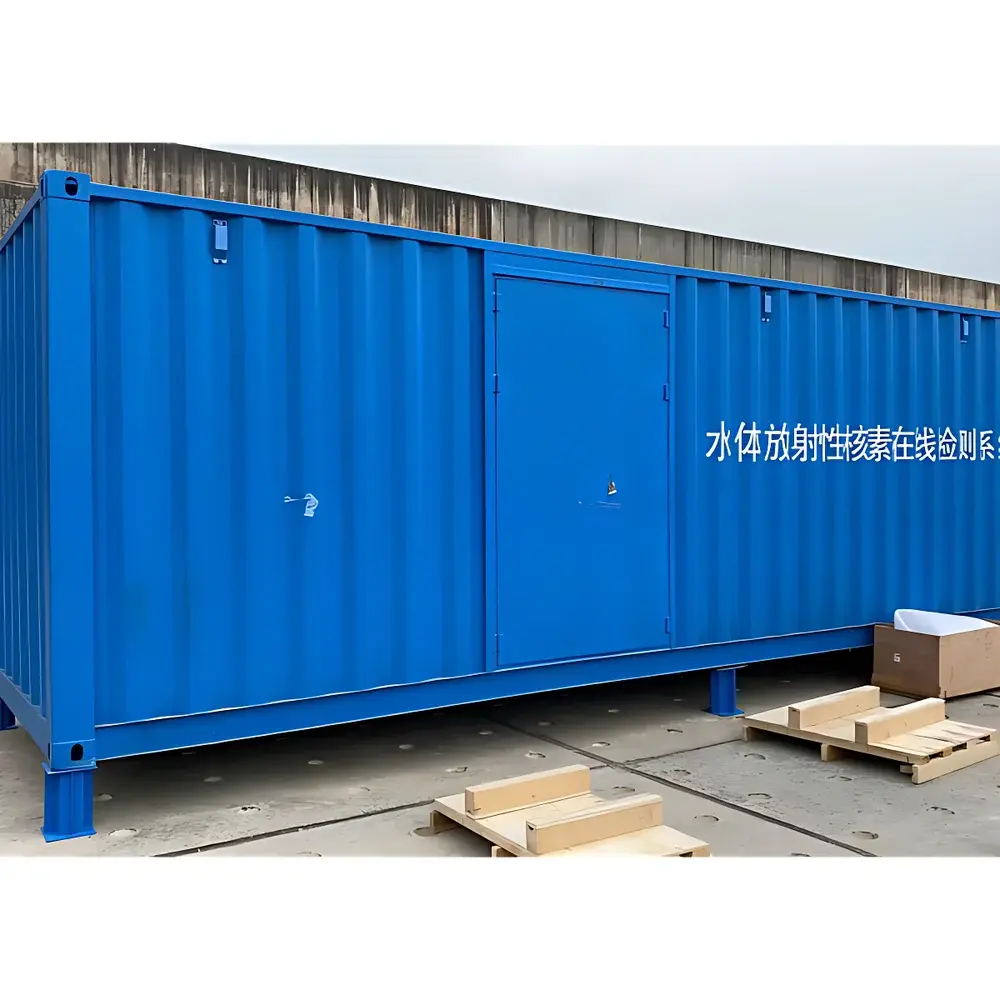
Power Plant Seawater Radiation Environmental Monitoring System
| Brand | — |
|---|---|
| Origin | Beijing, China |
| Manufacturer Type | Authorized Distributor |
| Product Category | Domestic |
| Model | Power Plant Seawater Radiation Environmental Monitoring System |
| Pricing | Upon Request |
| Instrument Class | Dose Rate Meter / Activity Monitor |
| Instrument Type | Online Continuous Monitoring System |
| Measured Medium | Liquid (Seawater) |
Overview
The Power Plant Seawater Radiation Environmental Monitoring System is a fully integrated, online radiation surveillance platform engineered for continuous, real-time assessment of radionuclide activity in seawater intake and discharge streams at coastal nuclear power facilities. Designed to meet stringent operational and regulatory requirements for environmental radiological protection, the system employs high-resolution gamma spectrometry as its core measurement principle—utilizing scintillation or semiconductor detectors (e.g., NaI(Tl) or HPGe-compatible digital acquisition) coupled with advanced pulse processing algorithms. It operates under ISO 11929:2019 (evaluation of measurement uncertainty in ionizing radiation) and supports compliance with IAEA Safety Standards Series No. RS-G-1.8 (Environmental and Effluent Monitoring for Nuclear Facilities), as well as national regulatory frameworks governing effluent discharge limits (e.g., China’s HJ 61–2021, US NRC Regulatory Guide 4.15). The system delivers quantitative gamma-emitting nuclide identification (e.g., 137Cs, 60Co, 58Co, 131I) and dose rate estimation via calibrated spectral deconvolution, enabling early anomaly detection and trend-based environmental impact assessment.
Key Features
- Automated seawater sampling subsystem featuring PLC-controlled dual-mode operation: continuous flow sampling and programmable interval sampling, with integrated pre-filtration (5–10 µm stainless-steel mesh) to prevent particulate fouling of detection cells.
- Digital gamma spectrometer with ≥16,384-channel MCA resolution, sustained data throughput ≥100 kcps, differential nonlinearity ≤±1%, and integral nonlinearity ≤±0.025%—ensuring high spectral fidelity and accurate peak area quantification.
- Advanced pulse processing firmware including low-frequency noise suppression, auto-optimal shaping, automatic pole-zero cancellation, zero-dead-time correction, gated baseline restoration, ballistic deficit correction, and virtual oscilloscope visualization for real-time signal diagnostics.
- Pulse pile-up rejection with user-definable threshold and 500 ns pair-resolution, minimizing spectral distortion under high-count-rate conditions typical of near-field marine effluent monitoring.
- Temperature-stabilized gain and offset control: gain drift <35 ppm/°C; zero-point drift <3 ppm/°C—maintained via embedded thermal sensors and closed-loop DAC feedback, eliminating manual recalibration across ambient ranges.
- Low-background lead shielding assembly (≥10 cm Pb equivalent) with graded copper/cadmium inner lining, reducing cosmic and terrestrial background contribution to <0.15 cps in 100–2000 keV region.
- Industrial-grade ruggedized computer (IP65-rated enclosure) integrating Ethernet interfaces from spectrometer, seawater flow controller, and BeiDou GNSS receiver—enabling synchronized timestamping, georeferenced data logging, and deterministic inter-device communication via Modbus TCP or OPC UA.
- Active air-damped isolation mount system with mechanical limit stops, suppressing resonant vibration below 60 Hz; ensures stable detector geometry and spectral reproducibility under marine platform motion or facility seismic microtremors.
Sample Compatibility & Compliance
The system is validated for direct, unprocessed seawater analysis without chemical pretreatment—compatible with salinity up to 35 g/kg and suspended solids concentrations ≤50 mg/L. All wetted components (sample lines, valves, flow cell) are constructed from marine-grade 316L stainless steel and EPDM/PFA-lined fittings to resist chloride-induced pitting and biofouling. Structural integrity complies with GB/T 2423.10–2019 (vibration testing) and GB/T 2423.17–2008 (salt mist corrosion resistance). Operating envelope: –5 °C to +40 °C ambient; static load capacity >1200 kg; oil- and seawater-resistant surface finish per ISO 12944-6 C5-M category.
Software & Data Management
Acquisition and analysis software runs on Windows IoT Enterprise LTSB, supporting automated spectral library matching (IAEA NuDat 3.0–compatible), isotope-specific minimum detectable activity (MDA) calculation per ISO 11929, and audit-trail-enabled data archiving compliant with GLP principles. Raw spectra, processed nuclide concentrations (Bq/L), ambient dose equivalent rate (nSv/h), and BeiDou-derived geographic coordinates (WGS84, ≤10 m CEP accuracy) are stored in encrypted SQLite databases with SHA-256 hash integrity verification. Data export supports CSV, XML, and IAEA-compliant RADAR format for integration into plant-wide environmental information systems (EIS) or national regulatory reporting portals.
Applications
- Real-time monitoring of liquid effluent discharges from nuclear power plant cooling water systems.
- Baseline environmental surveillance and post-incident radiological mapping in coastal zones adjacent to nuclear facilities.
- Validation of engineered barrier performance (e.g., spent fuel pool leakage, containment sump integrity).
- Support for periodic regulatory inspections under national nuclear safety regulations and IAEA INIR mission criteria.
- Long-term trend analysis of natural (e.g., 40K) and anthropogenic radionuclide accumulation in marine ecosystems.
FAQ
What radionuclides can this system reliably detect in seawater?
It is optimized for gamma-emitting isotopes with energies between 50 keV and 2000 keV, including but not limited to 137Cs, 60Co, 58Co, 131I, 134Cs, and naturally occurring 40K.
Is the system suitable for unattended operation over extended periods?
Yes—designed for 24/7 autonomous deployment with remote diagnostic capability, self-calibration routines, and fault-tolerant PLC logic that maintains sampling integrity during transient network outages.
How is spectral calibration maintained under varying temperature conditions?
Through hardware-level temperature compensation circuits and software-driven gain/zero tracking using reference peaks (e.g., 40K at 1461 keV or internal 133Ba check sources), ensuring long-term energy scale stability without manual intervention.
Does the system support integration with existing plant SCADA or DCS infrastructure?
Yes—via standard Modbus TCP, OPC UA, or configurable RESTful API endpoints for seamless data ingestion into central control systems and environmental dashboards.
What cybersecurity measures are implemented for remote access and data transmission?
All network interfaces enforce TLS 1.2+ encryption, role-based authentication (RBAC), and configurable firewall rules; firmware updates require signed packages verified via ECDSA-256.







