
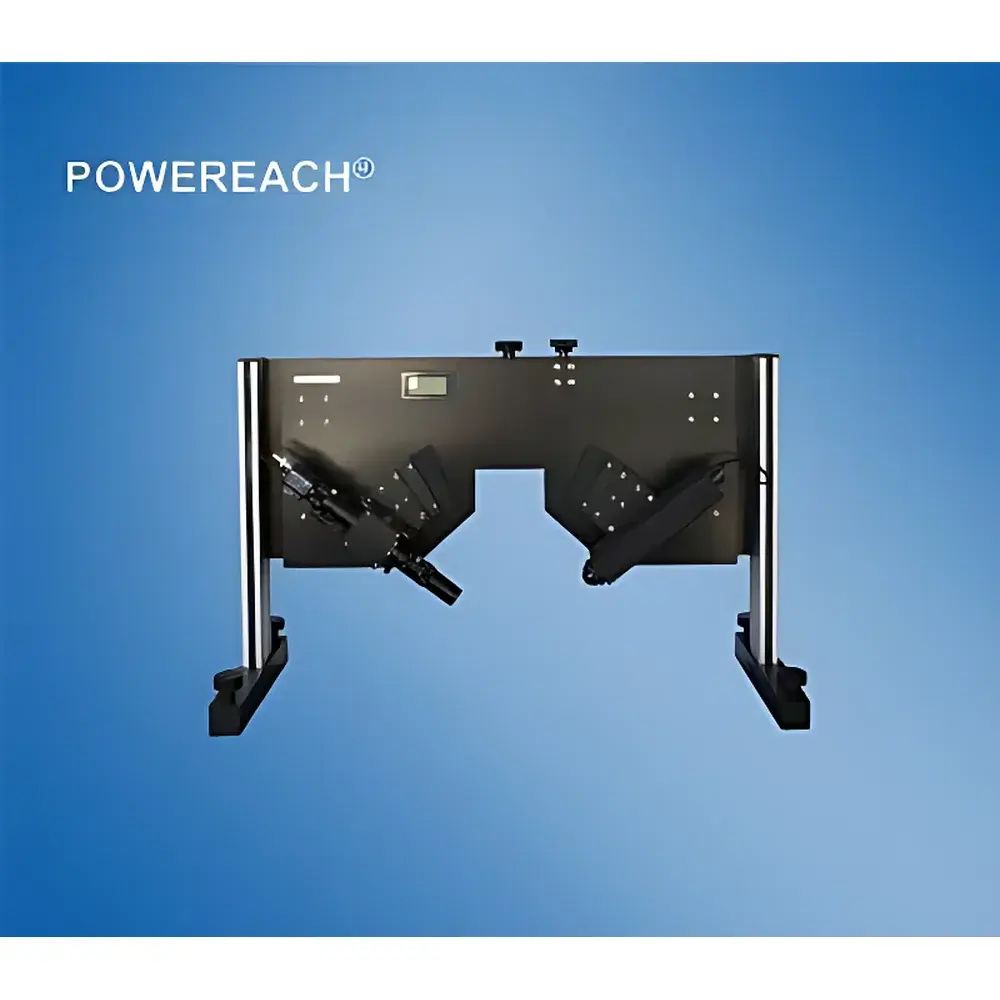
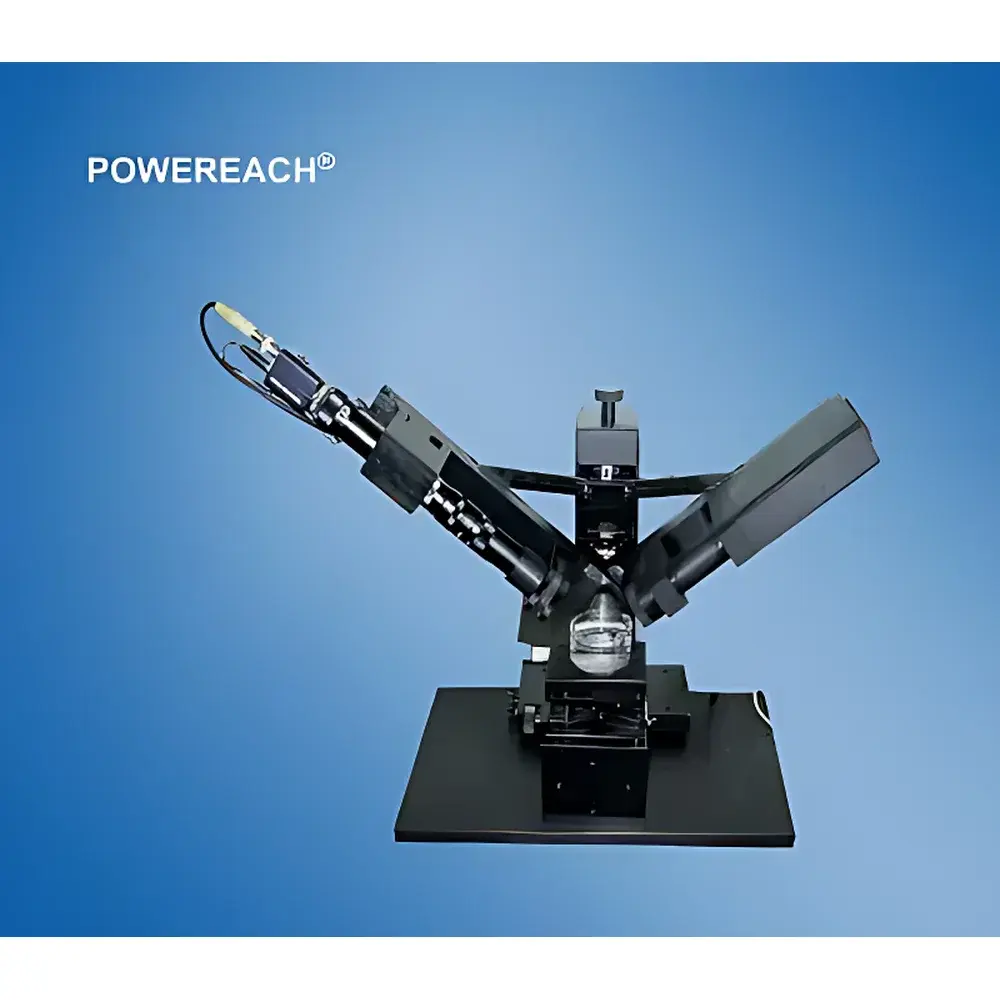
POWEREACH JB04 Brewster Angle Microscope
| Brand | POWEREACH |
|---|---|
| Model | JB04 |
| Origin | Shanghai, China |
| Light Source | 532 nm green laser (20 mW or 50 mW) |
| Laser Intensity Adjustment | 1–100% continuous |
| Objective Lens | Japanese MS-01 zoom objective, working distance 90 mm, magnification 700–1100 px/mm |
| Spatial Resolution | 2 µm |
| Incident Angle Range | 45°–60° |
| Polarization System | High-grade optical prism polarizer |
| Imaging Sensor | High-sensitivity CCD with electronic shutter |
| Image Acquisition | CG400 frame grabber card |
| Operating System Compatibility | Windows XP (32-bit), Windows 7 (32-bit) |
| Interface | RS232 serial port, native PCI slot required |
| Software | Proprietary GUI-based acquisition and analysis software |
Overview
The POWEREACH JB04 Brewster Angle Microscope is a precision optical instrument engineered for real-time, label-free visualization of monolayer molecular assemblies at the air–water interface. It operates on the fundamental principle of Brewster angle reflectivity: when p-polarized light strikes a dielectric interface at the Brewster angle (typically ~53° for water–air), reflectance drops to near zero. The formation of a Langmuir monolayer alters the interfacial refractive index and surface density, thereby shifting the effective Brewster angle and restoring measurable p-polarized reflectance. This subtle change in reflectivity—modulated by molecular packing, phase behavior, and domain morphology—is optically amplified and resolved via high-numerical-aperture microscopy. Unlike fluorescence or dye-based methods, the JB04 enables non-invasive, quantitative observation of intrinsic interfacial structure without perturbing thermodynamic equilibrium. Its design targets laboratories engaged in fundamental surfactant science, soft matter physics, and functional thin-film development where dynamic, in situ morphological feedback is essential for process control and mechanistic interpretation.
Key Features
- Optimized optical path incorporating a stabilized 532 nm green laser (20 mW or 50 mW output) with continuously adjustable intensity (1–100%) to balance signal-to-noise ratio and avoid photothermal disruption of fragile monolayers.
- Japanese MS-01 zoom objective lens with 90 mm working distance and calibrated magnification range (700–1100 pixels/mm), enabling consistent field-of-view scaling across experimental conditions.
- Spatial resolution of ≤2 µm—sufficient to resolve submicron domains, phase boundaries, and nucleation sites in condensed-phase monolayers and mixed lipid systems.
- Manually adjustable incident angle stage (45°–60°) with vernier scale and locking mechanism, facilitating precise alignment to the interface-specific Brewster condition and empirical optimization for heterogeneous or temperature-modulated films.
- High-extinction-ratio polarization system based on fused-silica prism polarizers, ensuring >99.9% p-polarization purity and minimal depolarization artifacts during long-duration acquisitions.
- Fully integrated digital imaging architecture: high-quantum-efficiency CCD sensor with programmable electronic shutter, synchronized capture via CG400 frame grabber, and deterministic timing control for kinetic studies down to 100 ms temporal resolution.
Sample Compatibility & Compliance
The JB04 is compatible with standard Langmuir trough configurations (e.g., KSV, NIMA, or custom-built systems) using ultrapure water (resistivity ≥18.2 MΩ·cm) as the subphase. It supports amphiphilic molecules including fatty acids, phospholipids, block copolymers, graphene oxide dispersions, and conjugated polymers. All optical components meet ISO 10110 surface quality standards; mechanical stages conform to ISO 2768-mK general tolerances. While the instrument itself does not carry CE or FDA certification, its operational methodology aligns with ASTM D1331 (surface tension of solutions), ISO 9073-7 (nonwovens interfacial characterization), and IUPAC recommendations for Langmuir monolayer analysis. Data acquisition workflows support audit-ready metadata logging (timestamp, angle, laser power, exposure time), satisfying GLP documentation requirements for academic and industrial R&D environments.
Software & Data Management
The JB04 is controlled by a proprietary Windows-native application developed for 32-bit Windows XP and Windows 7 platforms. The software provides real-time image preview, manual/automatic focus assist, region-of-interest (ROI) selection, time-lapse sequence triggering, and grayscale histogram analysis. Acquired images are saved in lossless TIFF format with embedded EXIF-style metadata (including system configuration and operator notes). Batch processing tools enable contrast normalization, background subtraction, and domain area quantification via threshold-based segmentation. Export options include CSV for statistical analysis in MATLAB or Python, and PNG/PDF for publication-ready figures. No cloud connectivity or remote access functionality is implemented—data remains fully local and under user control, complying with institutional IT security policies and GDPR-compliant data handling practices.
Applications
- Monitoring lateral phase separation and domain coalescence in binary lipid mixtures (e.g., DPPC/DOPC) during compression isotherms.
- Assessing monolayer homogeneity and defect density prior to Langmuir–Blodgett transfer onto solid substrates (SiO₂, mica, ITO).
- Tracking adsorption kinetics of proteins or nanoparticles at the air–water interface under controlled surface pressure.
- Characterizing collapse mechanisms—including fracture propagation, fold formation, and multilayer ejection—during over-compression experiments.
- Validating molecular tilt angles and packing density models by correlating reflectivity contrast with theoretical transfer matrix simulations.
- Qualitative screening of surfactant purity and batch-to-batch consistency in pharmaceutical excipient development.
FAQ
What operating systems are officially supported?
Windows XP (32-bit) and Windows 7 (32-bit) only. 64-bit OS versions, Windows 10/11, and virtualized environments are not supported due to driver-level dependencies on legacy RS232 and PCI hardware interfaces.
Is a dedicated computer required?
Yes. The system requires a physical machine with a native PCI slot (not PCIe-to-PCI bridge), RS232 serial port, and AMD-based discrete GPU. Integrated graphics or Intel HD Graphics are incompatible with the CG400 frame grabber.
Can the JB04 be integrated with third-party Langmuir troughs?
Yes—provided the trough features a standardized 100 mm × 100 mm observation window with optical access parallel to the interface and mechanical stability sufficient to maintain alignment within ±0.1° during compression cycles.
What maintenance is required for long-term calibration stability?
Annual verification of laser alignment and polarizer extinction ratio is recommended. No consumables or recalibration certificates are supplied; users may perform routine checks using a reference quartz slide and calibrated power meter.
Does the system support automated angle scanning or pressure synchronization?
No. Angle adjustment and surface pressure control remain manual or externally coordinated via separate instrumentation. The JB04 functions as a standalone imaging module, not a closed-loop feedback system.



