
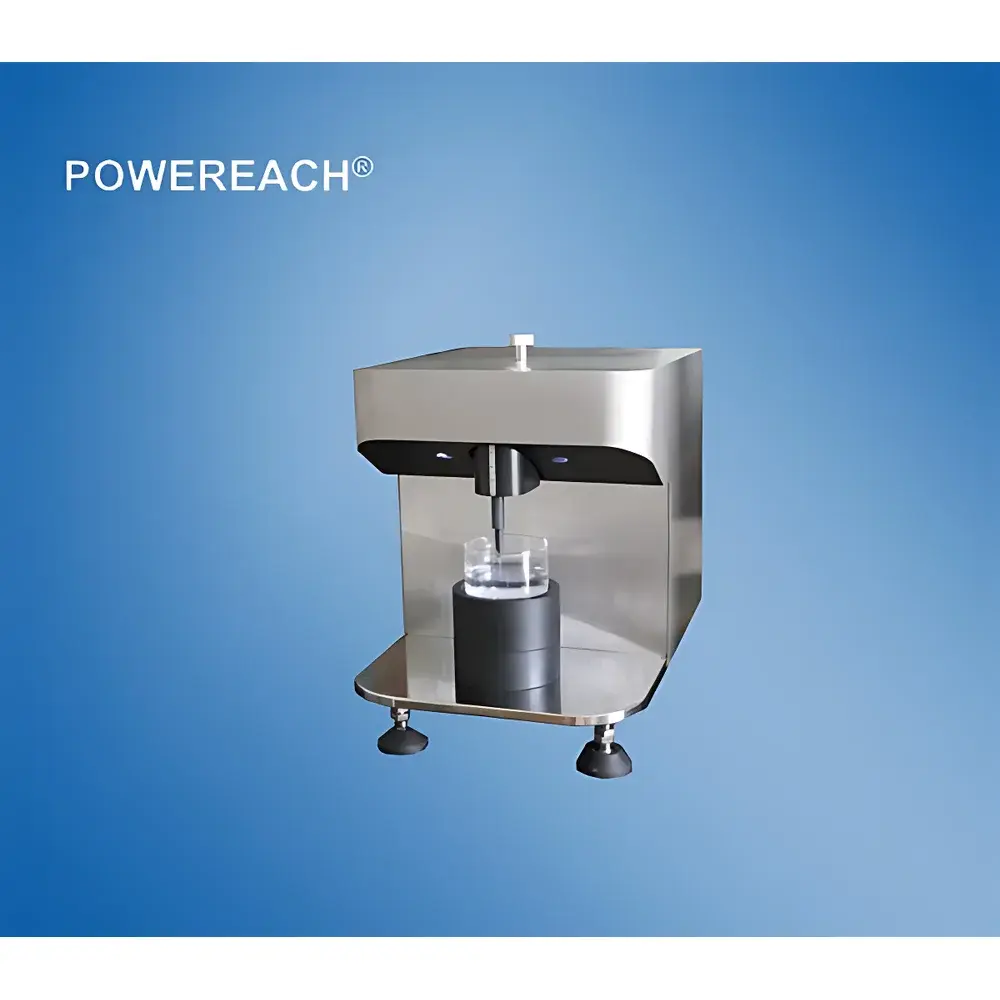
POWEREACH JBT07 Series Dynamic Bubble Pressure Tensiometer
| Brand | POWEREACH (Shanghai Zhongchen) |
|---|---|
| Origin | Shanghai, China |
| Model | JBT07 Series |
| Measurement Range | 10–100 mN/m |
| Resolution | 0.01 mN/m |
| Accuracy | ±0.1 mN/m |
| Temperature Display Range | Ambient (20–25°C typical) |
| Temperature Resolution | ±0.1°C |
| Bubble Frequency Range | 0.06–66 bubbles/s (water reference) |
| Bubble Lifetime Range | 0.015–1 s (water reference) |
| Detection Method | Maximum Bubble Pressure (MBP) |
| Power Supply | AC 220 V / 110 V, 50 Hz |
| Power Consumption | 50 W |
| Interface | RS-232 Serial (DB9) |
Overview
The POWEREACH JBT07 Series Dynamic Bubble Pressure Tensiometer is a precision instrument engineered for the quantitative determination of dynamic surface tension using the maximum bubble pressure (MBP) method—a well-established technique grounded in Young–Laplace interfacial thermodynamics. Unlike static tensiometers that measure equilibrium values, the JBT07 series captures time-resolved surface tension evolution at millisecond-to-second timescales by monitoring the pressure required to form and detach discrete gas bubbles at the tip of a vertically immersed capillary. As gas flow rate increases, bubble formation frequency rises and lifetime decreases—enabling systematic correlation between bubble age (tb) and corresponding surface tension (γ(tb)). This principle makes the instrument particularly suited for characterizing surfactant adsorption kinetics, evaluating rapid wetting processes, and assessing formulation stability under dynamic conditions encountered in coating, spraying, inkjet printing, and emulsion generation.
Key Features
- High-resolution MBP measurement with ±0.1 mN/m accuracy and 0.01 mN/m resolution across 10–100 mN/m range
- Four configurable models (JBT07A–JBT07D) supporting bubble frequencies from 0.06 to 66 bubbles per second—optimized for varying surfactant diffusion rates and interfacial relaxation times
- Adjustable liquid-level positioning mechanism ensuring precise and repeatable capillary immersion depth control
- Integrated high-sensitivity pressure transducer with low-drift analog signal conditioning and real-time digital acquisition
- RS-232 serial interface compliant with standard PC COM port protocols; supports both desktop and laptop configurations with native DB9 hardware
- Modular capillary system with two calibrated glass capillaries included—designed for consistent radius matching and minimal hysteresis
- Robust mechanical architecture with vibration-damping base and thermal mass stabilization for ambient-temperature operation (20–25°C)
Sample Compatibility & Compliance
The JBT07 series accommodates aqueous and organic solutions, polymer melts, microemulsions, and low-viscosity dispersions—provided they do not corrode borosilicate capillaries or clog the orifice. Sample volume requirements are minimal (typically <15 mL), reducing reagent consumption during screening. The instrument operates within ISO 1409:2016 and ASTM D971–18 guidelines for interfacial tension measurement by the bubble pressure method. While not certified for GMP environments out-of-the-box, its data traceability architecture—including timestamped raw pressure logs, user-defined test IDs, and exportable CSV datasets—supports alignment with GLP documentation workflows and internal audit requirements. All firmware and software comply with IEC 61000-4 electromagnetic compatibility standards.
Software & Data Management
The bundled Windows-based application provides real-time visualization of pressure vs. time waveforms, automatic detection of peak pressure points, and synchronized calculation of γ(tb) using the corrected Young–Laplace equation: γ = (r/2)·(ΔPmax − ρgh), where r is capillary radius, ΔPmax is measured maximum pressure, ρ is liquid density, g is gravitational acceleration, and h is immersion depth. Users may perform single-point measurements at defined bubble counts or execute automated frequency sweeps to generate full dynamic surface tension isotherms. Export formats include CSV, TXT, and PNG; all datasets retain metadata such as date/time stamp, operator ID, model configuration, and calibration parameters. Software updates are distributed via secure HTTPS portal with version-controlled changelogs.
Applications
- Surfactant adsorption kinetics in agrochemical adjuvants and pesticide formulations
- Rapid wetting evaluation of textile auxiliaries and dye leveling agents
- Dynamic interfacial behavior of biosurfactants in pharmaceutical suspensions
- Quality control of inkjet inks and functional coatings for printed electronics
- Stability assessment of oil-in-water emulsions used in food and cosmetics
- Research on nanoparticle-stabilized interfaces in catalytic and energy storage systems
- Teaching laboratory demonstrations of interfacial relaxation phenomena in physical chemistry curricula
FAQ
What is the fundamental physical principle behind the bubble pressure method?
The method relies on the Young–Laplace equation, which relates the maximum pressure inside a growing spherical bubble at a capillary tip to the local surface tension and capillary radius. At the moment of detachment, when bubble radius equals capillary radius, pressure reaches its maximum value—providing a direct, contactless measure of dynamic surface tension.
Does the instrument require temperature control beyond ambient conditions?
No. The JBT07 series is designed for stable operation at room temperature (20–25°C). For experiments requiring elevated or controlled temperatures, external thermostatted sample holders may be integrated—but are not part of the standard configuration.
Can the system be validated against certified reference materials?
Yes. Calibration verification can be performed using standard aqueous ethanol solutions (e.g., 2% v/v ethanol in water, γ ≈ 40.5 mN/m at 20°C) or n-hexadecane/water interfaces with published literature values. Capillary radius calibration is performed gravimetrically during factory setup.
Is FDA 21 CFR Part 11 compliance supported?
The base software does not include electronic signature, audit trail, or role-based access controls required for Part 11 compliance. However, raw data files and metadata are fully exportable for integration into validated LIMS or ELN platforms that provide those capabilities.
What maintenance is required for long-term operational reliability?
Routine maintenance includes periodic cleaning of capillaries with appropriate solvents (e.g., acetone for organics, dilute HNO3 for inorganic residues), inspection of O-rings and tubing integrity, and annual verification of pressure sensor linearity using dead-weight calibrators or NIST-traceable pressure standards.



