
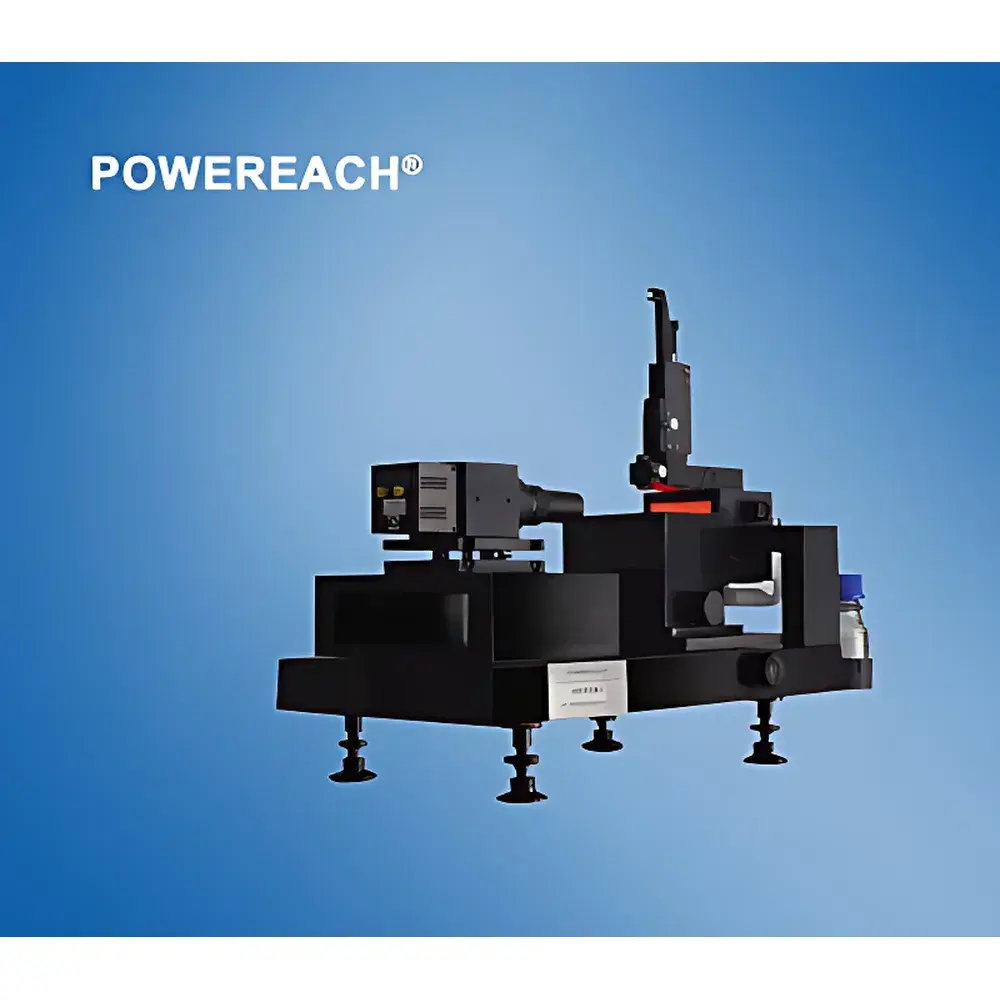
POWEREACH JC2000C Series Contact Angle Analyzer
| Brand | POWEREACH (Shanghai Zhongchen Digital Technology Equipment Co., Ltd.) |
|---|---|
| Origin | Shanghai, China |
| Model | JC2000C1 |
| Instrument Type | Benchtop Laboratory Contact Angle Measurement System |
| Measurement Modes | Static & Dynamic Contact Angle, Surface/Interfacial Tension (Sessile Drop & Pendant Drop), Surface Free Energy (Owens-Wendt Method) |
| Angular Range | 0–180° |
| Angular Resolution | 0.1° or 0.5° (selectable) |
| Image Magnification | 50–318 pixels/mm |
| Sample Stage Dimensions | 100 × 100 mm² |
| Vertical Stage Travel | 20 mm |
| Manual X/Y Stage Travel | 60 mm (X), 50 mm (Y) |
| Lens Translation Range | 40 mm (Z) |
| Imaging | USB Digital CCD Camera, 25 fps Real-Time Capture |
| Software | Proprietary Image Analysis Suite with Automated Tangent Fitting, Spline Curve Fitting (5-Point), Height-Method Calculation (3-/4-Point), and CMC/Surface Energy Modules |
Overview
The POWEREACH JC2000C Series Contact Angle Analyzer is a precision benchtop instrument engineered for quantitative characterization of solid–liquid interfacial wettability under controlled laboratory conditions. Based on the optical sessile drop method—complemented by pendant drop and captive bubble techniques—the system determines contact angle (θ) as the angle formed between the tangent to the liquid–vapor interface and the solid surface at the three-phase contact line (solid–liquid–vapor). This thermodynamically defined parameter serves as a direct indicator of surface energy heterogeneity, chemical functionality, and physical topography. The JC2000C1 model delivers high reproducibility in static and dynamic contact angle measurements—including advancing, receding, and roll-off angles—enabling rigorous evaluation of hysteresis behavior critical to coating adhesion, membrane filtration, biomedical device biocompatibility, and functional surface development. Its modular architecture supports expansion into interfacial tension quantification (via Young–Laplace fitting), critical micelle concentration (CMC) determination, and surface free energy estimation using the Owens–Wendt two-liquid model—making it suitable for R&D and QC applications across advanced materials, pharmaceuticals, and microelectronics.
Key Features
- Four-dimensional manual stage adjustment (X, Y, Z, and tilt) ensures precise sample positioning and optical alignment for heterogeneous or textured substrates.
- Dual-mode imaging acquisition: single-frame freeze capture, time-lapse imaging (1 s–3600 s intervals), and real-time high-speed video recording at 25 fps—essential for tracking rapid wetting dynamics or volatile solvent evaporation.
- Automated geometric analysis algorithms eliminate subjective operator bias: tangent-line placement is computed via spline curve fitting (5-point method), height-based interpolation (3- or 4-point), or direct angular measurement—fully embedded in proprietary software.
- Integrated peristaltic dosing pump enables repeatable, contamination-free liquid delivery; optional motorized syringe pumps (0.01 µL resolution) support automated advancing/receding cycle protocols.
- Optical path optimized for low-distortion imaging: continuous zoom lens (standard 1×–8× magnification range available), high-sensitivity USB CCD sensor, and adjustable LED backlighting ensure consistent contrast across diverse surface chemistries and roughness profiles.
- Compliance-ready data handling: all measurements include timestamped metadata, user ID logging, and raw image archives—supporting traceability requirements aligned with GLP and internal QA documentation standards.
Sample Compatibility & Compliance
The JC2000C1 accommodates a broad spectrum of solid substrates without requiring vacuum or conductive coating. Standard testing includes flat rigid solids (e.g., silicon wafers, polymer films, metal foils), pressed powder compacts (≥13 mm diameter, ≥0.1 mm thickness), fibers (mounted on custom jigs), woven/nonwoven textiles (using optional taut-mount frames), and porous membranes. Surface roughness up to Ra ≈ 5 µm is accommodated via adaptive edge-detection algorithms. While not certified to ISO 19403 or ASTM D7334, the instrument’s methodology conforms to the foundational principles outlined in these standards for contact angle measurement repeatability and environmental control (temperature-stable lab environment recommended). Data export formats (CSV, TIFF, PNG) facilitate integration into LIMS environments and third-party statistical analysis platforms.
Software & Data Management
The embedded Windows-based application provides full control over hardware synchronization, image acquisition, and quantitative analysis. Core modules include contact angle calculation (static/dynamic), surface tension derivation (pendant drop analysis), surface free energy computation (Owens–Wendt), and droplet geometry quantification (volume, diameter, height, contact diameter). All results are stored with immutable metadata: acquisition timestamp, operator ID, calibration status, and raw image files. Audit trail functionality records parameter changes and measurement edits—meeting baseline expectations for FDA 21 CFR Part 11–aligned workflows where electronic signatures and version-controlled reports are implemented at the institutional level. Export options include batch CSV reports, annotated TIFF overlays, and PDF summary sheets compliant with internal SOP templates.
Applications
This system is routinely deployed in academic and industrial laboratories for: evaluating plasma-treated polymer surfaces prior to adhesive bonding; characterizing hydrophobic/hydrophilic gradients on biosensor chips; assessing anti-fouling performance of marine coatings; optimizing inkjet printability on flexible electronics substrates; validating cleaning efficacy on semiconductor wafers; screening superhydrophobic textile finishes; and quantifying moisture uptake kinetics in pharmaceutical tablet excipients. Cross-sector adoption spans battery separator R&D (Li-ion electrolyte wettability), OLED encapsulation layer development, nanocellulose film processing, and quality control of medical-grade silicone tubing.
FAQ
What operating system is required?
Windows 7/10/11 (32-bit or 64-bit), with USB 2.0 port and dedicated graphics support for real-time image rendering.
Is calibration traceable to national standards?
The system uses geometric reference standards (certified glass angle plates) for angular verification; no NIST-traceable certificate is supplied, but users may perform in-house validation using ISO 8510-2 reference artifacts.
Can the instrument measure contact angles on curved or irregular surfaces?
Yes—through manual stage tilt and multi-point height-method analysis, enabling reliable measurement on convex/concave geometries and microstructured surfaces when combined with high-magnification optics.
Does the software support automated batch analysis of multiple images?
Yes—batch mode allows sequential processing of time-series image folders with uniform thresholding and region-of-interest parameters.
What maintenance is required for long-term accuracy?
Annual verification of optical alignment and stage repeatability is recommended; CCD sensor cleaning and lens inspection should be performed quarterly in high-humidity or particulate-rich environments.



