
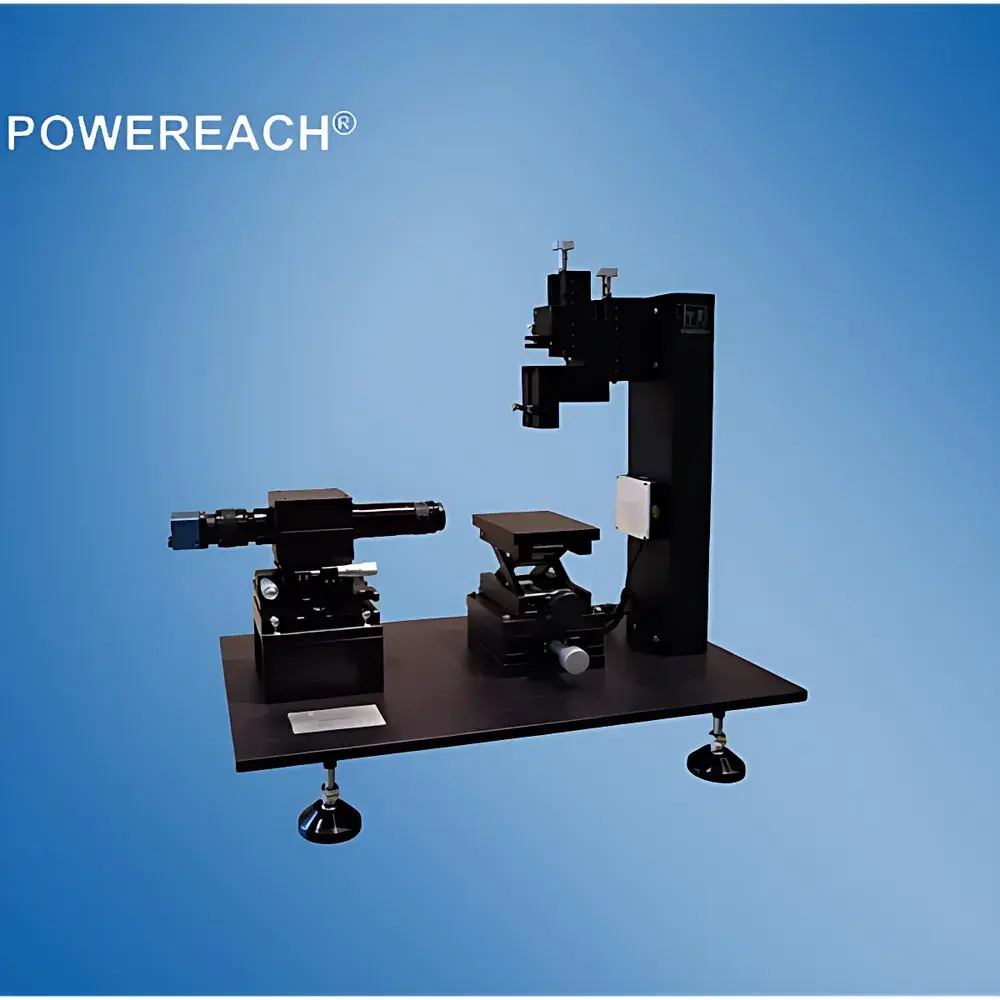
POWEREACH JC2000CS Video-Based Optical Contact Angle Goniometer
| Brand | POWEREACH (Shanghai Zhongchen) |
|---|---|
| Origin | Shanghai, China |
| Instrument Type | Benchtop Laboratory Goniometer |
| Measurement Principle | Video-based Optical Analysis with High-Resolution Imaging and Mathematical Droplet Contour Fitting |
| Contact Angle Range | 0–180° |
| Angular Resolution | 0.01° |
| Measurement Accuracy | ±0.1° or ±0.5° (selectable) |
| Sample Stage Dimensions | 70 mm × 100 mm |
| Vertical Stage Travel | 20 mm |
| Image Magnification | 70–420 pixels/mm |
| Camera | USB 2.0 Digital Industrial Camera with Sony CMOS Sensor |
| Optical System | 0.7×–4.5× Continuous Zoom Lens |
| Lighting | Adjustable High-Brightness LED Backlight |
| Measurement Modes | Sessile Drop, Pendant Drop, Captive Bubble, Tilting Plate |
| Contact Angle Analysis Methods | Tangent (θ), Height (θₕ), Elliptical Fitting, Young–Laplace Fitting, Five-Point Polynomial Fitting, Dual-Angle Asymmetric Analysis |
| Surface Tension Calculation | Axisymmetric Drop Shape Analysis (ADSA) via Pendant Drop Method |
| Surface Free Energy Models | Owens–Wendt (Two-Liquid), Wu Harmonic Mean, van Oss–Chaudhury–Good (vOCG), Acid–Base, Geometric Mean |
| Data Output | Excel (.xlsx), Image-Embedded Annotation, AVI Video Recording (25 fps), Audit-Trail-Ready Export Logs |
| Software Compliance | Supports GLP/GMP-aligned data integrity workflows |
Overview
The POWEREACH JC2000CS is a benchtop video-based optical contact angle goniometer engineered for precise, reproducible quantification of solid–liquid interfacial wettability. It operates on the fundamental principle of high-resolution digital imaging coupled with rigorous geometric and physical modeling of liquid droplet contours. By capturing static or dynamic sessile, pendant, captive bubble, or tilted-drop configurations under controlled illumination, the system extracts contact angles through pixel-level edge detection and curvature-constrained mathematical fitting—including Young–Laplace equation solving for non-spherical drops. Designed for laboratories requiring ISO/IEC 17025-compatible measurement traceability, the JC2000CS supports both routine QC screening and advanced research in nanomaterial surface functionalization, thin-film coating development, and biomaterial interface characterization. Its architecture integrates calibrated optics, thermally stable mechanical stages, and deterministic image acquisition—minimizing operator-induced variability while enabling compliance with ASTM D7334 (Standard Practice for Surface Wettability of Coated Surfaces), ISO 19403 (Contact Angle Measurement), and USP analytical instrument qualification guidelines.
Key Features
- High-fidelity imaging subsystem: USB 2.0 industrial camera with Sony CMOS sensor, delivering low-noise, high-contrast frames at up to 25 fps for dynamic contact angle tracking.
- 0.7×–4.5× continuous zoom optical path with parfocal design ensures consistent focus across magnification ranges; calibrated pixel-to-length mapping enables sub-micron spatial resolution.
- Dual-mode illumination: Adjustable LED backlight for silhouette contrast enhancement and optional coaxial front lighting for surface texture visualization.
- Motorized or manual sample stage with 20 mm vertical travel and fine micrometer adjustment—optimized for flat, curved, fibrous, or porous substrates up to 70 × 100 mm.
- Multi-algorithm contact angle engine: Simultaneous application of tangent, height, elliptical, five-point polynomial, and axisymmetric Young–Laplace fitting—automatically selecting optimal method per droplet morphology.
- Asymmetric contact angle analysis: Independent left/right angle calculation with statistical comparison and automatic mean reporting—critical for heterogeneous or anisotropic surfaces.
- Surface energy module: Implements Owens–Wendt, Wu, van Oss–Chaudhury–Good, and geometric mean models using user-defined reference liquids; calculates dispersive/polar components and acid–base parameters.
- Comprehensive data governance: All measurements embed timestamp, operator ID, instrument serial number, calibration certificate expiry, and SHA-256 image hash—supporting FDA 21 CFR Part 11–compliant audit trails when deployed with validated IT infrastructure.
Sample Compatibility & Compliance
The JC2000CS accommodates diverse physical forms without modification: rigid solids (metals, ceramics, polymers), flexible films, woven/nonwoven textiles, single fibers (with auxiliary holders), and compressed powder pellets. Curved surfaces—including convex and concave geometries—are corrected algorithmically using radius-of-curvature inputs. Roughness correction is applied via user-defined Ra or Rz values per ISO 4287. The system meets essential requirements for ISO 14644 cleanroom environments (Class 8 compatible), CE-marked per EN 61326-1 (EMC) and EN 61010-1 (safety), and aligns with GLP documentation standards through structured metadata export. While not pre-certified for GMP manufacturing, its software architecture permits validation per Annex 11 and IQ/OQ/PQ protocols when integrated into qualified laboratory networks.
Software & Data Management
The proprietary POWEREACH AnalySIS software provides a unified interface for acquisition, processing, and reporting. It supports three acquisition modes: single-frame freeze capture, time-lapse imaging (1–3600 s intervals), and real-time video streaming (AVI export). All raw images are stored losslessly in TIFF format; processed results—including annotated droplet contours, fitted curves, and numerical outputs—are exported to Excel with embedded formulas and version-controlled revision history. Surface tension calculations employ ADSA-Pendant algorithms validated against NIST SRM 8542 reference oils. Database management includes project-based organization, role-based access control (via Windows Active Directory integration), and automated backup to network drives. Audit logs record every parameter change, image reprocessing event, and user login—enabling full forensic reconstruction of analytical decisions.
Applications
This instrument serves cross-disciplinary applications where interfacial thermodynamics govern performance: optimization of anti-fouling coatings in biomedical devices; evaluation of hydrophobicity in membrane filtration layers; quantification of plasma treatment efficacy on polymer packaging; assessment of ink adhesion on printed electronics substrates; and characterization of self-cleaning surfaces in architectural glass R&D. In battery materials science, it measures electrolyte wettability on separator membranes and electrode coatings—correlating contact angle hysteresis with Li-ion transport resistance. In pharmaceutical development, it supports excipient selection by mapping wetting behavior of API powders under simulated gastric fluid conditions—informing tablet disintegration kinetics per USP .
FAQ
What calibration standards are supported?
Certified contact angle reference slides (e.g., PTFE, silicon wafer, glass) with traceable certification from NIST-accredited labs are recommended; built-in software calibration wizard guides users through pixel-size and lens distortion verification.
Can the system measure advancing and receding angles automatically?
Yes—using programmable syringe pump integration (optional accessory), the software triggers sequential image capture during controlled volume increase/decrease to compute hysteresis loops.
Is the software compliant with 21 CFR Part 11?
The software itself does not include electronic signature modules; however, its structured audit trail, immutable metadata embedding, and export integrity features enable deployment within Part 11–validated IT ecosystems when paired with appropriate access controls and electronic signature platforms.
How is surface roughness compensated during analysis?
Users input measured Ra/Rz values (from profilometry) to activate Wenzel or Cassie–Baxter correction models—adjusting apparent contact angle to estimate intrinsic surface energy.
What operating systems are supported?
Windows 10/11 (64-bit) with .NET Framework 4.8 and DirectX 12; legacy support for Windows 7 SP1 ends Q4 2025 per vendor lifecycle policy.



