
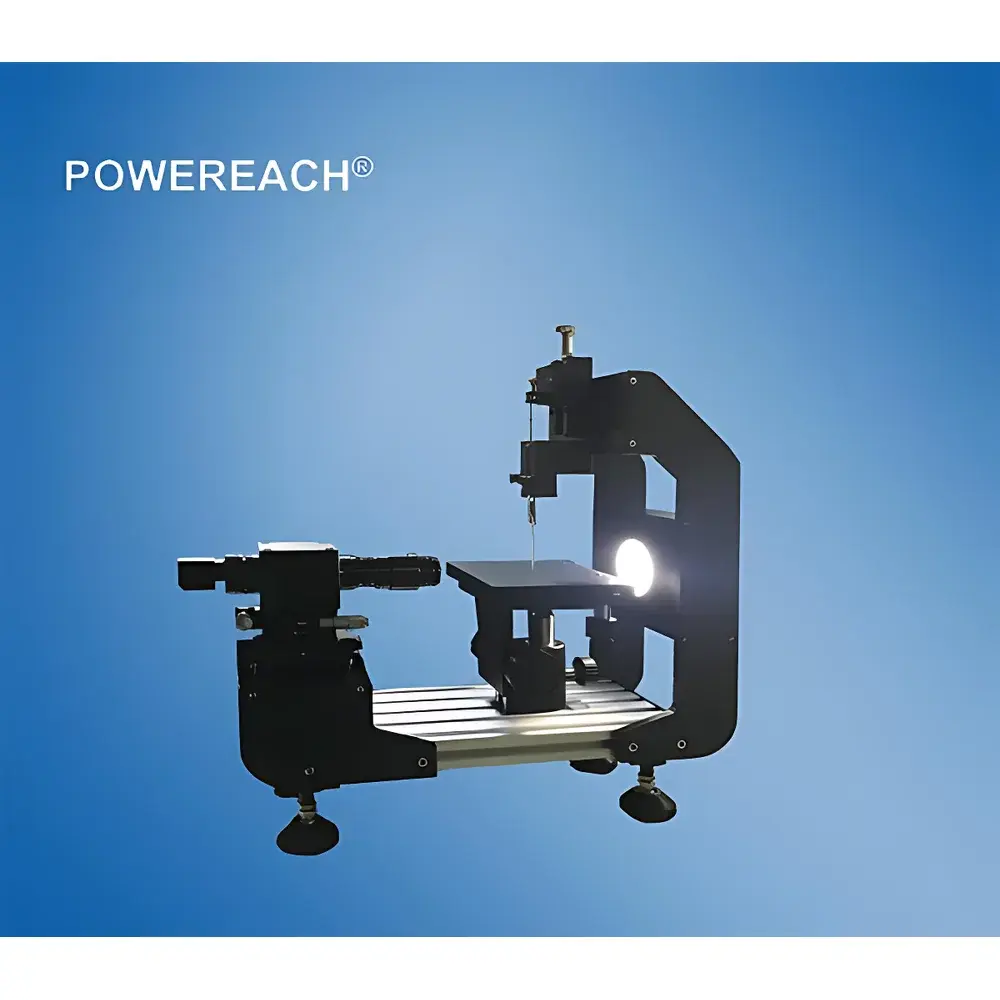
POWEREACH JC2000E Video-Based Optical Contact Angle Goniometer
| Brand | POWEREACH (Shanghai Zhongchen) |
|---|---|
| Origin | Shanghai, China |
| Model | JC2000E |
| Instrument Type | Benchtop Laboratory Goniometer |
| Contact Angle Measurement Range | 0–180° |
| Contact Angle Resolution | 0.01° |
| Accuracy | ±0.1° |
| Sample Stage Dimensions | 100 mm × 100 mm |
| Image Magnification | 50–318 pixels/mm |
| Surface/Interfacial Tension Range (Sessile Drop & Pendant Drop Methods) | 0.01–2000 mN/m |
| Optical System | 0.7–4.5× Continuous Zoom Lens with Post-Magnification Optics |
| Camera Interface | USB 3.0 Digital CCD |
| Software | POWEREACH® V2.11 Image Analysis Suite |
Overview
The POWEREACH JC2000E is a precision benchtop video-based optical contact angle goniometer engineered for quantitative characterization of solid–liquid–gas interfacial phenomena. It operates on the principle of high-resolution silhouette imaging combined with advanced geometric fitting algorithms to determine contact angles from sessile and pendant drop profiles. The system captures dynamic wetting behavior—including advancing and receding angles—enabling rigorous assessment of surface heterogeneity, hysteresis, and time-dependent spreading kinetics. Designed for materials science, coatings R&D, and quality control laboratories, the JC2000E supports ASTM D7334 (Standard Practice for Surface Wettability of Coatings), ISO 19403-2 (Contact angle measurement by optical methods), and aligns with GLP-compliant workflows through audit-trail-capable software logging.
Key Features
- High-fidelity optical path: 0.7–4.5× continuous zoom lens with post-magnification optics ensures stable pixel-to-angle calibration across magnification ranges; image resolution supports reliable sub-degree contact angle quantification (±0.1° accuracy, 0.01° resolution)
- Modular manual positioning system: Three-axis (X/Y/Z) sample stage with 50 mm (X), 30 mm (Y), and 50 mm (Z) travel; precision tilt platform enables controlled substrate inclination for dynamic contact angle analysis
- Dual-mode fluid dispensing: Manual rotary syringe drive with 50 µL and 100 µL calibrated glass syringes plus disposable tips ensures repeatable droplet deposition without cross-contamination
- LED cold light source: Adjustable monochromatic illumination minimizes thermal drift and sample heating, critical for temperature-sensitive polymers and biological substrates
- USB 3.0 digital CCD camera: High-frame-rate acquisition (up to 54 fps) enables capture of rapid wetting transitions; synchronized trigger mode supports automated time-lapse acquisition at user-defined intervals (1–3600 s)
- Comprehensive analytical software: POWEREACH® V2.11 includes multiple fitting models—circle, ellipse, Young–Laplace, and five-point polynomial—as well as curvature correction for convex/concave surfaces
Sample Compatibility & Compliance
The JC2000E accommodates a broad range of solid substrates including rigid plates (≤100 mm × ∞ × 25 mm), fibers, textiles, pressed powders, thin films, and patterned surfaces. Its open-stage architecture allows direct mounting of custom fixtures or environmental chambers (e.g., humidity-controlled enclosures or temperature stages). All measurements comply with internationally recognized standards: surface tension values derived via pendant drop analysis meet ISO 1409 requirements; contact angle outputs are traceable to NIST-calibrated reference liquids (e.g., water, diiodomethane, ethylene glycol). The instrument’s mechanical stability and thermal management support reproducible data under ambient lab conditions (20–25°C, 40–60% RH), satisfying routine QC validation per ISO/IEC 17025 guidelines.
Software & Data Management
POWEREACH® V2.11 is a Windows-native application (compatible with Windows 7/10, 32- or 64-bit) offering full data provenance. It records timestamped metadata—including operator ID, sample ID, environmental parameters, and instrument configuration—for each measurement session. Dynamic contact angle sequences generate CSV-exportable time-series datasets with advancing/receding angle tracking and hysteresis calculation. Surface energy modules implement Owens–Wendt, Wu, van Oss–Chaudhury–Good, and Zisman one-liquid methods using user-entered reference liquid properties. Software logs include version history, parameter change timestamps, and export audit trails—supporting FDA 21 CFR Part 11 compliance when deployed with institutional electronic signature protocols. Free lifetime software updates ensure compatibility with evolving OS security patches and regulatory reporting formats.
Applications
This goniometer serves critical functions across academic and industrial domains: evaluating hydrophobic/hydrophilic modification efficacy in nanocoatings and plasma-treated polymers; quantifying wettability shifts during inkjet printing formulation development; assessing fiber wicking performance in technical textiles; characterizing electrode surface energetics in battery separator R&D; validating cleaning efficacy on semiconductor wafers; and measuring biofilm adhesion propensity on medical device substrates. Its ability to resolve contact angles on microstructured or curved surfaces—via built-in curvature compensation—makes it suitable for optical lens coatings, MEMS packaging, and flexible electronics manufacturing where traditional flat-surface assumptions fail.
FAQ
What computer specifications are required to operate the JC2000E?
A Windows 7 or 10 PC (32- or 64-bit) with one available USB 3.0 port is mandatory. No dedicated GPU or high-end CPU is required; standard office-grade laptops or desktops suffice.
Does the system support automated environmental control?
The base configuration does not include integrated temperature or humidity chambers, but the open mechanical design permits third-party integration of climate-controlled enclosures or heated/cooled stages.
Can the JC2000E measure contact angles on rough or porous surfaces?
Yes—through dynamic measurement modes (advancing/receding) and multi-point fitting algorithms, it resolves apparent contact angles on heterogeneous or textured surfaces; optional surface roughness correction modules may be added per project requirements.
Is calibration verification included with the instrument?
A set of NIST-traceable contact angle calibration standards (10°, 60°, and 110° polymer slides) is provided with initial delivery, along with step-by-step SOP documentation for routine verification.
How is data integrity ensured during long-term deployment?
All measurement sessions are automatically archived with embedded metadata; software-generated reports include digital signatures, revision stamps, and export logs compliant with internal QA documentation systems.



