
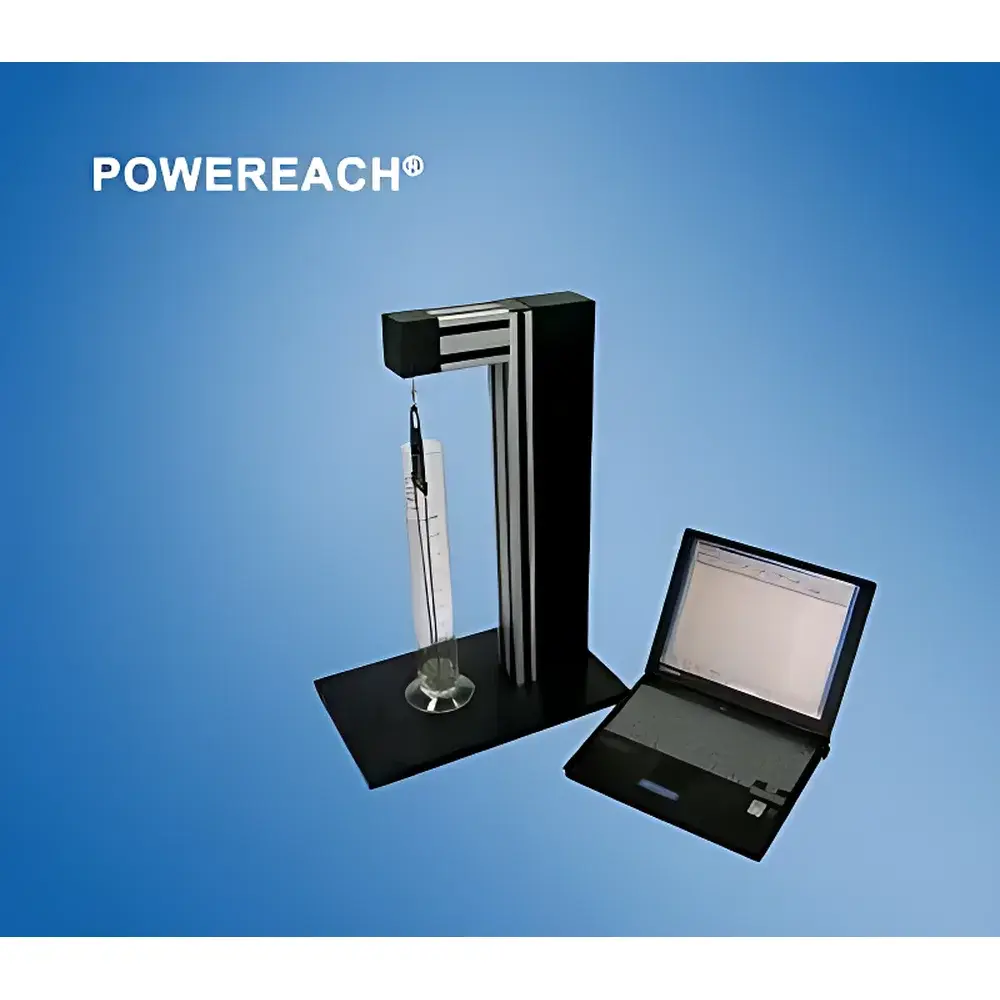
POWEREACH JCJ04 Gravitational Sedimentation Particle Size Analyzer
| Brand | POWEREACH |
|---|---|
| Model | JCJ04 |
| Type | Gravitational Sedimentation Particle Size Analyzer |
| Origin | Shanghai, China |
| Measurement Principle | Gravitational sedimentation (Stokes’ law-based) |
| Particle Size Range | 1–60 µm |
| Maximum Sample Mass Capacity | 0–100 g (selectable) |
| Sensitivity | 0.1 mg |
| Data Acquisition Interval | 0.5 s |
| Sample Vessel | 500 mL calibrated glass cylinder |
| Calibration Weights | 0.5 g, 10 g, 50 g, 100 g |
| Data Output | Real-time sedimentation curve, D10/D50/D90, mean diameter, particle size distribution histogram, cumulative distribution, error estimation |
| Software Functions | Auto-zero, tare, self-calibration, alarm threshold setting, curve storage/retrieval, statistical analysis, report generation & printing |
| Compliance | Designed for GLP-compliant laboratories |
Overview
The POWEREACH JCJ04 Gravitational Sedimentation Particle Size Analyzer is a precision instrument engineered for quantitative characterization of particulate systems based on the physical principle of gravitational sedimentation. It operates under Stokes’ law assumptions—where terminal settling velocity of spherical particles in a Newtonian fluid is directly related to particle diameter, density difference, and fluid viscosity. This method provides robust, reproducible size distribution data for particles ranging from 1 to 60 micrometers, particularly suited for dense, non-agglomerating powders and suspensions with moderate density contrast against the dispersing medium. Unlike optical or laser-based techniques, sedimentation analysis delivers intrinsic hydrodynamic size information without reliance on optical scattering models or refractive index assumptions—making it especially valuable in quality control of ceramic raw materials, pigment slurries, mineral fillers, pharmaceutical excipients, and environmental sediment samples.
Key Features
- High-sensitivity Japanese-imported load cell sensor with linearity ≤0.05% FS and long-term stability <0.1% full-scale drift/year
- Microcontroller-based real-time data acquisition at 0.5-second intervals, synchronized with PC via RS-232 serial interface
- Dual 500 mL calibrated glass sedimentation cylinders included for parallel testing or method validation
- Integrated calibration suite: certified stainless-steel weights (0.5 g, 10 g, 50 g, 100 g) enabling traceable mass calibration per ISO/IEC 17025 guidelines
- Onboard zero/tare/self-calibration functions with audible and visual alarm thresholds for out-of-range conditions
- Full-featured analytical software supporting ASTM D1894 (for particle size by sedimentation), ISO 13321 (photon correlation spectroscopy reference), and USP (for lipid emulsion droplet sizing)
Sample Compatibility & Compliance
The JCJ04 accommodates a wide range of solid-phase materials including metal oxides, clays, carbon black, titanium dioxide, calcium carbonate, silica fume, and biological macromolecular aggregates. Samples must be dispersed in low-viscosity liquids (e.g., water, ethanol, isopropanol) and stabilized against aggregation using appropriate surfactants or ultrasonication prior to analysis. The system complies with fundamental metrological requirements outlined in ISO/IEC 17025 for testing laboratories and supports documentation practices aligned with GMP/GLP environments—including electronic signature capability, user access levels, and audit-trail-enabled data modification logs when deployed with validated software configurations. While the base hardware does not include temperature control, optional thermostatic jacketing can be retrofitted to maintain ±0.5°C bath stability during extended runs.
Software & Data Management
The proprietary JCJ-Analyzer software (v3.2+) runs natively on Windows XP through Windows 10 (32-/64-bit), requiring only one available COM port and USB interface. It captures raw mass-vs.-time sedimentation profiles, automatically calculates d50, d10/d90, span, and log-normal distribution parameters, and exports ASCII, CSV, and XML formats for LIMS integration. All datasets are stored with embedded metadata: operator ID, date/time stamp, instrument serial number, calibration history, and environmental notes. The software includes built-in uncertainty propagation tools per GUM (Guide to the Expression of Uncertainty in Measurement) and generates PDF reports compliant with internal QA templates or external regulatory submissions.
Applications
- Quality assurance of ceramic body formulations and glaze suspensions in tile and sanitaryware manufacturing
- Routine monitoring of pigment dispersion stability in inkjet inks and automotive coatings
- Characterization of catalyst support particles in petrochemical refining processes
- Environmental sediment transport modeling via grain-size distribution of riverine and estuarine deposits
- Biophysical analysis of protein aggregation kinetics and colloidal stability of monoclonal antibody formulations
- Educational use in physical chemistry and colloid science laboratories for direct experimental verification of Stokes’ law
FAQ
What sample preparation steps are required before measurement?
Samples must be thoroughly deagglomerated using probe sonication (typically 2–5 min at 20–40 W) and suspended in a suitable low-viscosity liquid with known density and viscosity. Centrifugal pre-filtration may be applied to remove oversized contaminants.
Is temperature control integrated into the system?
No—the JCJ04 operates at ambient laboratory temperature. For temperature-sensitive analyses, users may integrate an external thermostatic water bath around the sedimentation cylinder.
Can the system comply with FDA 21 CFR Part 11 requirements?
Yes—when configured with password-protected user roles, electronic signatures, and immutable audit trails enabled in the software, and operated within a validated SOP framework.
What is the minimum detectable mass change?
The sensor resolution is 0.1 mg across the full 0–100 g range, corresponding to sub-micron equivalent size resolution for particles near the lower end of the 1–60 µm range.
Does the instrument require annual recalibration?
While no mandatory annual recalibration is specified, periodic verification using certified reference weights and documented performance checks are recommended every 6 months per ISO/IEC 17025 Clause 6.5.



