
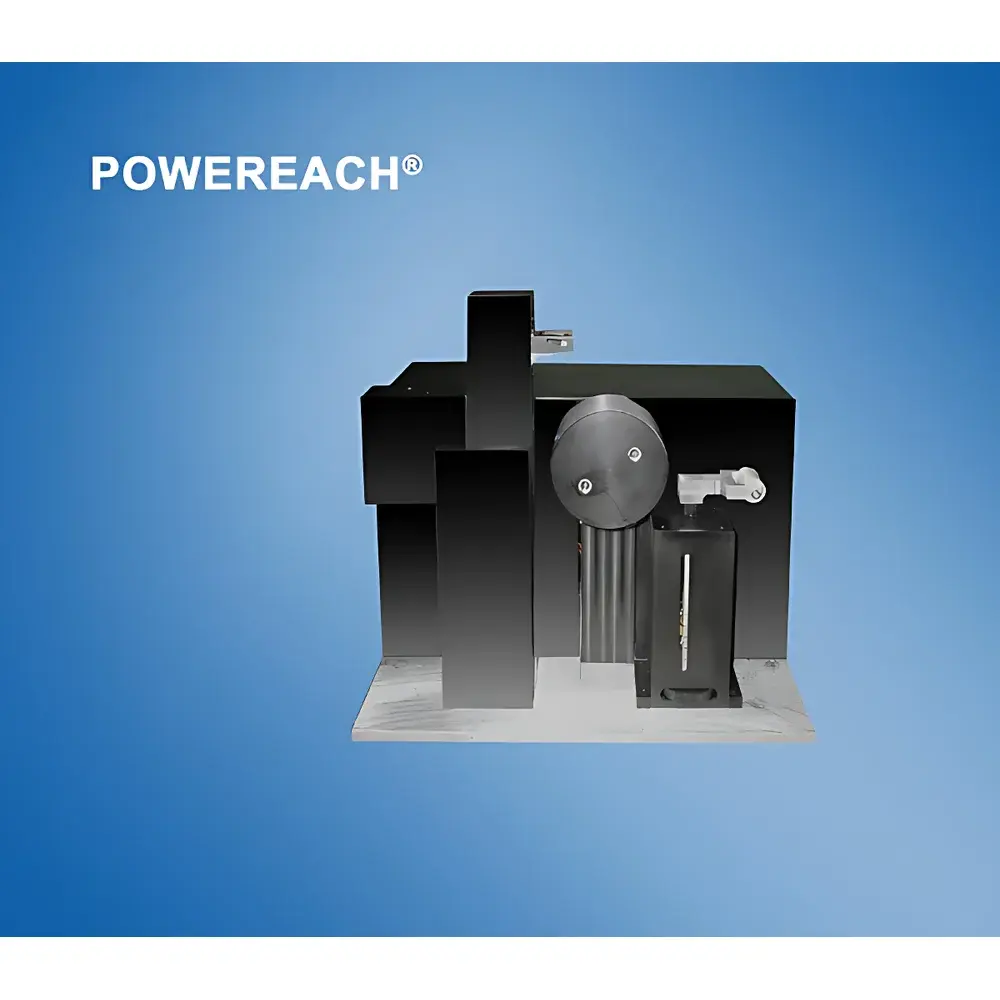
POWEREACH JDF05 Tribological Tester for Coefficient of Friction Measurement
| Brand | POWEREACH (Shanghai Zhongchen) |
|---|---|
| Origin | Shanghai, China |
| Model | JDF05 |
| Instrument Type | Coefficient of Friction Tester |
| Max. Friction Force | Not Specified |
| Friction Force Resolution | mN |
| Compliance | ASTM D1894, ISO 8295, GB/T 10006 |
| Software Interface | USB + RS232 (COM port required) |
| Data Acquisition | Real-time force-time curve, static/dynamic COF calculation |
Overview
The POWEREACH JDF05 Tribological Tester is a precision-engineered benchtop instrument designed to quantify the coefficient of friction (COF) between planar material surfaces under controlled sliding conditions. It operates on the fundamental principle of horizontal reciprocating or unidirectional sliding contact between a standardized test specimen and a rotating or linearly driven friction wheel—emulating real-world interfacial shear behavior in textiles, polymer films, coated papers, packaging laminates, and technical membranes. Unlike general-purpose tensile testers, the JDF05 isolates and measures only tangential resistance forces during relative motion, eliminating confounding axial load effects. Its mechanical architecture adheres to the core metrological requirements defined in ASTM D1894 (Standard Test Method for Static and Kinetic Coefficients of Friction of Plastic Film and Sheeting) and ISO 8295 (Plastics — Film and Sheet — Determination of the Coefficients of Friction), ensuring traceable, repeatable data suitable for QC release, R&D benchmarking, and regulatory documentation.
Key Features
- Modular friction head assembly with interchangeable drive modes: continuous rotation or programmable oscillatory motion for static (breakaway) and dynamic (sliding) COF evaluation
- Precision-machined stainless-steel friction wheel with embedded mounting interface for standardized counterface materials (e.g., polished steel, rubber, or user-supplied substrates), maintaining surface planarity within ±2 µm after attachment
- High-stability specimen clamping system with adjustable pressure and alignment mechanism to eliminate edge slippage and ensure uniform contact area (standard test area: 25 mm × 25 mm)
- Dual-range force transducer with millinewton (mN) resolution, calibrated per ISO/IEC 17025-accredited procedures; supports both static peak detection and real-time kinetic force logging
- Programmable test duration, dwell time, and sliding velocity (0.1–100 mm/s range, software-defined), enabling compliance with multi-step protocols such as those specified in GB/T 10006 for plastic films
- Integrated safety enclosure with interlocked access door and emergency stop circuitry meeting IEC 61000-6-2 electromagnetic compatibility and EN 61000-6-4 emission standards
Sample Compatibility & Compliance
The JDF05 accommodates flat, flexible specimens up to 3 mm thickness and 100 mm width, including woven/nonwoven textiles, biaxially oriented polypropylene (BOPP) films, metallized PET laminates, medical-grade silicone sheets, and hydrophobic nanocoated glass. Specimen mounting requires no adhesive or surface modification—mechanical clamping preserves native surface chemistry and topography. All hardware and firmware configurations are validated against national and international tribology standards: ASTM D1894 (plastic film), ISO 8295 (film and sheet), GB/T 10006 (Chinese national standard for plastic film friction), and TAPPI T 549 (paper and board). The system supports GLP-compliant operation through audit-trail-enabled software (see Software & Data Management), and its force calibration certificate is issued with NIST-traceable reference standards.
Software & Data Management
The JDF05 operates exclusively via its dedicated Windows-based control and analysis suite, requiring either a supplied OEM desktop PC (Windows 7/10 32-bit, one free USB 2.0 port, one functional RS232 COM port) or user-provided compatible hardware. The software provides real-time visualization of force vs. time curves, automatic identification of static COF (peak force / normal load) and kinetic COF (mean sliding force / normal load), and batch statistical reporting (mean, SD, CV%, min/max) across ≥10 replicates. Raw ASCII data export (.csv) is supported for third-party statistical analysis (e.g., JMP, Minitab). Audit trails record operator ID, timestamp, parameter settings, calibration events, and result modifications—fully compliant with FDA 21 CFR Part 11 requirements when deployed in regulated environments. Firmware updates and calibration file management are performed locally without cloud dependency.
Applications
- Quality assurance of textile finishing treatments (e.g., silicone softeners, fluorocarbon repellents) by quantifying surface energy modulation via COF shifts
- Development of low-friction packaging films for high-speed filling lines, where excessive COF causes jamming or misfeeds
- Evaluation of anti-blocking performance in extruded polyolefin films used in food and pharmaceutical blister packaging
- Characterization of tactile properties in synthetic leather and automotive interior trim materials
- Research into biomimetic surface textures (e.g., shark-skin microstructures) for drag reduction in fluid-conveying membranes
- Validation of cleaning efficacy on touchscreens and optical lenses by measuring post-cleaning COF recovery
FAQ
Does the JDF05 comply with ASTM D1894 and ISO 8295?
Yes—the mechanical configuration, force transduction accuracy, and test protocol logic fully align with both standards. A certified conformance report is included with each unit.
Can the JDF05 measure both static and kinetic coefficients of friction?
Yes—static COF is determined from the initial breakaway force peak; kinetic COF is calculated from the average force during steady-state sliding, both automatically extracted by the software.
Is an external computer mandatory for operation?
Yes—a Windows 32-bit PC with USB and RS232 connectivity is required. Optional OEM-supplied systems include three-year on-site warranty.
What maintenance is required for long-term measurement stability?
Annual recalibration of the force sensor using certified deadweight standards is recommended; friction wheel surfaces should be cleaned with isopropyl alcohol before each test series.
Can custom counterface materials be mounted on the friction wheel?
Yes—the wheel’s modular insert design accepts user-fabricated substrates up to 1.5 mm thickness, provided they are bonded flat and rigidly to maintain consistent contact geometry.



