
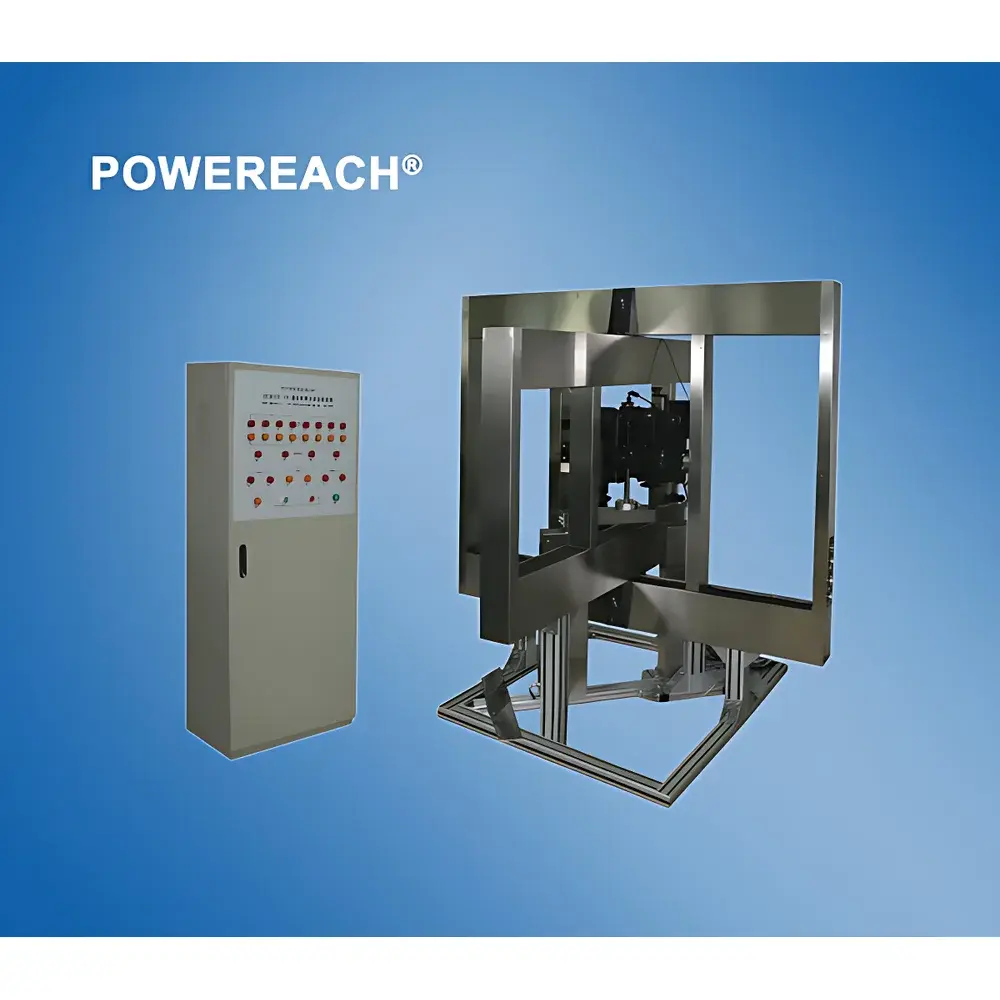
POWEREACH JDS05C Triaxial Mechanical Testing System for Composite Materials
| Brand | POWEREACH |
|---|---|
| Origin | Shanghai, China |
| Model | JDS05C |
| Instrument Type | Electromechanical Triaxial Testing System |
| Max Biaxial Tensile Force | 4.0–5.0 kN (per axis) |
| Max Punching Force (Z-axis) | 2.0 kN |
| Displacement Resolution | 0.02 mm |
| Crosshead Speed Range | 0.8–2.0 mm/s |
| Max Travel per Axis | 300 mm |
| Load Cell Accuracy | ±1 N (with overload protection) |
| High-Speed Imaging | 30–200 fps CCD camera |
| Operating Environment | 8–30 °C, RH < 80% |
| Software Control | Real-time speed, stroke, and data acquisition via proprietary Windows-based interface |
| Compliance | Configurable to ASTM D5034, D5035, D638, ISO 13934-1, ISO 13935-1, GB/T 3923.1, and textile-specific GLP workflows |
Overview
The POWEREACH JDS05C Triaxial Mechanical Testing System is an electromechanical platform engineered for quantitative mechanical characterization of anisotropic soft materials—particularly woven fabrics, nonwovens, polymer membranes, and fiber-reinforced composites—under simultaneous multiaxial loading conditions. Unlike conventional uniaxial tensile testers, the JDS05C implements a true triaxial architecture: two orthogonal in-plane axes (X and Y) apply programmable biaxial tension up to 5.0 kN each, while a vertically actuated indenter (Z-axis) delivers controlled puncture or dome-forming loads up to 2.0 kN. This configuration replicates real-world service stresses encountered in technical textiles, medical implants, packaging films, and flexible electronics substrates. The system operates on a closed-loop servo-controlled motion architecture with high-fidelity load cell feedback (±1 N resolution) and sub-millimeter displacement repeatability. Measurement principles conform to established standards for tensile modulus, breaking force, elongation at break, tear propagation resistance, and energy absorption (i.e., area under the stress–strain curve), enabling traceable, reproducible mechanical profiling across R&D, QC, and regulatory submission contexts.
Key Features
- Triaxial actuation architecture: Independent X/Y biaxial tension + Z-axis puncture/dome testing in a single integrated frame
- High-resolution force measurement: Dual-range load cells calibrated to ±1 N accuracy with automatic overload cutoff
- Precision displacement control: 0.02 mm resolution over 300 mm travel per axis; programmable crosshead speeds from 0.8 to 2.0 mm/s
- Synchronized optical monitoring: Integrated coaxial optical path with adjustable magnification and real-time display of specimen deformation
- High-speed imaging module: 30–200 fps monochrome CCD camera with external trigger synchronization for fracture process capture
- Embedded software suite: Windows-based interface supporting real-time parameter adjustment, multi-channel data logging (force, displacement, time, image timestamp), and export to CSV, Excel, or PDF report templates
- Modular fixture compatibility: Standardized mounting interfaces for pneumatic clamps, gripper jaws, and custom fixtures (e.g., ring-dome, bias-tension, seam strength configurations)
Sample Compatibility & Compliance
The JDS05C accommodates specimens ranging from 50 × 50 mm² fabric swatches to 200 × 200 mm² membrane sheets, with thicknesses from 0.05 mm (electrospun nanofibers) to 5 mm (laminated composites). Its dual-clamp design supports both loose-weave textiles and high-modulus carbon fiber preforms without slippage. The system meets mechanical and data integrity requirements for compliance-driven environments: force calibration traceable to NIST-equivalent national metrology institutes; software audit trails compatible with GLP documentation protocols; configurable user access levels and electronic signature support aligned with FDA 21 CFR Part 11 readiness (when deployed with validated IT infrastructure). Test methods are directly implementable per ASTM D5034 (grab test), ASTM D5035 (strip test), ISO 13934-1 (tensile properties), ISO 13935-1 (tear propagation), and GB/T 3923.1 (Chinese national standard for textile tensile testing).
Software & Data Management
The proprietary POWEREACH TestMaster v3.2 software provides deterministic control of all hardware subsystems—including motor sequencing, load cell sampling (1 kHz internal rate), image acquisition triggers, and environmental metadata tagging. Raw data streams are time-synchronized across force, displacement, and frame number channels. Post-test analysis includes automatic yield point detection, tangent modulus calculation, strain energy density integration, and comparative overlay of up to eight curves. Export formats include ANSI-compliant CSV (with header metadata), Excel-compatible .xlsx, and publication-ready vector graphics (.svg/.emf). All data files carry embedded digital signatures and immutable timestamps. For regulated laboratories, optional validation packages (IQ/OQ/PQ documentation, software version history logs, and change control records) are available upon request.
Applications
- Textile R&D: Quantifying anisotropic strength retention after dyeing, coating, or plasma treatment
- Medical device development: Validating burst pressure and strain distribution in synthetic vascular grafts and wound dressings
- Packaging engineering: Assessing puncture resistance and delamination onset in multilayer food-grade laminates
- Automotive interiors: Measuring seat fabric dimensional stability under combined shear and compression cycles
- Flexible electronics: Characterizing crack initiation thresholds in stretchable conductive elastomers under biaxial strain
- Academic mechanics research: Generating full-field strain maps via DIC (Digital Image Correlation) when paired with third-party stereo camera systems
FAQ
What standards does the JDS05C support out-of-the-box?
ASTM D5034, D5035, D638, ISO 13934-1, ISO 13935-1, and GB/T 3923.1 test routines are preconfigured in the software; custom method templates can be built using the scripting engine.
Is high-speed imaging mandatory for operation?
No—the core mechanical testing functions operate independently of the CCD module; the camera is an optional add-on for dynamic failure analysis.
Can the system perform cyclic fatigue testing?
Yes—software-defined waveforms (sine, triangle, trapezoidal) enable programmable load/displacement cycling up to 10⁶ cycles with dwell control and amplitude modulation.
What computer specifications are required?
A Windows PC (32-bit or 64-bit) with one USB 2.0 port, one RS-232 serial port, 4 GB RAM, and 500 MB free disk space; no GPU acceleration is required.
Does POWEREACH provide installation and training outside mainland China?
Yes—on-site commissioning, operator certification, and method transfer support are available globally through authorized service partners; lead times vary by region.
Related Products



