
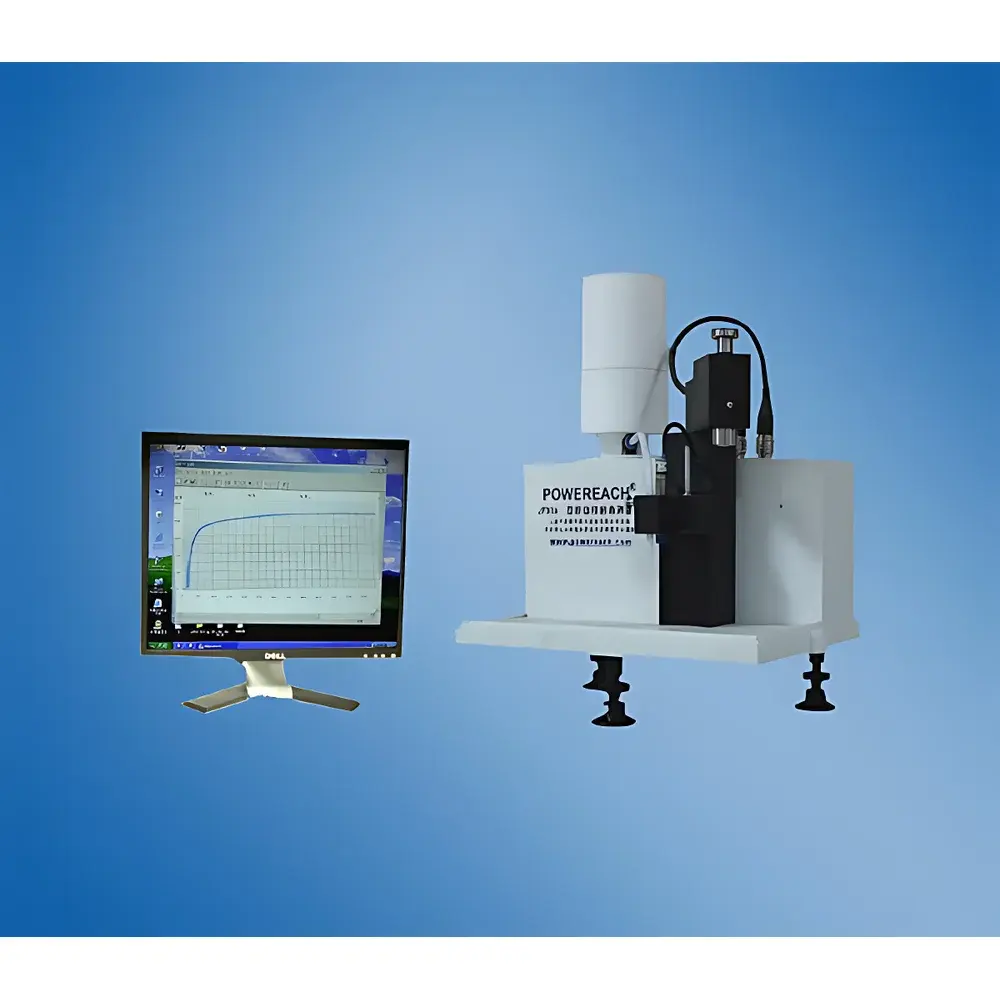
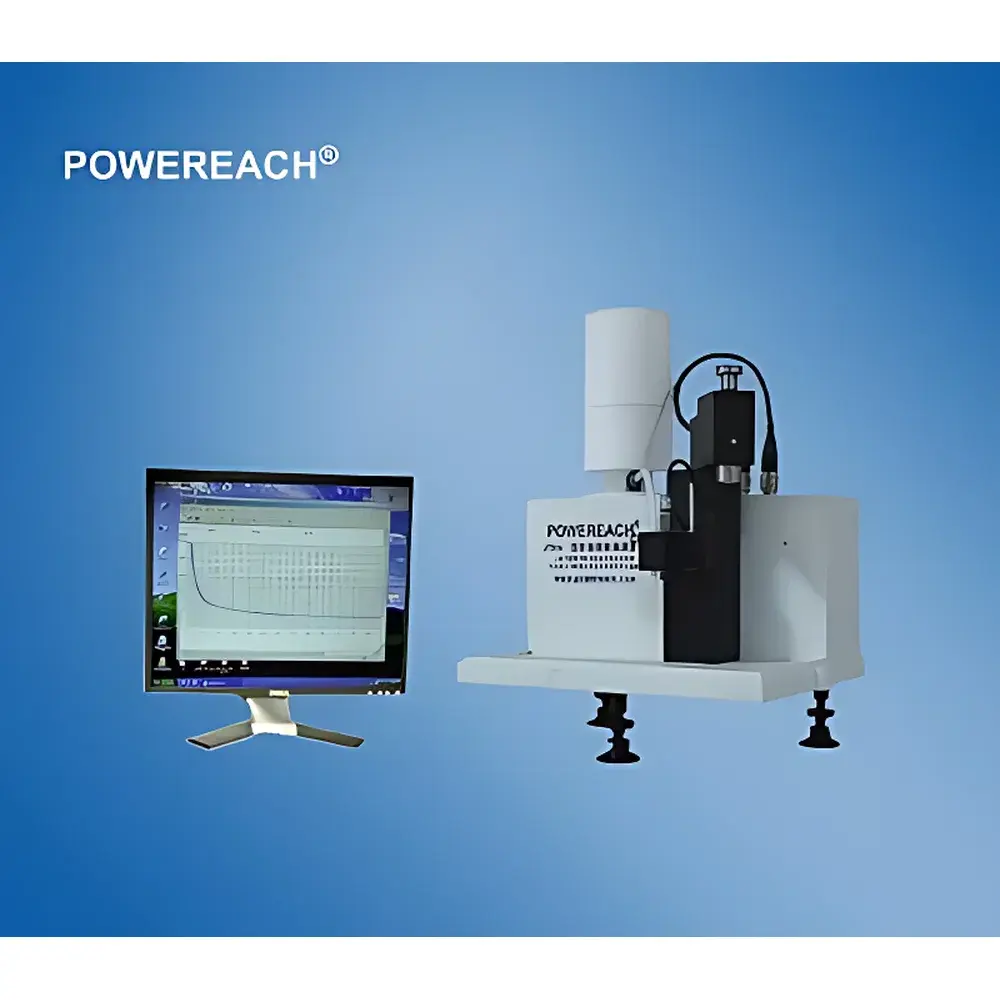
POWEREACH JF99A Powder Contact Angle Analyzer
| [Brand | POWEREACH |
|---|---|
| Origin | Shanghai, China |
| Model | JF99A |
| Instrument Type | Benchtop Laboratory Analyzer |
| Measurement Principle | Washburn Capillary Penetration Method |
| Contact Angle Range | 0–90° (calculated, relative) |
| Contact Angle Resolution | ±0.3° |
| Pressure Measurement Range | 0–330 mbar |
| Pressure Accuracy | ±0.16 mbar |
| Quartz Tube Dimensions | OD 10 mm / ID 8 mm or ID 6 mm |
| Sample Particle Size Requirement | ≤200 mesh (74 µm) |
| Surface Tension Range | 0.01–2000 mN/m |
| Image Magnification | 0.7×–5× (50–318 pixel/mm) |
| Stage Size | 120 × 120 mm |
| Power Consumption | <20 W |
| Dimensions (W×D×H) | 295 × 240 × 260 mm] |
Overview
The POWEREACH JF99A Powder Contact Angle Analyzer is a dedicated benchtop instrument engineered for the quantitative assessment of liquid–powder wettability via the Washburn capillary penetration method. Unlike conventional sessile-drop contact angle systems designed for flat solid surfaces, the JF99A addresses the intrinsic heterogeneity and porosity of powdered materials by measuring dynamic capillary rise kinetics under controlled pressure conditions. The instrument operates on the fundamental principle that the rate of liquid infiltration into a packed powder column follows the Washburn equation: h² = (γ·cosθ·r·t)/(2η), where h is the penetration height, γ is the liquid surface tension, θ is the contact angle, r is the effective pore radius, t is time, and η is liquid viscosity. By monitoring real-time pressure changes in the sealed headspace above the powder column during spontaneous liquid uptake—enabled by a high-stability piezoresistive pressure sensor—the system derives cosθ through linear regression of h² vs. t. This approach yields a relative, thermodynamically consistent contact angle value optimized for comparative ranking of powder wettability under identical experimental conditions. It is particularly suited for R&D and QC applications in pharmaceutical formulation, catalyst development, battery electrode slurry design, and functional pigment dispersion.
Key Features
- Integrated Washburn measurement architecture with dual quartz tube options (ID 6 mm and 8 mm) to accommodate varying powder densities and permeability requirements
- High-precision pressure transducer (range: 0–330 mbar; accuracy: ±0.16 mbar) enabling sub-second temporal resolution of capillary front advancement
- Automated sample loading station ensuring reproducible powder packing density and eliminating operator-induced variability
- Dedicated hydrophobic filter membrane interface to prevent direct liquid immersion while permitting controlled capillary contact
- Modular quartz tube assembly with PTFE sleeves and cup pads for chemical inertness and thermal stability during repeated use
- Benchtop footprint (295 × 240 × 260 mm) with low power draw (<20 W), compatible with standard laboratory electrical infrastructure
- USB 2.0 or RS-232 serial interface for seamless integration with Windows-based host PCs running proprietary acquisition and analysis software
Sample Compatibility & Compliance
The JF99A requires powdered samples with particle size ≤200 mesh (≤74 µm) to ensure uniform packing and laminar capillary flow. It is validated for use with non-cohesive, free-flowing powders including metal oxides (e.g., TiO₂, SiO₂), pharmaceutical excipients (microcrystalline cellulose, lactose), carbon blacks, lithium cobalt oxide cathode materials, and ceramic precursors. Samples must be dry and free of volatile binders or surfactants that could alter interfacial energetics. While the instrument does not provide absolute contact angle values traceable to NIST standards (due to inherent assumptions in the Washburn model), its output supports ISO 10621:2022 (Powder metallurgy — Determination of wettability of metal powders) and ASTM D7483–22 (Standard Test Method for Measuring Wettability of Powders Using Capillary Rise). Data acquisition complies with GLP-aligned metadata logging, including timestamp, ambient temperature, operator ID, and calibration status—enabling audit-ready documentation for regulated environments.
Software & Data Management
The bundled Windows application provides real-time pressure curve visualization, automatic baseline correction, and least-squares fitting of the Washburn linear region. Raw pressure vs. time data are exported in CSV format for third-party statistical analysis (e.g., JMP, Python pandas). Each measurement session generates an immutable project file (.pca) containing instrument configuration, sample metadata, raw sensor output, fitted parameters (slope, intercept, R²), and calculated cosθ with propagated uncertainty. Software updates are delivered free of charge for the lifetime of the instrument and include enhancements to noise filtering algorithms and compliance reporting templates aligned with FDA 21 CFR Part 11 requirements (electronic signatures, audit trail, user access control).
Applications
- Ranking surfactant efficacy in pigment dispersion formulations for inkjet inks and coatings
- Evaluating binder–powder affinity in dry granulation processes for oral solid dosage forms
- Assessing electrolyte wettability in porous separator layers of Li-ion battery cells
- Optimizing slurry rheology and particle–liquid interaction in ceramic tape casting
- Screening surface modification treatments (e.g., silanization, plasma coating) on nanostructured powders
- Supporting quality control of incoming raw materials in catalyst manufacturing per ISO 18877
FAQ
What is the fundamental limitation of the Washburn method for contact angle determination?
The Washburn method yields a relative, model-dependent contact angle based on assumed cylindrical pore geometry and laminar flow. It cannot resolve advancing/receding angles or account for surface heterogeneity at the single-particle level.
Can the JF99A measure contact angles >90°?
No. The instrument is calibrated and validated only for 0–90°, as capillary rise ceases for hydrophobic systems (θ > 90°), resulting in no measurable pressure change.
Is temperature control available?
The base configuration operates at ambient laboratory temperature (20–25°C). Optional thermostatic chamber integration is available upon request for isothermal studies between 15–40°C.
Does the system require calibration with reference liquids?
Yes. Calibration uses standard liquids of known surface tension (e.g., water, diiodomethane, ethylene glycol) to verify pressure-to-height conversion and validate linearity across the operating range.
How is powder packing density standardized across measurements?
The included automatic sample loader applies a defined compaction force (adjustable up to 5 kN) with integrated load feedback, ensuring batch-to-batch reproducibility within ±2% relative density deviation.



