
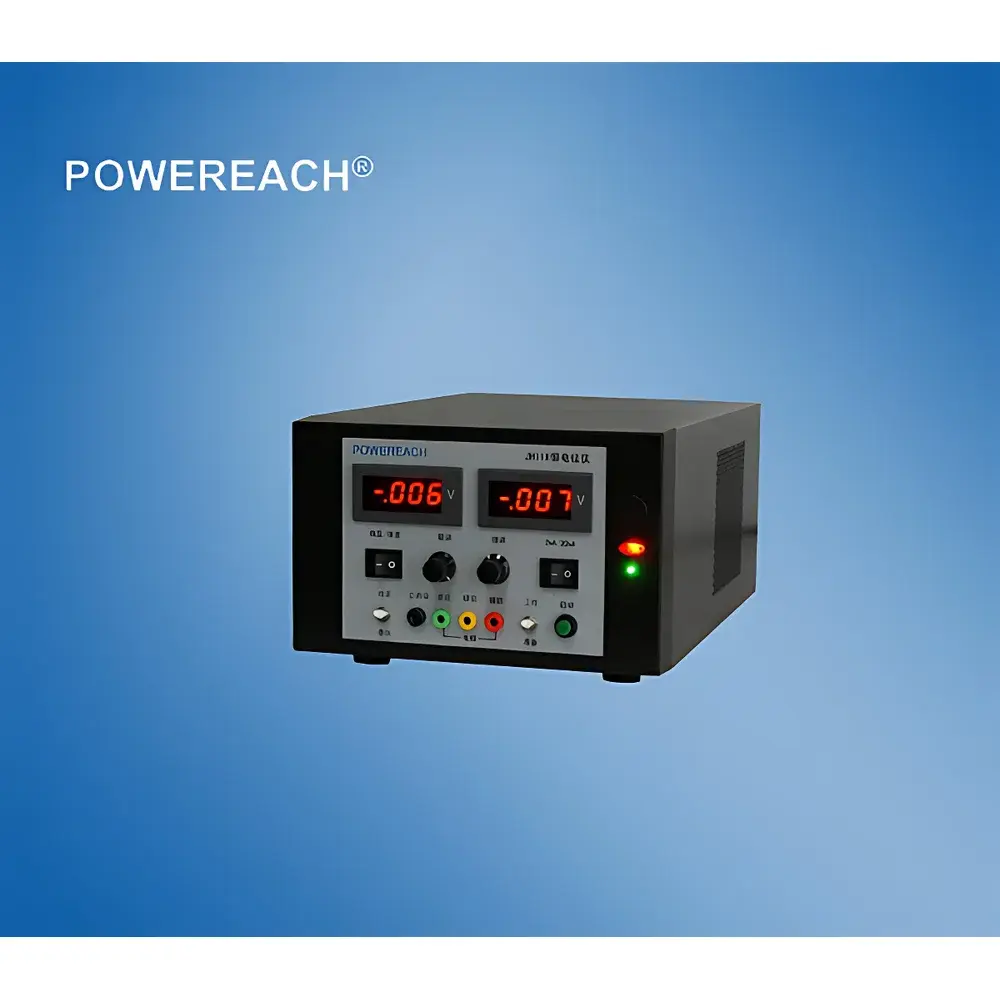
POWEREACH JH11X Dual-Digital Potentiostat
| Brand | POWEREACH |
|---|---|
| Origin | Shanghai, China |
| Model | JH11X |
| Instrument Type | Single-Channel Electrochemical Workstation |
| Potentiostatic Range | ±2 V |
| Current Range | ±2 mA / ±20 mA (dual-range) |
| Potential Resolution | 0.001 V |
| Current Resolution | 0.001 mA |
| Reference Electrode Input Impedance | ≥10¹² Ω |
| Cell Voltage Range | ±13 V |
| Power Supply | AC 220 V, 50 Hz |
| Dimensions | 320 × 215 × 130 mm |
Overview
The POWEREACH JH11X Dual-Digital Potentiostat is a compact, benchtop electrochemical workstation engineered for precision potentiostatic and galvanostatic control in fundamental and applied research. Based on the classical three-electrode configuration (working, reference, and counter electrodes), it implements controlled-potential electrolysis and current monitoring to quantify electron-transfer kinetics, interfacial charge transfer resistance, and faradaic reaction mechanisms. Designed for laboratory environments where reproducibility, stability, and ease of integration are critical, the JH11X supports cyclic voltammetry (CV), linear sweep voltammetry (LSV), chronoamperometry (CA), chronopotentiometry (CP), and basic electrochemical impedance spectroscopy (EIS) — though it does not include a built-in frequency generator for advanced EIS profiling. Its dual digital display simultaneously presents real-time potential and current values, enabling immediate visual verification of experimental conditions without software dependency.
Key Features
- Dual high-resolution digital displays: independent 0.001 V and 0.001 mA readouts for instantaneous monitoring of applied potential and measured current
- Adjustable potentiostatic range of ±2 V with fine analog control, optimized for aqueous and non-aqueous redox systems within common solvent windows
- Two selectable current ranges (±2 mA and ±20 mA) accommodate both microelectrode-scale measurements and bulk electrode kinetics
- Reference electrode input impedance ≥10¹² Ω ensures minimal loading error during high-impedance measurements (e.g., coated electrodes, polymer electrolytes, or low-conductivity media)
- Cell voltage compliance up to ±13 V enables operation with resistive cells or high-overpotential reactions, including certain battery material characterizations
- Robust analog front-end architecture minimizes noise and drift under continuous DC polarization, supporting long-duration corrosion or passivation studies
Sample Compatibility & Compliance
The JH11X is compatible with standard electrochemical cells (e.g., conventional three-neck glass cells, rotating disk electrodes, and screen-printed electrode cartridges) using conventional aqueous buffers (e.g., PBS, KCl), organic electrolytes (e.g., LiPF₆ in EC/DMC), and ionic liquids. It complies with general laboratory safety standards for Class I electrical equipment (IEC 61010-1). While the instrument itself does not carry CE or UL certification, its design adheres to electromagnetic compatibility (EMC) principles suitable for shared lab environments. Data generated may be documented in accordance with GLP practices; however, the unit lacks audit-trail functionality or electronic signature support required for FDA 21 CFR Part 11–compliant environments. Users intending regulatory submissions should integrate external validated data acquisition systems.
Software & Data Management
The JH11X operates as a standalone analog potentiostat and does not include embedded firmware or USB/RS-232 connectivity. All parameter setting and output monitoring occur via front-panel controls and dual LCDs. For digital data capture, users must interface the analog current and potential outputs (BNC or screw-terminal) with an external data acquisition system (e.g., National Instruments DAQ, Keysight U2300A, or Arduino-based loggers) and custom or third-party software (e.g., LabVIEW, Python with PySerial, or MATLAB). This architecture preserves signal integrity by avoiding internal digitization artifacts but requires users to implement their own calibration routines, time-stamping, and metadata tagging per experiment. No proprietary drivers or SDKs are provided.
Applications
- Electrode kinetics studies: determination of heterogeneous electron transfer rates using Tafel analysis or scan-rate-dependent CV peak separation
- Corrosion science: potentiodynamic polarization and open-circuit potential (OCP) monitoring of metals and alloys in simulated service environments
- Battery material screening: charge/discharge profiling of cathode/anode candidates under constant-voltage conditions
- Electroanalytical chemistry: amperometric detection of redox-active species (e.g., dopamine, H₂O₂, heavy metal ions) at modified electrodes
- Electrodeposition process optimization: controlled-potential plating of Cu, Ni, or Zn layers with in-situ current integration
- Teaching laboratories: hands-on instruction in electrochemical fundamentals, including Nernst equation validation and diffusion-controlled current modeling
FAQ
Does the JH11X support electrochemical impedance spectroscopy (EIS)?
No — the JH11X lacks an integrated frequency response analyzer (FRA) or sine-wave excitation source. It can only perform DC or step-based techniques. EIS requires external hardware or a more advanced workstation.
Can I connect the JH11X to a computer for automated data logging?
Yes, via its analog output terminals. Users must supply and configure an external DAQ device and software; no native PC interface or driver is included.
What is the maximum recommended solution conductivity for stable operation?
For optimal performance and minimal iR drop error, conductivities between 0.01 and 1 S/m (e.g., 0.1 M KCl or 0.1 M H₂SO₄) are advised. Very low-conductivity media (<10⁻³ S/m) may require Luggin capillary placement or positive feedback iR compensation — which the JH11X does not provide.
Is the instrument suitable for battery cycling tests?
It supports constant-potential (galvanostatic) modes useful for single-step charge/discharge, but lacks multi-step sequencing, coulombic efficiency calculation, or voltage cutoff logic — features found in dedicated battery cyclers.
Are calibration certificates or traceable standards available?
POWEREACH does not supply factory calibration certificates with the JH11X. Users are responsible for periodic verification using certified reference resistors, voltage sources, and electrochemical test cells (e.g., Randles circuit simulators).
Related Products




