
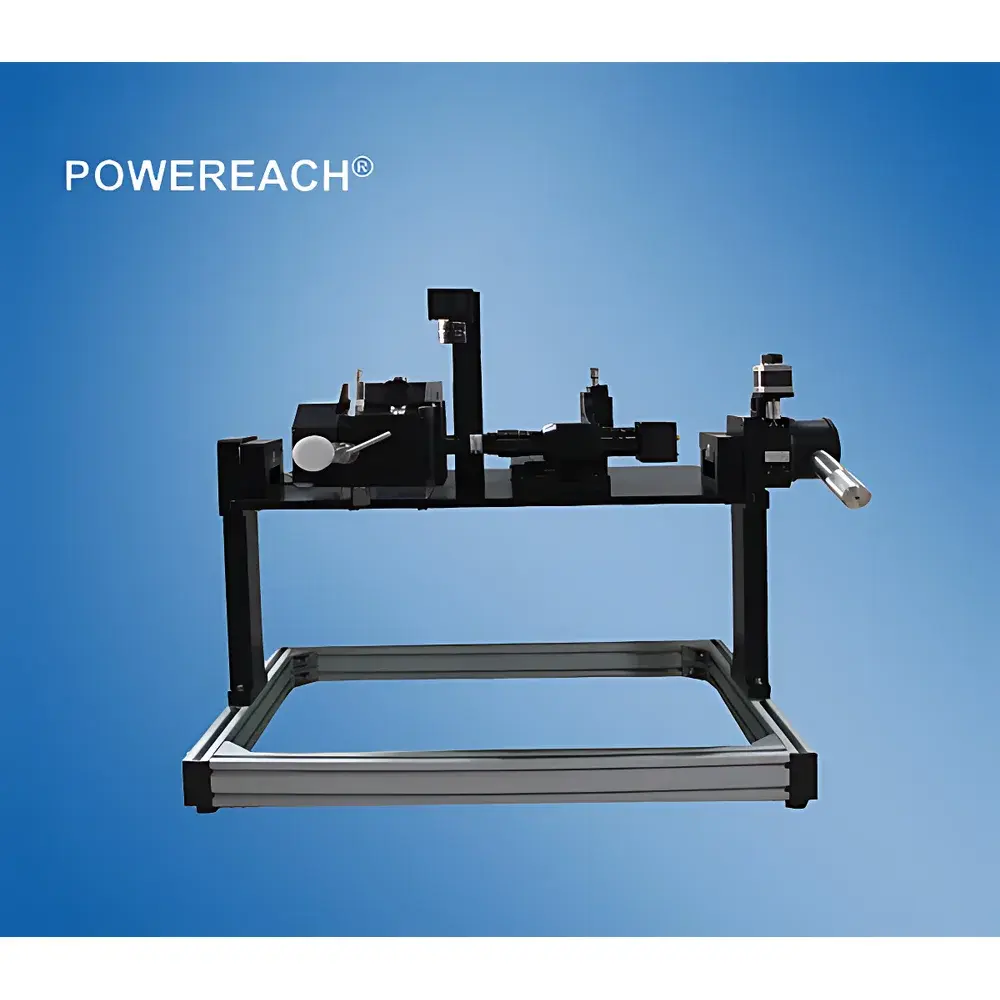
POWEREACH JJ2000H High-Temperature Rotating Drop Interfacial Tensiometer
| Brand | POWEREACH (Shanghai Zhongchen Digital Technology Equipment Co., Ltd.) |
|---|---|
| Origin | Shanghai, China |
| Model | JJ2000H |
| Measurement Range | 100 to 10⁻⁶ mN/m |
| Resolution | 0.001 mN/m |
| Accuracy | ±0.01 mN/m |
| Temperature Control Range | Ambient to 150 °C |
| Max Operating Pressure | 0.7 MPa |
| Motor Speed Range | 1,000–14,000 rpm |
| Speed Control Precision | ±5 rpm |
| Heating Method | Electric, Pt100 Sensor |
| Imaging | 752×480 CCD, 60 fps, LED-illuminated |
| Sample Tube ID | φ2 mm and φ4 mm quartz |
| Interface | RS232 or USB 2.0 |
Overview
The POWEREACH JJ2000H High-Temperature Rotating Drop Interfacial Tensiometer is an engineered solution for ultra-low interfacial tension (IFT) measurement under elevated temperature and pressure conditions. Based on the rotating drop principle—a well-established hydrodynamic method rooted in Laplace’s equation and centrifugal force equilibrium—the instrument determines interfacial tension by analyzing the geometry of a dispersed droplet rotating coaxially within a denser continuous phase inside a sealed, thermostatted quartz capillary. At high rotational speeds, the droplet elongates into a near-cylindrical shape; its aspect ratio (length/diameter) is inversely proportional to the square root of interfacial tension. This physical model enables reliable quantification across an exceptionally wide dynamic range—from 100 mN/m down to 10⁻⁶ mN/m—making the JJ2000H particularly suited for applications demanding sub-micronewton sensitivity, such as enhanced oil recovery (EOR) formulation screening, microemulsion phase behavior analysis, and thermally activated surfactant systems.
Key Features
- High-pressure, high-temperature chamber rated to 0.7 MPa and 150 °C, constructed with corrosion-resistant stainless steel housing and precision-machined internal components to ensure dimensional stability and thermal uniformity.
- Modular quartz capillary system with quick-release spring-pin mounting mechanism—enabling rapid, non-destructive insertion and ejection of sample tubes while maintaining axial alignment and minimizing mechanical stress.
- PID-controlled electric heating system using Pt100 platinum resistance sensors and Omron temperature controllers, delivering ±0.01 °C thermal stability and uniform axial heat distribution without external chillers or baths.
- High-speed servo motor drive (up to 14,000 rpm) with imported German motor and U.S.-sourced optical encoder feedback, offering ±5 rpm speed regulation accuracy across 500 programmable setpoints.
- LED-optimized imaging subsystem comprising a 0.7–4.5× zoom microscope lens, 752×480 pixel CCD camera operating at 60 frames per second, and synchronized trigger-based acquisition—ensuring stable, non-flickering image capture across all rotational regimes, including low-speed (<500 rpm) and turbulent high-speed conditions.
- Three-axis manual micrometer stage (X/Y/Z, 0.01 mm resolution) for precise droplet centering and focal adjustment, supporting reproducible positioning within the optical field of view.
Sample Compatibility & Compliance
The JJ2000H accommodates both φ2 mm and φ4 mm inner-diameter quartz capillaries, enabling flexible selection based on sample viscosity, density contrast, and required IFT detection limit. Its sealed, pressurized architecture supports volatile, thermally labile, or air-sensitive systems—including crude oil/brine/surfactant mixtures, polymer-surfactant hybrids, and pharmaceutical nanoemulsions. The instrument complies with core metrological practices outlined in ASTM D971 (Standard Test Method for Interfacial Tension of Oil Against Water by the Ring Method—adapted for rotating drop validation), ISO 6295 (Petroleum products—Determination of interfacial tension—Rotating drop method), and relevant sections of USP (Analytical Instrument Qualification). All temperature, speed, and image metadata are time-stamped and stored with audit-trail capability, supporting GLP-compliant workflows and 21 CFR Part 11–aligned data integrity requirements when operated with validated software configurations.
Software & Data Management
The Windows-native acquisition and analysis software provides fully automated IFT calculation via boundary-detection algorithms applied to calibrated BMP images. It implements dual-mode operation: fully autonomous mode (initiated by single “Run” command) performs real-time image capture, edge detection, geometric measurement, and IFT computation using the Vonnegut–Neumann equation; semi-manual mode permits post-acquisition refinement of upper/lower interface coordinates with full traceability of operator adjustments. Calibration includes independent horizontal and vertical magnification correction using certified stage micrometers. All datasets—including raw images, processed parameters, temperature/time/speed logs—are stored in a relational SQLite database with export functionality to Excel (.xlsx) and standard bitmap formats. Long-term kinetic studies are supported via programmable timed acquisition (e.g., one frame every 30 seconds over 72 hours), with live plotting of IFT vs. time, temperature, or rotation rate.
Applications
- Enhanced oil recovery (EOR) research: Screening of alkali-surfactant-polymer (ASP) and low-salinity flooding formulations under reservoir-relevant T/P conditions.
- Colloid and interface science: Characterization of microemulsion phase inversion temperature (PIT), Winsor type transitions, and spontaneous emulsification behavior.
- Coatings and inks: Evaluation of surfactant efficiency in pigment dispersion stabilization and substrate wetting dynamics at elevated processing temperatures.
- Pharmaceutical development: Quantification of interfacial activity in lipid-based drug delivery systems (e.g., SMEDDS, SNEDDS) and protein-surfactant interactions at physiological and accelerated storage temperatures.
- Fuel and lubricant additives: Assessment of deposit control agents, demulsifiers, and corrosion inhibitors at operational thermal boundaries.
FAQ
What is the minimum measurable interfacial tension, and under what conditions is it achievable?
The specified lower limit of 10⁻⁶ mN/m assumes optimal density matching between phases, use of φ2 mm quartz tubing, rotational speeds ≥10,000 rpm, and high-contrast imaging conditions. Actual performance depends on droplet stability, optical clarity, and signal-to-noise ratio during edge detection.
Can the instrument operate without external cooling or chiller units?
Yes—the integrated stainless steel heating block and PID controller are self-contained; no auxiliary cooling is required for operation up to 150 °C. For extended high-temperature runs (>120 °C), ambient lab ventilation is recommended to prevent localized heat accumulation.
Is the software compatible with modern Windows OS versions (e.g., Windows 10/11) and 64-bit architectures?
The current release supports Windows 10 and 11 (64-bit), with backward compatibility to Windows 7. Driver packages for USB 2.0 and RS232 interfaces are digitally signed and WHQL-certified.
How is calibration verified and maintained over time?
Calibration relies on physical stage micrometers for optical scaling and certified reference oils (e.g., n-decane/water at 25 °C, γ = 44.9 mN/m) for IFT verification. The software logs all calibration events, including date, operator ID, and deviation metrics, supporting scheduled recalibration per internal SOPs or ISO/IEC 17025 requirements.
What maintenance protocols are recommended to ensure long-term measurement reproducibility?
Daily: Wipe optical surfaces with lint-free wipes and spectroscopic-grade ethanol; purge residual samples from capillaries before depressurization. Weekly: Inspect motor coupling alignment and verify thermal sensor response time. Annually: Full system qualification including speed/torque linearity, temperature uniformity mapping, and image sharpness assessment using USAF 1951 target.



