
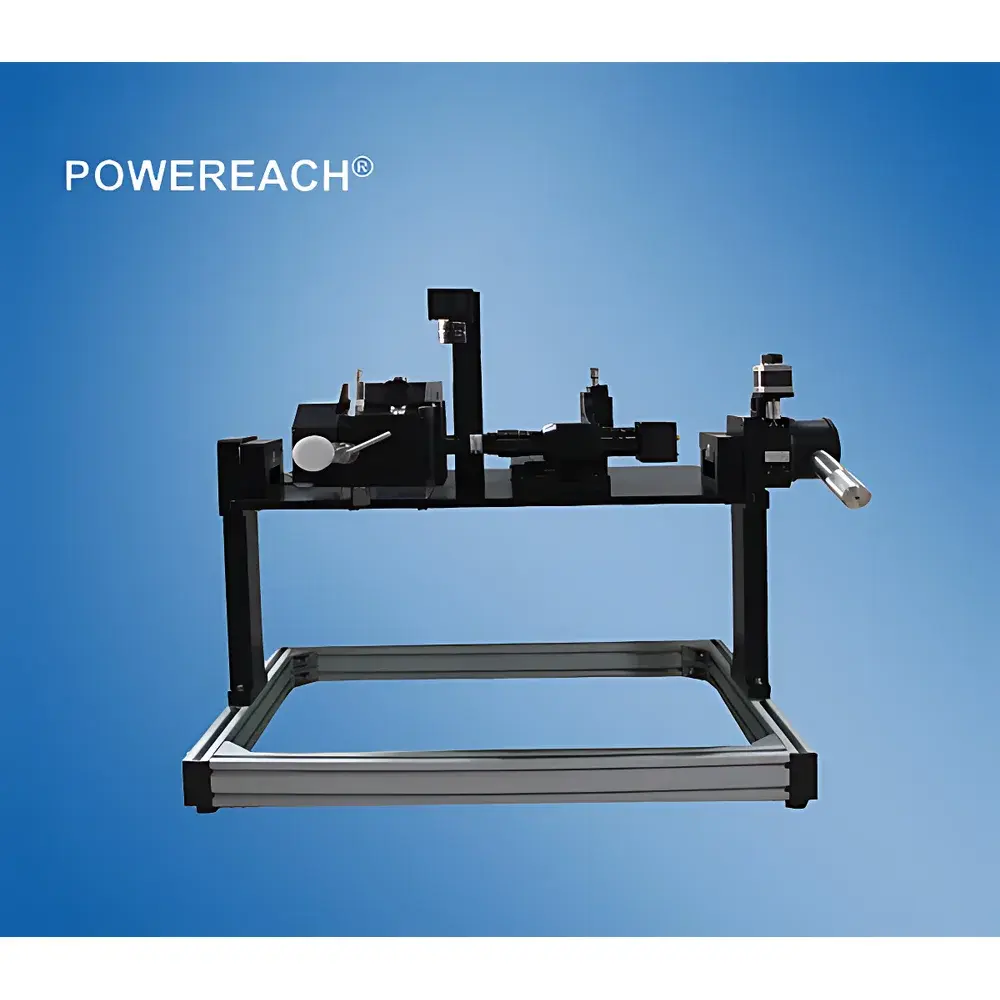
POWEREACH JJ2000H2 High-Temperature Acid-Resistant Spinning Drop Interfacial Tensiometer
| Brand | POWEREACH |
|---|---|
| Origin | Shanghai, China |
| Model | JJ2000H2 |
| Measurement Range | 100 to 1×10⁻⁶ mN/m |
| Resolution | 0.001 mN/m |
| Accuracy | ±0.01 mN/m |
| Measurement Principle | Image-based spinning drop analysis — high-speed CCD captures droplet morphology under controlled centrifugal rotation |
| Temperature Control Range | Ambient to 150 °C |
| Pressure Rating | 0.7 MPa |
| Maximum Rotational Speed | 14,000 rpm |
| Speed Control Precision | ±5 rpm |
| Heating System | PID-controlled stainless-steel jacketed heater with Pt100 sensor |
| Imaging System | 60 fps monochrome CCD (752 × 480 pixels), motorized XYZ-stage with 0.01 mm resolution, 0.7–4.5× zoom lens |
| Sample Tube Options | φ2 mm and φ4 mm quartz capillaries |
| Interface | USB 2.0 or RS232 |
| Compliance | Designed for GLP-compliant lab environments |
Overview
The POWEREACH JJ2000H2 is a high-precision, high-pressure, high-temperature spinning drop interfacial tensiometer engineered for quantitative measurement of ultra-low interfacial tensions (IFT) in chemically aggressive and thermally demanding environments. It operates on the well-established spinning drop principle: a denser droplet of one liquid phase is suspended within a less-dense continuous phase inside a rotating quartz capillary. Under centrifugal force, the droplet elongates; its equilibrium shape is governed by the balance between centrifugal stress and interfacial energy. By capturing high-resolution images of the deformed droplet at precisely controlled rotational speeds and temperatures, the instrument computes interfacial tension values using the Young–Laplace equation—without requiring calibration fluids or empirical corrections. The JJ2000H2 extends this methodology into extreme operational regimes: it accommodates sustained operation up to 150 °C and 0.7 MPa, while maintaining structural integrity in contact with hydrochloric-acid-based “mud acid” formulations commonly used in oilfield stimulation. Its stainless-steel pressure chamber, corrosion-resistant heating assembly, and precision-machined rotor ensure long-term mechanical stability and thermal homogeneity—critical for reproducible measurements in surfactant screening, enhanced oil recovery (EOR) formulation development, and emulsion stability assessment.
Key Features
- Acid-resistant, high-pressure chamber constructed from electropolished 316 stainless steel with integrated sealing and pressure relief mechanisms—validated for repeated exposure to HCl/HF mixtures at elevated temperatures.
- PID-controlled electrothermal system featuring Pt100 platinum resistance thermometers and Omron temperature controllers, delivering ±0.01 °C thermal stability across the full 20–150 °C range without external chillers or baths.
- High-torque servo motor drive (14,000 rpm max) with imported German motor and U.S.-sourced optical encoder, enabling programmable multi-point rotational profiles and ±5 rpm speed repeatability over extended runtime.
- Motorized XYZ positioning stage with 0.01 mm resolution and 360° programmable rotation—enabling automatic droplet tracking, precise focal plane alignment, and consistent image acquisition across variable sample opacities.
- 60 fps monochrome CCD imaging system with LED-illuminated backlit optics and real-time edge-enhanced rendering—optimized for low-contrast, turbid systems such as crude oil–surfactant microemulsions.
- Modular quartz capillary handling system with spring-loaded ejector mechanism—eliminates manual tube insertion/extraction force, reduces breakage risk, and ensures repeatable axial alignment during rotation.
Sample Compatibility & Compliance
The JJ2000H2 supports diverse sample chemistries relevant to petroleum, pharmaceutical, and specialty chemical R&D. Compatible systems include hydrocarbon–aqueous surfactant solutions, polymer-stabilized nanoemulsions, bio-surfactant formulations, and acid-treated reservoir fluid analogs. Quartz capillaries (φ2 mm and φ4 mm internal diameter) provide optical clarity and thermal shock resistance. The instrument’s architecture meets essential design criteria for regulated laboratory use: pressure vessel compliance with ASME BPVC Section VIII Div. 1 guidelines (as applied to Class I laboratory equipment), electrical safety per IEC 61010-1, and electromagnetic compatibility per EN 61326-1. When operated with validated software configurations—including timestamped audit trails, user access controls, and electronic signature support—the system satisfies documentation requirements for GLP and GMP environments per OECD Test Guideline 115 and ASTM D971.
Software & Data Management
The native Windows-based application provides fully automated measurement workflows: users define temperature setpoint, rotational ramp profile, and image capture interval; the software synchronizes motor control, thermal regulation, and high-speed frame acquisition. Boundary detection employs adaptive edge-finding algorithms to identify droplet extremities in real time; interfacial tension is computed using calibrated pixel-to-length conversion factors and validated numerical solvers. All raw images (BMP format), metadata (RPM, °C, MPa, timestamp), and derived IFT values are stored in an embedded SQLite database with relational indexing. Export functions support direct generation of Excel-compatible .csv files, publication-ready plots (time-series, temperature sweeps, concentration gradients), and annotated image sequences. Software features include adjustable magnification calibration (horizontal/vertical independent scaling), manual boundary refinement with versioned revision history, and batch processing of historical datasets. Optional 21 CFR Part 11 compliance packages include role-based authentication, electronic signatures, and immutable audit logs.
Applications
- Enhanced Oil Recovery (EOR): Quantitative evaluation of ultralow IFT (<10⁻³ mN/m) in alkali–surfactant–polymer (ASP) and low-salinity flooding formulations under reservoir-relevant P/T conditions.
- Surfactant & Formulation Science: Structure–property relationship studies for nonionic, anionic, and zwitterionic surfactants; critical micelle concentration (CMC) mapping; microemulsion phase behavior analysis.
- Pharmaceutical Colloids: Stability assessment of lipid nanoparticles, liposomal drug carriers, and self-emulsifying drug delivery systems (SEDDS) across physiological temperature ranges.
- Coatings & Inks: Interfacial rheology of pigment dispersions in organic media; wetting dynamics on functionalized substrates; binder–solvent interaction modeling.
- Environmental & Material Science: Interfacial aging kinetics of biodegradable surfactants in soil leachates; corrosion inhibitor film formation at metal–solution interfaces.
FAQ
What is the minimum measurable interfacial tension value, and under what conditions is it achievable?
The instrument achieves reliable measurements down to 1×10⁻⁶ mN/m when using φ2 mm quartz capillaries, rotational speeds ≥10,000 rpm, and high-contrast imaging conditions (e.g., dyed aqueous phase vs. transparent oil). Achieving sub-10⁻⁵ mN/m requires strict environmental vibration isolation and thermal equilibration times ≥30 minutes.
Can the system operate continuously at 150 °C and 0.7 MPa for extended periods?
Yes—the pressure chamber, sealing gaskets, and motor cooling architecture are rated for continuous duty at these limits. Recommended maximum continuous run time per cycle is 8 hours; longer durations require scheduled thermal cycling and seal inspection per maintenance protocol.
Is the software compatible with modern Windows OS versions (e.g., Windows 11 64-bit)?
The current release (v4.3.2) supports Windows 10 and 11 (64-bit) natively. Legacy RS232 communication is maintained via USB-to-serial adapters certified for Windows Hardware Quality Labs (WHQL) compatibility.
How is measurement traceability ensured for regulatory submissions?
Traceability is established through NIST-traceable calibration of the Pt100 sensor (certified ±0.05 °C), encoder-based RPM verification using optical tachometry, and pixel-scale calibration using NIST SRM 2059 step gauges. Full calibration records are exportable as PDF reports.
Does the system support automated temperature–speed–IFT sweeps?
Yes—users can define multi-segment protocols where temperature ramps, rotational acceleration profiles, and image capture intervals are synchronized. Each segment generates a discrete dataset with unified metadata tagging for cross-parameter correlation analysis.
Related Products



