
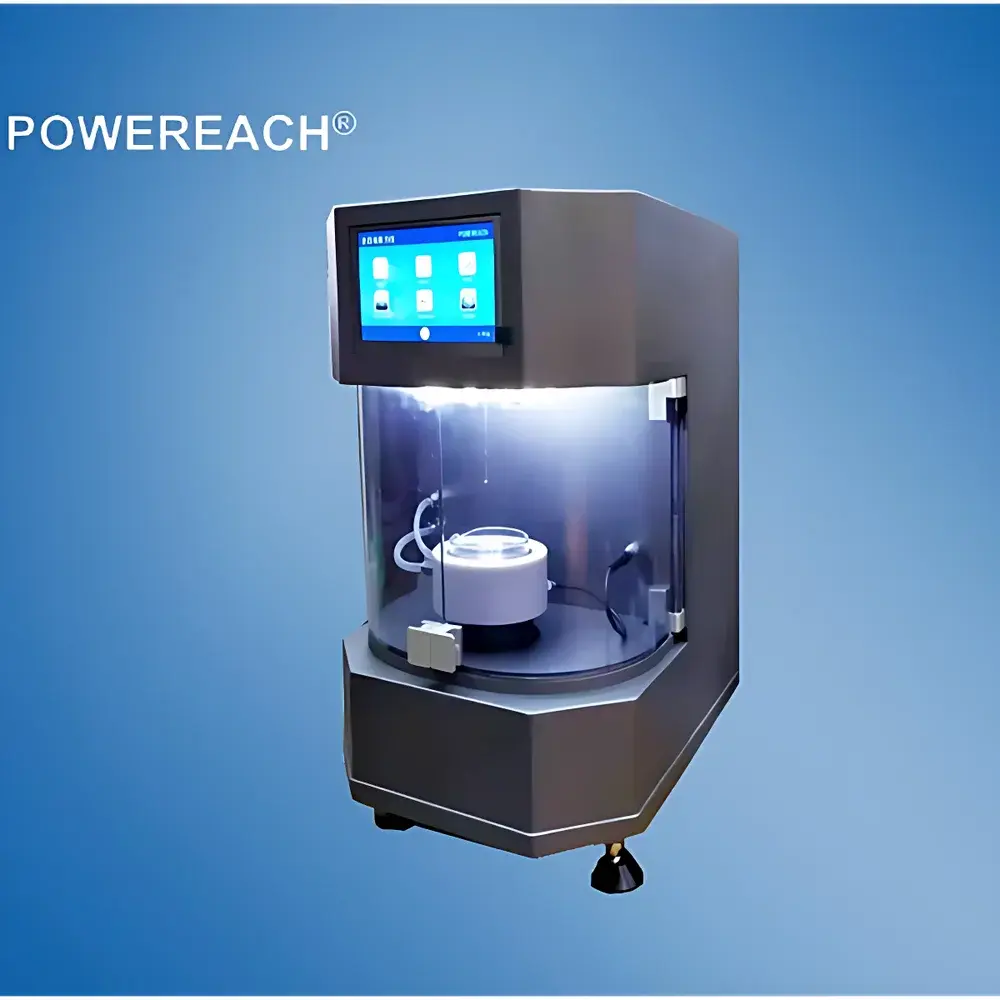
POWEREACH JK99B Automated Surface Tensiometer
| Brand | POWEREACH (Shanghai Zhongchen) |
|---|---|
| Origin | Shanghai, China |
| Model | JK99B |
| Measurement Range | 0–500 mN/m |
| Resolution | 0.01 mN/m |
| Accuracy | ±0.05 mN/m |
| Temperature Display Accuracy | ±0.1 °C |
| Measurement Methods | Du Noüy Ring Method & Wilhelmy Plate Method |
| Power Supply | AC 220 V ±5%, <150 W |
| Interface | RS-232 Serial (requires external PC) |
Overview
The POWEREACH JK99B Automated Surface Tensiometer is a precision instrument engineered for the quantitative determination of surface tension (γLV) and liquid–liquid interfacial tension (γLL) using classical force-balance principles. It operates on two internationally standardized physical methods: the Du Noüy ring method (ASTM D971, ISO 6295, GB/T 5549–2010) and the Wilhelmy plate method (ISO 6295, GB/T 22237–2008, GB/T 6541–1986). Unlike optical or oscillating jet techniques, the JK99B relies on direct mechanical force measurement via a high-stability Japanese-imported load cell sensor, delivering traceable, reproducible results under ambient or controlled thermal conditions. Designed for integration into quality control laboratories, R&D facilities, and academic teaching environments, the system requires connection to a Windows-based host PC for real-time data acquisition, curve visualization, and automated calculation—eliminating manual interpolation and operator-dependent error.
Key Features
- High-resolution force detection with 0.01 mN/m resolution and ±0.05 mN/m absolute accuracy across the full 0–500 mN/m range
- Dual-method compatibility: automatic switching between platinum ring (sample volume: 40–50 mL) and platinum plate (sample volume: 20–30 mL) configurations
- Integrated temperature-sensing platform with ±0.1 °C readout accuracy and provision for external circulation thermostats (e.g., Julabo, Huber, or Lauda units)
- Hardware- and software-initiated zeroing functions for rapid baseline stabilization before each measurement cycle
- Factory-calibrated with certified stainless-steel calibration weights; includes traceable ring-code verification set for in-lab validation
- Low-noise mechanical stage with smooth vertical translation and programmable lift/drop control for stepwise kinetic measurements
- Robust architecture optimized for long-term stability in industrial QC labs and university teaching labs—no consumables beyond standard platinum accessories
Sample Compatibility & Compliance
The JK99B supports a broad spectrum of liquids, including low-viscosity aqueous solutions, organic solvents, surfactant formulations, polymer melts, crude oils, lubricants, coatings, inks, and emulsions. Its mechanical design accommodates samples up to medium viscosity (≤1000 mPa·s) without modification. All measurements comply with major national and international standards: GB/T 22237–2008 (equivalent to ISO 6295), GB/T 5549–2010 (equivalent to ASTM D971), and GB/T 6541–1986 (interfacial tension of oil–water systems). The instrument’s firmware and software enforce standardized calculation algorithms—including Harkins–Jordan correction for ring method and wetting perimeter compensation for plate method—ensuring data interoperability with regulatory submissions, third-party testing reports, and cross-laboratory benchmarking.
Software & Data Management
The included Windows-native application provides full GLP-compliant data handling: timestamped measurement logs, auto-saved tension vs. time curves, export to CSV/Excel, and printable PDF reports with embedded metadata (operator ID, sample ID, method, temperature, calibration status). Audit trail functionality records all parameter changes, zeroing events, and calibration actions. The software supports FDA 21 CFR Part 11–compatible user authentication when deployed on domain-joined systems. Raw force data and processed tension values are stored in structured binary archives, enabling retrospective reprocessing with updated correction models. No cloud dependency or subscription licensing—software updates are provided free of charge for the lifetime of the instrument.
Applications
- Surfactant efficacy screening in detergent, personal care, and pharmaceutical formulation development
- Crude oil–brine interfacial tension analysis for enhanced oil recovery (EOR) studies
- Quality assurance of coating formulations (paints, varnishes, inkjet inks) during batch release
- Stability assessment of emulsions and microemulsions in food, agrochemical, and cosmetic products
- Surface energy evaluation of functionalized polymers and nanocomposites
- Teaching laboratory experiments in physical chemistry, colloid science, and materials engineering curricula
FAQ
Does the JK99B operate independently, or does it require a connected PC?
The JK99B is a PC-dependent instrument. It communicates exclusively via RS-232 serial interface and requires a Windows host (7/10/11) with an available COM port. No standalone display or onboard processing is provided.
What temperature control options are supported?
The built-in platform features a PT100 sensor and dual-port fluid channels compatible with standard external recirculating chillers or heating baths. POWEREACH does not supply the thermostat unit, but offers integration support and mounting adapters upon request.
Is calibration traceable to national metrology institutes?
While the JK99B itself is not NIST-traceable out-of-box, its calibration protocol follows ISO/IEC 17025–aligned procedures. Users may perform in-house verification using certified reference standards (e.g., pure water at 20 °C: γ = 72.75 mN/m; 2-propanol at 20 °C: γ = 23.0 mN/m), and the included ring-code set enables documented repeatability checks per internal QA requirements.
Can the instrument measure dynamic surface tension?
Yes—both ring and plate methods support time-resolved acquisition. The Wilhelmy plate enables rapid kinetic profiling (1–5 s per point), while the ring method captures slower equilibration processes (150–200 s per measurement), suitable for studying adsorption kinetics of slow-diffusing surfactants.
What maintenance is required for long-term reliability?
Routine cleaning of platinum accessories with ethanol and flame-annealing (using supplied alcohol lamp) is recommended between samples. The load cell requires no periodic recalibration under normal use; annual verification using the included calibration weights satisfies most ISO 9001 and GLP audit requirements.



