
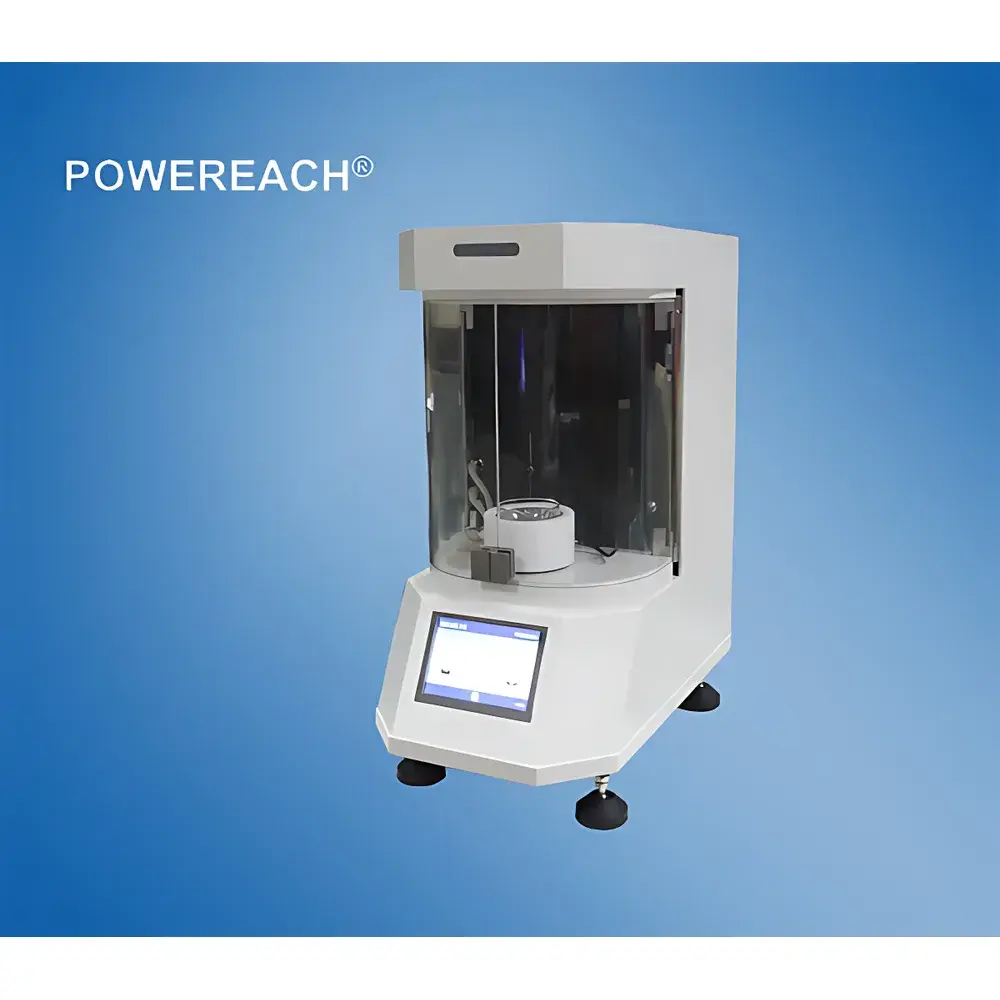
POWEREACH JK99C Fully Automated Surface & Interfacial Tensiometer
| Brand | POWEREACH (Shanghai Zhongchen) |
|---|---|
| Origin | Shanghai, China |
| Model | JK99C |
| Measurement Range | 0–500 mN/m |
| Resolution | 0.01 mN/m |
| Accuracy | ±0.05 mN/m |
| Methods | Platinum Ring Method (Du Noüy) & Platinum Plate Method (Wilhelmy Plate) |
| Temperature Sensing Precision | ±0.1 °C |
| Power Supply | AC 220 V ±5%, <150 W |
| Compliance | GB/T 22237–2008, GB/T 5549–2010, GB/T 6541–1986 |
Overview
The POWEREACH JK99C Fully Automated Surface & Interfacial Tensiometer is an engineered solution for precise, repeatable quantification of surface tension (γLV) and liquid–liquid interfacial tension (γLL) using two internationally standardized physical measurement principles: the Du Noüy ring method and the Wilhelmy plate method. Based on force-balance gravimetric detection, the instrument measures the detachment or immersion force exerted on a calibrated platinum probe at the air–liquid or liquid–liquid interface. Its high-stability servo-controlled vertical translation stage—driven by precision lead screw and stepper motor—ensures sub-micron positioning repeatability and minimal mechanical drift. The integrated Japanese-origin load cell delivers long-term signal stability and low thermal hysteresis, enabling reliable operation across extended test sequences under ambient laboratory conditions (30–85% RH, 15–35 °C). Designed for both routine QC and research-grade characterization, the JK99C operates as a standalone unit with embedded touchscreen interface and thermal roll printer—or connects via RS-232 to Windows-based PCs for real-time curve acquisition, time-series analysis, and audit-compliant data archiving.
Key Features
- Fully automated, one-touch operation with hardware and software-initiated zero calibration—eliminating manual tare steps and operator-induced variability.
- Dual-method compatibility: Platinum ring (sample volume: 40–50 mL; measurement cycle: 150–200 s) and platinum plate (sample volume: 20–30 mL; cycle: 1–5 s), supporting dynamic surface tension profiling and equilibrium interfacial tension determination.
- High-resolution force detection: 0.01 mN/m resolution with ±0.05 mN/m accuracy across the full 0–500 mN/m range—validated per ISO 1409 and ASTM D971 protocols.
- Integrated temperature-sensing platform (±0.1 °C precision) with external circulation port for connection to user-supplied thermostatic baths—enabling controlled-temperature interfacial studies per ISO 6889 and ASTM D1331.
- Modular mechanical design featuring low-noise linear motion, anti-vibration base, and built-in leveling system—optimized for benchtop stability in shared lab environments.
- Factory-calibrated with certified stainless-steel ring weights; rapid verification and traceable recalibration supported via on-board calibration utility and documented uncertainty budgets.
Sample Compatibility & Compliance
The JK99C accommodates a broad spectrum of Newtonian and weakly non-Newtonian liquids—including aqueous surfactant solutions, organic solvents, crude oils, polymer melts, coatings, inks, pharmaceutical emulsions, and biological fluids—without requiring viscosity compensation. Its dual-probe architecture ensures compatibility with low-surface-tension systems (e.g., fluorinated solvents) and high-tension molten salts alike. Regulatory alignment includes compliance with Chinese national standards GB/T 22237–2008 (surfactant surface tension), GB/T 5549–2010 (interfacial tension of petroleum products), and GB/T 6541–1986 (crude oil/water interfacial tension). While not pre-certified to FDA 21 CFR Part 11, the PC software supports ALCOA+ data integrity principles—including electronic signatures, audit trails, and immutable raw data export (.csv, .txt)—facilitating GLP/GMP-aligned validation in regulated QC labs.
Software & Data Management
The included Windows-compatible application provides real-time plotting of force vs. time, automatic peak detection, and built-in correction algorithms (Harkins–Jordan for ring method; wetted perimeter compensation for plate method). All raw sensor data—including timestamped force values, temperature readings, and motor position logs—are stored in open-format files for third-party statistical analysis. The software enables multi-curve overlay, batch processing of replicate measurements, and customizable report generation with embedded metadata (operator ID, sample ID, environmental conditions). For laboratories subject to regulatory audits, optional configuration supports 21 CFR Part 11-compliant user access control, electronic signature workflows, and encrypted database logging—deployable without additional hardware.
Applications
- Surfactant formulation development and critical micelle concentration (CMC) determination in agrochemical, detergent, and personal care R&D.
- Crude oil–water interfacial tension screening for enhanced oil recovery (EOR) surfactant selection and reservoir simulation input.
- Quality control of coating formulations—evaluating leveling behavior, substrate wettability, and additive dispersion stability.
- Pharmaceutical emulsion and liposome characterization—monitoring interfacial film formation kinetics and excipient efficacy.
- Academic research in colloid and interface science—including Langmuir monolayer studies when coupled with a Langmuir–Blodgett trough.
- Environmental testing of dispersant efficiency in marine oil spill remediation protocols.
FAQ
What standards does the JK99C comply with?
It conforms to GB/T 22237–2008, GB/T 5549–2010, and GB/T 6541–1986. Its measurement methodology aligns with ISO 1409 (plastic films), ISO 6889 (interfacial tension), and ASTM D971/D1331.
Can the JK99C measure interfacial tension between two immiscible liquids?
Yes—using either the platinum ring or platinum plate method, provided the lower-phase density exceeds that of the upper phase and interfacial stability permits stable probe immersion.
Is temperature control built-in?
The instrument includes an integrated temperature sensor and a circulation port for external thermostatic bath coupling. A dedicated chiller or water bath must be supplied separately.
Does the system support Good Manufacturing Practice (GMP) documentation requirements?
Raw data export, time-stamped measurement logs, and configurable electronic signatures enable alignment with GMP Annex 11 and ALCOA+ data integrity frameworks.
What maintenance is required for the platinum probes?
Probes must be cleaned after each use with appropriate solvents (e.g., ethanol, acetone), flame-annealed before reuse, and inspected for deformation or contamination—per ISO 1409 Section 6.2 guidelines.



