
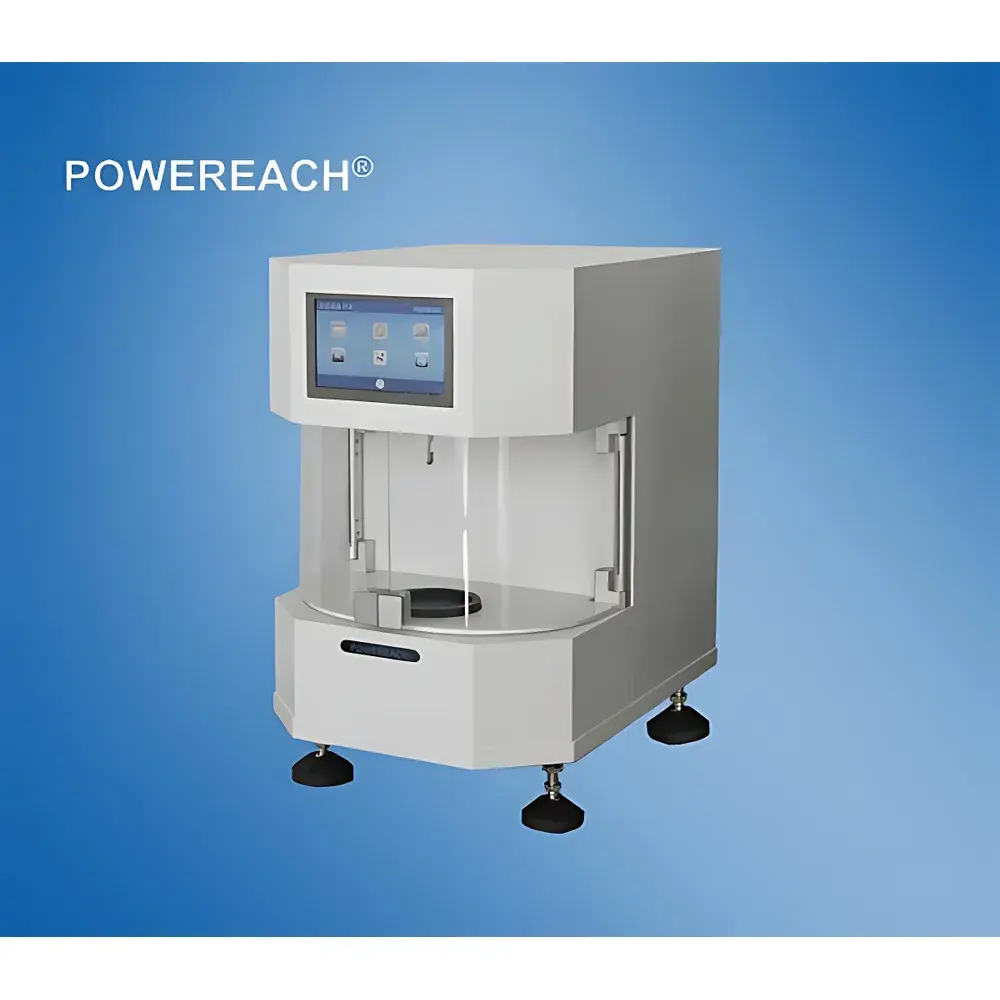
POWEREACH JK99F Fully Automated Surface and Interfacial Tensiometer
| Brand | POWEREACH (Shanghai Zhongchen) |
|---|---|
| Origin | Shanghai, China |
| Model | JK99F |
| Measurement Range | 0–999.99 mN/m |
| Resolution | 0.01 mN/m |
| Accuracy | ±0.01 mN/m |
| Methods | Du Noüy Ring Method (40–50 mL sample volume) & Wilhelmy Plate Method (20–30 mL sample volume) |
| Sampling Cycle | 1–5 s (plate), 50–200 s (ring) |
| Z-axis Travel | 0–30 mm |
| Z-axis Precision | 1 µm |
| Power Supply | AC 220 ±5 V, <150 W |
| Operating Humidity | 30–85% RH |
| Compliance | GB/T 22237–2008, GB/T 5549–2010, GB/T 6541–1986, SY/T 5370–1999 |
Overview
The POWEREACH JK99F Fully Automated Surface and Interfacial Tensiometer is an entry-level precision instrument engineered for reliable, operator-independent measurement of surface tension (liquid–air) and interfacial tension (liquid–liquid) using two standardized physical methods: the Wilhelmy plate method and the Du Noüy ring method. Based on classical tensiometric principles—where surface or interfacial forces are quantified via the force exerted on a calibrated platinum probe immersed at the phase boundary—the JK99F delivers high reproducibility in ambient-temperature environments without active temperature control. Its architecture integrates a high-resolution micro-stepping motor-driven vertical stage (1 µm positioning resolution), a low-drift load cell sensor, and real-time force transduction electronics optimized for static and dynamic equilibrium detection. Designed for routine QC labs and academic research settings where traceability and method interoperability are critical, the JK99F supports dual-method validation per ISO 1409:2016 and ASTM D971–18 guidelines, enabling direct comparison of results across laboratories adhering to national or industrial standards.
Key Features
- Fully automated measurement sequence with one-touch operation via integrated 7-inch resistive touchscreen—no external PC required
- Dual-method compatibility: Wilhelmy plate (fast, 1–5 s cycle; ideal for low-to-moderate viscosity fluids) and Du Noüy ring (50–200 s cycle; suitable for higher-viscosity systems and interfacial measurements)
- High-precision Z-axis motion system: 0–30 mm travel range with 1 µm step resolution and mechanical stability verified under continuous 8-hour operation
- Onboard calibration support: includes certified stainless-steel calibration weights and built-in zero-reset function for daily drift compensation
- Real-time data processing: automatic application of Harkins–Jordan correction factors (for ring method) and Zuidema–Waters correction (for plate method); no manual calculation required
- Robust mechanical design: CNC-machined aluminum housing, anti-vibration base, and silent stepper drive ensure minimal environmental interference during sensitive force measurements
- Compliance-ready firmware: timestamped measurement logs with operator ID field, configurable audit trail export (CSV), and adherence to GLP documentation requirements
Sample Compatibility & Compliance
The JK99F accommodates a broad range of liquid-phase systems including aqueous surfactant solutions, hydrocarbon–water interfaces, polymer melts (within viscosity limits), crude oil–brine systems, coating formulations, ink vehicles, and pharmaceutical emulsions. Sample volumes are minimized to 20–30 mL (plate) or 40–50 mL (ring), reducing reagent consumption and waste generation. The instrument conforms to multiple Chinese national standards: GB/T 22237–2008 (general principles for surface tension measurement), GB/T 5549–2010 (Wilhelmy plate method), GB/T 6541–1986 (Du Noüy ring method), and SY/T 5370–1999 (petroleum industry interfacial tension specification). While not certified for FDA 21 CFR Part 11 compliance out-of-the-box, its data export structure (time-stamped CSV with raw force values, corrected tension, method flag, and operator input) supports integration into validated LIMS environments when paired with institutional procedural controls.
Software & Data Management
All measurement logic and correction algorithms reside in embedded firmware—eliminating dependency on third-party software or OS updates. The touchscreen interface displays real-time force curves, automatically identifies peak detachment force (ring) or equilibrium immersion depth (plate), and applies standardized corrections before outputting final tension values in mN/m. Raw sensor output, corrected results, method selection, date/time stamp, and user-defined sample ID are stored locally in non-volatile memory (up to 1,000 records). Data export is performed via USB flash drive in plain-text CSV format compatible with Excel, MATLAB, or statistical analysis platforms. Firmware updates are delivered free of charge throughout product lifetime and installed via USB—ensuring continued alignment with evolving standard revisions and minor algorithm refinements.
Applications
- Enhanced oil recovery (EOR) screening: quantitative evaluation of surfactant efficacy in reducing oil–water interfacial tension below 0.1 mN/m
- Formulation development: optimization of detergent blends, agrochemical adjuvants, and personal care emulsifiers via time-resolved surface tension kinetics
- Coating and ink R&D: correlation of surface tension with substrate wettability, leveling behavior, and defect formation thresholds
- Quality control in petrochemicals: batch verification of fuel additives, lubricant dispersants, and corrosion inhibitors
- Academic research in colloid science: investigation of adsorption dynamics, CMC determination, and mixed surfactant synergism
- Regulatory testing support: generation of compliant datasets for GB, SY/T, and ISO-aligned reports in domestic and ASEAN markets
FAQ
Does the JK99F support temperature-controlled measurements?
No. The JK99F operates exclusively at ambient laboratory temperature (typically 20–25 °C). For temperature-dependent studies, external thermostatic baths or optional accessories from third-party suppliers may be used with manual stage adjustment.
Can the instrument measure interfacial tension between two immiscible liquids?
Yes. Both the Wilhelmy plate and Du Noüy ring methods are validated for liquid–liquid interfacial tension, provided the denser phase forms the lower layer and the probe is positioned at the interface with appropriate density matching.
Is sensor calibration traceable to national standards?
Calibration uses certified mechanical weights traceable to CNAS-accredited metrology institutes. While the load cell itself is not individually certified, the full-system verification procedure satisfies GB/T 27476.5–2014 requirements for laboratory equipment validation.
What maintenance is required for long-term accuracy?
Daily cleaning of platinum probes with ethanol and flame-annealing (using included alcohol lamp), quarterly verification with calibration weights, and annual sensor linearity check using reference liquids (e.g., pure water at 20 °C = 72.75 mN/m) are recommended.
Is remote technical support available?
Yes. POWEREACH provides complimentary remote video-assisted training and troubleshooting during the first year. On-site service is available globally through authorized partners, subject to regional service agreements.
Related Products



